

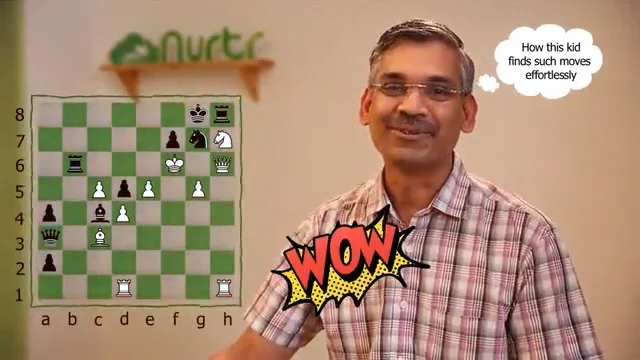
GM RB Ramesh – Nurtr Dream Room – Beginner Level: A Grandmaster’s First Season, Episode by Episode
Most beginner chess videos explain the rules and stop. This one is built the way a coach builds a season for a junior. nurtr describes the Dream Room as “cinematically recorded, bestselling content by Grandmaster R B Ramesh”, and it is organized like a TV series: every episode opens by recalling the previous one and closes by announcing the next (“In the next episode, we are going to learn about forcing moves”). The order is the method — rules and notation first, then attack and defence, then a calculation habit, then seven tactical themes, then sacrifices against the king, and only after that the opening principles and the first endgames.
What makes it different is the classroom. GM Ramesh does not lecture to a camera. He sets positions for a small group of young students, asks them for the move, lets them get things wrong and corrects them on the spot, so you hear the mistakes beginners really make. Between the chess blocks he holds five discussion episodes with chess parents and a mental trainer, which are rare at this level. If you are comparing options, see the rest of our chess courses list.
| Course Fact | Details |
|---|---|
| Coach | GM RB Ramesh — British Champion 2002, Commonwealth Champion 2007, India Olympiad team coach 2012–2018, FIDE Mark Dvoretsky Award 2018 for best trainer of juniors (per nurtr) |
| Programme | nurtr Chess Dream Room — Beginner season, episodes 1–39 (first of three levels) |
| Video | 39 episodes · 5h 17m · average about 8 minutes · MP4 · 1.68 GB |
| Split | 34 board lessons + 2 parent discussions + 3 mental-trainer discussions |
| Shortest / longest | Ep 7, 3 Stages of Chess (3:40) / Ep 34, Attacking an Uncastled King (16:05) |
| Practice | “Pause and think” positions solved live by the student group; the coach recommends 10–20 puzzles a day at home |
| Study files | Video only — the PDF episode books are a separate product |
| Level | Complete beginners, young juniors, and parents guiding a child |
What the Dream Room Beginner Season Teaches, Block by Block
Episodes 1–7: board, rules and scoresheet
The opening block covers what a tournament newcomer has to get exactly right. You learn that the bottom-right square is always light, that the queen goes on her own colour, and why a king in the centre controls eight squares but only three in the corner. Episode 3 opens with Philidor (“Pawn is the soul of chess”) and lists the pawn’s four special moves, including en passant. Episode 4 explains a rule many children get wrong: touch the king first when you castle, because a rook touched first must be moved. Episode 5 adds notation, the scoresheet and the chess clock, and episode 7 gives a working test for when the opening ends: once every piece has been developed at least once.
Episodes 8–16: attack, defence, mates and draws
Attack and check come first, then the four ways to meet a threat: move away, block, support or capture — with a fifth option, ignoring the threat and sacrificing, saved for later. Episodes 12–14 build up to mating with queen, two rooks and a single rook, using the queen “L pattern” to push the king to the edge, followed by mates in one and two. Episode 16 lists the kinds of draw and corrects a common mistake: to claim a threefold repetition, you write your move on the scoresheet and call the arbiter instead of playing it.
Episodes 17–29: CCTP and seven tactical themes
Episode 17 is the turning point of the Dream Room Beginner season. Ramesh notices that young players get lost because they calculate quiet moves, so he gives them a fixed order: check first, then captures, then threats, then pawn breaks. The last one is his own addition — most teachers stop at check, capture and threat, but he argues a break such as e4–e5 against a pawn on d6 is just as important. The class learns it as “CCTP”, and every later solution is described in those terms. Then come seven themes in about an hour, each with an everyday image: a skewer is a “reverse pin”, clearance is moving a book off the table so the mug fits, and an overloaded piece is a child handed three ice creams at once. The back-rank episode ends with a game by Fischer, “one of my favourite players”.
Episodes 30–36: sacrifices and king hunts
The sacrifice block starts with a simple rule: a castled king feels safe with three pawns in front of it plus at least one minor piece nearby. When that piece is missing, sacrifices on h7, f7, e6 and h6 start to work — the Greek gift Bxh7+, the Nf7 and Ne6 shots, and Bxh6 with a clearance follow-up. Episode 34 opens with a trap every beginner should know: 1.e4 b6 2.d4 Bb7 3.Bd3 f5? 4.exf5 Bxg2 5.Qh5+ g6 6.fxg6 Nf6 7.gxh7+ Nxh5 8.Bg6#, used to show two mistakes at once — neglecting development and grabbing material with your own king exposed.
Episodes 37–39: opening rules and the first endgames
Episode 37 sets out the opening rules: fight for the centre, develop knights toward it, castle early, don’t push the rook pawns and don’t move the same piece twice. Episode 38 shows each rule broken and punished, against Alekhine’s Defence, the Berlin and the Sicilian, and tackles a habit he works hard to stop — children delaying castling out of fear of an attack. The 15-minute finale teaches opposition, the key squares, outflanking, mined squares, the drawn rook pawn with the wrong bishop, and the Philidor defence, a position the coach says “everyone should know”.
The five discussion episodes
Episodes 6 and 15 answer parents’ questions: hide your own nerves, give feedback as suggestions so the child adopts it as their own idea, keep tournament talk away from the dinner table and judge a game by the fight rather than the result. Episodes 21, 29 and 36 with the mental trainer cover ambition that arrives too early, staying calm during a match, fitness for long tournaments and the difference between practice and deliberate practice:
Dream Room Beginner: Full Running Order
Block 1 · Episodes 1–7 · 52m
All 39 Dream Room Beginner Episodes
- 1. First Thing First — board, centre, piece values, set-up (8:34)
- 2. Moving the Pieces (8:14)
- 3. Pawns & Pawns — double step, capture, promotion, en passant (8:00)
- 4. Castling & the Illegal Moves (4:48)
- 5. Algebraic Notation & the Chess Clock (5:55)
- 6. Discussions with Parents, Part 1 — discussion (13:30)
- 7. 3 Stages of Chess (3:40)
Block 2 · Episodes 8–16 · 58m
- 8. The Attack (7:41) · 9. The Check (7:36)
- 10. Introduction to Defence (4:39) · 11. Introduction to Capture (5:03)
- 12. Checkmate & Stalemate (3:59) · 13. The Basic Checkmates (9:28)
- 14. Checkmates in 1 or 2 Moves (5:05)
- 15. Discussions with Parents, Part 2 — discussion (9:50)
- 16. Types of Draws (4:18)
Block 3 · Episodes 17–29 · 1h 43m
- 17. Forcing the Moves — CCTP (11:37) · 18. Gain of Material (6:36)
- 19. Double Attack & Defence (6:24)
- 20. Discovered Attack, Discovered Check & Double Check (6:15)
- 21. Discussions with Mental Trainer, Part 1 — discussion (5:51)
- 22. Tactical Theme 1: The Pin (9:12) · 23. Tactical Theme 2: The Skewer (5:32)
- 24. Tactical Theme 3: Decoy & Deflection (10:40) · 25. Tactical Theme 4: Clearance (7:42)
- 26. Tactical Theme 5: The Fork (6:50) · 27. Tactical Theme 6: Overloading (8:24)
- 28. Tactical Theme 7: Back Rank Mate (8:43)
- 29. Discussions with Mental Trainer, Part 2 — discussion (10:07)
Block 4 · Episodes 30–36 · 1h 04m
- 30. Thematic Sacrifices 1: Bh7 (9:41) · 31. Thematic Sacrifices 2: Nf7 (4:16)
- 32. Thematic Sacrifices 3: Ne6 (10:59) · 33. Thematic Sacrifices 4: Bh6 (8:52)
- 34. Attacking an Uncastled King (16:05) · 35. Attacking a Castled King (6:07)
- 36. Discussions with Mental Trainer, Part 3 — discussion (8:57)
Block 5 · Episodes 37–39 · 38m
- 37. Opening Principles, Part 1 (11:45)
- 38. Opening Principles, Part 2 — rules broken and punished (11:20)
- 39. Basic Endgames — opposition, key squares, Philidor (15:10)
- Season total: 39 MP4 episodes · 5h 17m · 1.68 GB
Who the Dream Room Beginner Season Is For
- Children learning chess properly for the first time — the pace, the classroom format and the student answers are aimed at them.
- Chess parents who want to watch alongside, plus the coach’s advice on tournament pressure and how to talk about games.
- Newcomers to tournaments who need notation, the clock, draw claims and touch-move when castling explained properly.
- Adult beginners who know how the pieces move but have no system for calculation, tactics or basic endgames.
- School and club teachers who want one ready-made topic per session in a tested running order.
It is not the right buy if you already win with forks and back-rank mates. In that case go straight to the Dream Room Intermediate Level, or train calculation with GM Ramesh’s Improve Your Chess Calculation. Adults who want the basics in one faster course may prefer IM Valeri Lilov’s Comprehensive Beginner’s Course.
- A full beginner season in a coach’s order, from setting up the board to the Philidor position
- Live classroom format: you hear real student mistakes being corrected
- The CCTP forcing-move routine gives beginners a way to calculate
- Bite-size episodes (average about 8 minutes) with a clear “next episode” structure
- Covers tournament practicalities: scoresheet, clock, draw claims
- Parent and mental-trainer discussions you rarely find at this level
- Video only: no PGN or PDF files in this package
- About 4.5 hours of chess lessons; five of the 39 episodes are discussions
- The opening and endgame sections are introductions, not a repertoire
- Episodes recap a lot, which adults may find slow
FAQ
Do the Dream Room Beginner episodes have to be watched in order?
For the chess blocks, yes. Each one builds on the last, and the tactics and sacrifice episodes reuse the CCTP method from episode 17. The five discussion episodes can be watched at any time.
Can a child study it alone?
Older children can. Younger ones do better with a parent pausing the video at each “pause and think” moment and setting up the positions on a real board, which is how the coach runs his own class. One episode a day is a comfortable pace.
Are there printed exercises?
Not in this package. The separate Dream Room PDF Flip Books include one PDF for each of these 39 episodes.
What do I receive, and how is it delivered?
39 MP4 video files, 1.68 GB in total. Digital files. Crypto payment only. Fast delivery is handled manually after payment confirmation. Download links remain available for 7 days; save your files locally.
The Dream Room Beginner season is what a first year with a top junior coach looks like. The rules come first, then GM Ramesh builds one habit, CCTP, and keeps returning to it through tactics, sacrifices and king attacks, before ending with the opening rules and the endgame positions every new player needs. A child can watch one episode a day and, after 39 days, know the rules, the tournament procedures, seven tactical themes, the classic sacrifices and the first endgames.
For printed positions away from the screen, pair it with the Dream Room PDF Flip Books, and check the coupons page before you order.
Browse the category: Chess Courses · Chess Courses Cheap List
More from the coach: GM RB Ramesh courses
New releases: Courses On Budget updates
Official episode list: nurtr.com Chess Dream Room
Background reading: Rules of chess on Wikipedia
Recommended next-season stack:





Reviews
There are no reviews yet.