


GM RB Ramesh – Nurtr Dream Room – Intermediate Level: Where Tactics Turn into Understanding
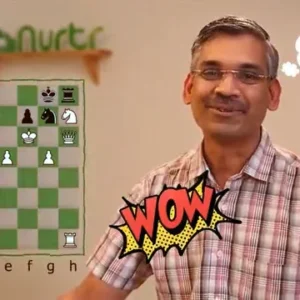
nurtr sells the Dream Room as “40+ hours of cinematically recorded, comprehensive bestselling content” for players from beginner to advanced, and this level carries most of that weight. The format never changes: Ramesh sits at the demonstration board with one or two of his own students, sets up a position, asks “what would you play here?” and only then explains. On camera are Divya Deshmukh (introduced as world under-12 champion), Rakshitta Ravi (former world under-10 champion), WIM Michelle Catharina, Varsha, Ananya Gupta, Manikya and Utkarsh. You hear them think aloud, get it wrong, and get corrected — which is exactly what makes the Dream Room Intermediate Level work as a self-study course: pause, solve, then compare.
The three levels form a ladder. The Beginner Level (39 videos, 5h 17m) teaches the rules, notation, basic mates and the classic tactical themes. This middle level assumes all that and moves into strategy and technique. The Advanced Level (42 videos, 13h 18m) then switches to deep blindfold calculation with Praggnanandhaa and young grandmasters. All three sit in the RB Ramesh collection.
| Course Fact | Details |
|---|---|
| Coach | GM RB Ramesh — British Champion 2002, Commonwealth Champion 2007, coach of India’s Olympiad team 2012–2018 (per nurtr) |
| Series | nurtr Dream Room — Level 2 of 3 (Beginner · Intermediate · Advanced) |
| Video | 90 episodes · 25h 37m (numbered 1–91; episode 61 is not in the package) |
| Topics | Calculation, prophylaxis, pawn structure, piece play, exchanges, attack and defence, 25 endgame episodes, mindset |
| Study files | Video only — positions are read out and shown on the demo board; no PGN or PDF in this package |
| Level | Intermediate juniors and club players who already know basic tactics |
| Platform | nurtr (MP4 video, 1.62 GB) |
What the Dream Room Intermediate Level Teaches
CCTV: calculating with forcing moves
The course opens with calculation, not openings. Forcing moves are defined as checks, captures, threats and pawn breaks — “which can also be called as CCTV,” as one student sums it up — and every later calculation episode leans on that checklist. Episode 8, “The Drawback,” is a small gem: Ramesh shows that after g3 the h3-square is “100% weak” and f3 “50% weak”, so every pawn move hands the opponent something. In-between moves, “accelerators” (forcing moves played in succession), simple tactics, study solving and a 23-minute session on the calculation process and its typical errors complete Part 1.
Prophylaxis, tension and the pawn skeleton
Three prophylaxis episodes make the point that you do not stop every enemy idea — only the ones that actually help your opponent. “Maintaining Tension” teaches restraint: release a pawn tension only when it gains something concrete, such as space, an open file or an outpost. The pawn-majority pair contrasts Botvinnik vs Tal from the 1961 world championship match, where Tal never got his queenside majority moving, with Ramesh’s own Semi-Slav game from 2008 — the year, he says, he stopped playing professional chess.
Pieces, exchanges and the bad bishop
Improving pieces starts with diagnosis: a bishop on g2 and rook on f1 become passive the moment your own pawn lands on f3, and a piece blocked by a pawn stays bad far longer than one blocked by a knight. Before any trade, Ramesh asks three questions — who benefits, can the opponent avoid it (if not, delay it), and can I force it in a better version — then backs them with Rubinstein’s games. Petrosian and Topalov illustrate the positional exchange sacrifice; a three-part bad-bishop series ends with his 2004 Pune Open game against Nisha Mohota. Episode 87 sorts advantages into attacking, material and positional, the last being “the most difficult advantage to handle.”
A full endgame course inside the course
Part 5 of the Dream Room Intermediate Level runs 25 episodes and 7h 09m. It covers the Centurini bishop ending (composed in 1847), key squares in king and pawn endings, queen endings (“the queen belongs to the center”), opposite-colour bishops, the principle of two weaknesses and a long rook-ending thread — basic positions, drawing against the rook pawn, and defending two pawns down with f- and h-pawns, taken from Gligorić vs Smyslov via Dvoretsky’s Endgame Manual. Classics include Flohr vs Capablanca (1935), Fischer vs Taimanov (1971), Nimzowitsch (1925) and Tony Miles (1978) knight endings, and Karpov’s conversion technique.
Parents, mindset and tournament life
Twelve episodes leave the board. Chess parents ask how to cope with watching their child play and how to talk during a tournament; a mental trainer argues that “a tournament is not like an examination”; a coach discusses bad form and work ethic; Rakshitta Ravi explains how she prepares, and a 42-minute talk on building an opening repertoire concludes that young players gain more from middlegames and endgames than from theory.
Dream Room Intermediate Level: Episode Index by Theme
The original numbering jumps between topics (episode 13 is a bishop ending, episode 16 is piece play), so we have grouped all 90 videos of the Dream Room Intermediate Level into six themes. Episode numbers are kept, so you can still watch in the original order.
Part 1 — Calculation & Tactics · 10 videos · 2h 34m
- Ep 1 — Forcing moves, part 1 — checks, captures, threats (17:01)
- Ep 2 — Forcing moves, part 2 — the CCTV checklist (23:40)
- Ep 8 — The drawback — what every move gives away (19:14)
- Ep 27 — The accelerators — forcing moves in succession (10:44)
- Ep 30 — Calculation studies — the common mistakes (16:23)
- Ep 42 — Intermediate (in-between) moves (10:16)
- Ep 43 — Simple tactics (14:11)
- Ep 49 — Solving studies (10:33)
- Ep 84 — Calculation explained — process and common mistakes (23:12)
- Ep 85 — Complex calculation (9:35)
Part 2 — Prophylaxis, Pawns & Structure · 14 videos · 4h 17m
- Ep 4 — Prophylaxis, part 1 (11:56)
- Ep 5 — Prophylaxis, part 2 — anticipating counterplay (26:34)
- Ep 6 — Pawn sacrifice, part 1 (16:01)
- Ep 7 — Pawn sacrifice, part 2 (13:31)
- Ep 9 — Pawn majority, part 1 — Botvinnik vs Tal, 1961 (34:45)
- Ep 10 — Pawn majority, part 2 — using the majority on time (20:31)
- Ep 11 — Prophylaxis, part 3 (14:02)
- Ep 33 — Understanding weak squares, part 1 (17:59)
- Ep 34 — Understanding weak squares, part 2 (22:02)
- Ep 38 — Pawn breaks, part 1 — which break to choose (15:29)
- Ep 39 — Pawn breaks, part 2 (19:46)
- Ep 41 — Maintaining tension (18:39)
- Ep 48 — Handling pawns — the bones of the position (11:12)
- Ep 60 — Playing on colours (15:32)
Part 3 — Pieces, Exchanges & Positional Judgement · 21 videos · 6h 19m
- Ep 16 — Improving pieces, part 1 — spotting the worst piece (11:20)
- Ep 17 — Improving pieces, part 2 (10:56)
- Ep 31 — Initiative (16:40)
- Ep 32 — Learning from the classics (33:18)
- Ep 35 — Centralisation (10:51)
- Ep 50 — Exchange sacrifice, part 1 — Petrosian (13:56)
- Ep 51 — Exchange sacrifice, part 2 — Topalov (14:57)
- Ep 53 — The manoeuvre (22:43)
- Ep 58 — Exchanging pieces, part 1 — three questions before any trade (9:51)
- Ep 59 — Exchanging pieces, part 2 — Rubinstein (19:59)
- Ep 63 — Which rook? (16:21)
- Ep 64 — Improving the pieces (18:12)
- Ep 66 — Exchanging the pieces (22:04)
- Ep 67 — The bad bishop, part 1 (10:32)
- Ep 68 — The bad bishop, part 2 (13:20)
- Ep 69 — The bad bishop, part 3 — Ramesh vs Nisha Mohota, 2004 (25:36)
- Ep 79 — Playing with the double bishops (repeats the Ep 69 game) (25:33)
- Ep 87 — Classifying advantages & assessing a position (28:53)
- Ep 88 — Evaluation of position (12:51)
- Ep 90 — Positional play, part 1 — Ivanchuk vs Short, 1997 (22:06)
- Ep 91 — Positional play, part 2 — Ponomariov vs Svidler (19:42)
Part 4 — Attack, Defence & Fortresses · 8 videos · 2h 11m
- Ep 20 — Attacking the king, part 1 — first find a weakness (20:00)
- Ep 21 — Attacking the king, part 2 (14:48)
- Ep 28 — Active defence, part 1 (10:02)
- Ep 45 — Attacking the king, part 3 — Ramesh vs IM Mitrakanth, 1995 (20:27)
- Ep 46 — Attacking the king, part 4 — Ramesh vs IM Rahul Shetty, 2001 (18:44)
- Ep 65 — Attacking the king, part 5 — John Nunn’s Sicilian (13:57)
- Ep 70 — The blockade & the fortress — Aronian vs Van Wely, 2008 (17:37)
- Ep 71 — Queen + knight vs queen + bishop (15:42)
Part 5 — Endgames · 25 videos · 7h 09m
- Ep 13 — Bishop & pawn ending, part 1 — the Centurini position (11:40)
- Ep 14 — Bishop & pawn ending, part 2 (14:39)
- Ep 15 — Two bishops vs bishop & knight — a classic from 1883 (29:15)
- Ep 18 — Knight & pawn endings, part 1 — Nimzowitsch, 1925 (21:16)
- Ep 19 — Knight & pawn endings, part 2 — Tony Miles, 1978 (13:09)
- Ep 23 — Rook & pawn endings, part 1 — basic positions (11:16)
- Ep 24 — King & pawn endings, part 1 — key squares (12:40)
- Ep 25 — Rook & pawn endings, part 2 (20:21)
- Ep 26 — Rook & pawn endings, part 3 (18:56)
- Ep 36 — King activity (12:55)
- Ep 54 — Bishop vs knight, part 1 (15:04)
- Ep 55 — Bishop vs knight, part 2 — Fischer vs Taimanov, 1971 (30:12)
- Ep 56 — Queen & pawn endings, part 1 — the queen belongs in the centre (12:40)
- Ep 57 — Queen & pawn endings, part 2 (17:43)
- Ep 72 — Knight vs bishop, part 1 — Flohr vs Capablanca, 1935 (25:38)
- Ep 73 — Knight vs bishop, part 2 — good knight vs bad bishop (1973 game) (27:36)
- Ep 74 — Rook & pawn endings, part 4 — defending two pawns down (f- and h-pawns) (24:34)
- Ep 75 — Rook & pawn endings, part 5 — basic positions (14:32)
- Ep 76 — Rook & pawn endings — drawing against the rook pawn (11:17)
- Ep 77 — Endgame technique — Karpov & Zvjaginsev games (19:15)
- Ep 78 — Important endgames — the extra exchange (15:01)
- Ep 80 — The principle of two weaknesses (15:09)
- Ep 81 — Bishop & pawn endings, part 3 — zugzwang (12:34)
- Ep 82 — Bishop & pawn endings, part 4 (9:08)
- Ep 83 — Opposite-colour bishops — the basics (13:17)
Part 6 — Parents, Mindset & Tournament Life · 12 videos · 3h 04m
- Ep 3 — Discussions with parents, part 1 — handling tournament pressure (13:31)
- Ep 12 — Discussions with parents, part 2 — communicating with your child (9:51)
- Ep 22 — Preparing for the tournament — with Rakshitta Ravi (12:19)
- Ep 29 — Mental trainer & a chess champ, part 1 — insecurities and doubts (9:15)
- Ep 37 — Mental trainer & a chess champ, part 2 — fear of losing (12:18)
- Ep 40 — Building an opening repertoire (42:40)
- Ep 44 — Mental trainer & a chess champ, part 3 — concentration (11:16)
- Ep 47 — Preparing at home before & after the game (20:09)
- Ep 52 — Mental trainer & coach, part 1 — bad form (12:15)
- Ep 62 — Mental trainer & coach, part 2 — work ethic (12:03)
- Ep 86 — Discussion with Divya Deshmukh — how she trains (15:37)
- Ep 89 — Common mistakes by young players (13:00)
Who the Dream Room Intermediate Level Is Built For
- Juniors past the basics who spot forks and pins but don’t yet know what to do in a quiet position.
- Club players who spoil won endgames — the endgame block alone is longer than many dedicated endgame courses.
- Chess parents and coaches who want to see how a top trainer questions a student, plus the parent and mental-trainer episodes.
- Self-learners who like to pause and solve: nearly every episode starts with a position and a question before the answer.
It is not the right start for someone still learning how the pieces move — begin with the Dream Room Beginner Level. Players who already handle these themes and want harder calculation should go straight to the Advanced Level or Ramesh’s Improve Your Chess Calculation.
- 25h 37m — the largest and broadest of the three Dream Room levels
- Real students thinking aloud, so you see typical mistakes being corrected
- 25 endgame episodes, from the Centurini position to Karpov’s technique
- Ramesh’s own games from 1995, 2001, 2004 and 2008 alongside world-class classics
- Rare parent and mental-trainer sessions — the Dream Room Intermediate Level speaks to families of junior players too
- No PGN or PDF files — you set positions up yourself from the board
- Episode 79 (“Playing with the Double Bishops”) repeats the Nisha Mohota game from episode 69
- Topics are scattered across the original numbering; our theme index fixes that
- Some discussion episodes are aimed at parents rather than players
FAQ
How does the Dream Room Intermediate Level differ from the other two levels?
Beginner covers rules, mates and tactical motifs in short videos. Intermediate is the strategy-and-endgame level, filmed with junior students. Advanced is built around blindfold calculation, endgame studies and coach discussions with grandmasters on camera.
Do I need the Beginner Level before the Dream Room Intermediate Level?
Not if you already know the basic tactical themes and simple mates. Ramesh assumes that knowledge from episode 1, where forcing moves are treated as a calculation tool rather than a new idea.
What files do I get, and how is it delivered?
90 MP4 videos (1.62 GB). There are no PGN or PDF files in this package. Digital files. Crypto payment only. Fast delivery is handled manually after payment confirmation. Download links remain available for 7 days; save your files locally.
Is it useful for parents and coaches?
Yes. Besides the board lessons, it includes two parent discussions and several mental-trainer and coach sessions on pressure, fear of losing, concentration, bad form and work ethic.
The Dream Room Intermediate Level is the one to own if you can only pick a single Ramesh level. It covers the middle of the improvement curve — calculation habits, prophylaxis, structures, exchanges and a serious endgame curriculum — and it teaches through real students, which makes the typical mistakes visible. The lack of PGNs and one repeated episode are real but minor flaws against more than 25 hours of coaching.
Get all 90 episodes through Courses On Budget, and look at the coupons page before checkout.
Browse the category: Chess Courses · Chess Courses Cheap List
More from the coach: GM RB Ramesh courses
New releases: Courses On Budget updates
Official course page: nurtr.com Dream Room
About the coach: R. B. Ramesh on Wikipedia
Recommended Dream Room stack:



Reviews
There are no reviews yet.