

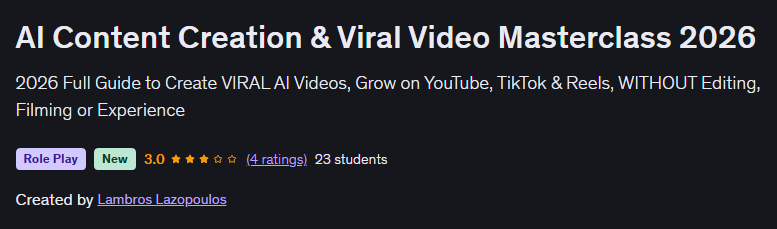
| Course | Lambros Lazopoulos – AI Content Creation & Viral Video Masterclass 2026 |
| Primary subject | AI content creation, AI video, avatars, UGC ads, repurposing, attention strategy |
| Archive size | 2.15 GB |
| Files in supplied index | 40 files across 8 indexed folders |
| Video evidence | 14 transcript-covered MP4 lessons, about 2h 47m 32s total |
| Supporting materials | PDF lesson files, walkthrough HTML guides, knowledge-check HTML files |
| Review basis | Supplied course index + supplied full video transcript text |
The supplied material shows a course that moves from AI-content strategy into a hands-on video-production toolkit, then into avatars, AI-generated UGC ads, long-form-to-short-form repurposing, and an attention-focused framework. The archive also includes walkthrough guides and lesson PDFs rather than video alone.
What This Index Review Covers
The course opens by defining a broader role for AI in content production. In the transcript, Lambros Lazopoulos discusses AI avatars, ads, podcasts, B-roll, short-form video, scripting and the shift from technical production work toward ideation. He frames the future creator less as a person doing every production task and more as a creative strategist who decides what to make, why it should exist, and how different AI tools fit into a content system.
That strategic layer matters because the later lessons are not presented as disconnected software tricks. The index shows a progression: first understand the new AI-content environment, then set up an AI video toolkit, then create avatars and videos, then produce marketing assets, and finally connect content production to the attention economy and an Attention to Dollars framework.
The supplied transcript repeatedly emphasizes orchestration: using different tools for scripts, visuals, voice, avatars and repurposing while keeping the human contribution concentrated on intent, ideas and positioning. That makes the curriculum broader than a single-tool tutorial, even though HeyGen is explicitly demonstrated in the video-toolkit section.
The product page is Lambros Lazopoulos – AI Content Creation & Viral Video Masterclass 2026. For broader browsing, the site also maintains AI & ChatGPT Courses and the regularly refreshed Courses On Budget updates page.
Inside Lambros Lazopoulos – AI Content Creation & Viral Video Masterclass 2026
| Course area | What the supplied files show |
|---|---|
| Understanding the New Era of AI Content Creation | Two core video lessons cover types of AI content and where AI content creation is heading, supported by PDFs, walkthrough guides and knowledge-check HTML files. |
| Setting Up Your AI Video Toolkit | Lessons include getting started with HeyGen, navigating an AI avatar dashboard, and using AI translation and video-editing tools. |
| Creating AI Videos and Avatars | The index lists cloning yourself into an AI avatar, photo-to-video creation, and use of an AI Video Agent for automated video generation. |
| Producing Marketing Content with AI | The material includes AI-generated UGC ads and turning long-form content into short AI videos. |
| Understanding the Attention Economy | Three lessons address the Attention to Dollars concept, how media captures attention, and the rise of the creator economy. |
| The Attention to Dollars Framework | A final indexed video breaks down a five-step Attention to Dollars framework. |
The practical video section is unusually explicit in the index. Rather than one generic ‘AI video’ module, it separates platform setup, avatar navigation, translation/editing, avatar cloning, photo-to-video generation and an AI video agent. The transcript confirms that the lessons discuss both ready-made avatars and a digital twin approach, as well as the ability to create multilingual versions of video.
The marketing section continues that applied progression. One lesson is dedicated to AI-generated UGC ads, and another to converting long-form material into short-form video. The transcript discusses taking longer recordings and extracting or generating shorter vertical assets, with the broader objective of turning one idea into many content pieces.
The final part adds a business/strategy lens. The course does not stop at production output; it explicitly covers the attention economy, creator economy and a five-step framework connecting attention to monetization. This is one of the clearest differentiators visible in the supplied index.
How the Course Is Structured
The learning path starts with context before software. That order is visible in both the folder structure and transcript: students are first asked to understand the types of media AI can produce and the changing role of the creator. Only after that foundation does the course move into specific video workflows.
The middle of the archive is execution-heavy. The files pair MP4 lessons with PDFs and walkthrough HTML documents, so several lessons have a second reference format beyond the video. That makes the archive useful for readers who prefer to revisit steps without replaying an entire lesson.
The closing modules return to strategy. Based on the transcript, Lazopoulos argues that as production gets easier, differentiation shifts toward ideas, hooks, intent, audience psychology and systems thinking. Whether or not a student agrees with that prediction, it is a documented organizing thesis of the course and explains why the attention modules sit after the production modules.
- 14 MP4 lessons are listed in the index and are covered by supplied transcripts.
- The transcript-covered runtime totals approximately 2 hours 47 minutes 32 seconds.
- The archive summary reports 40 files and 2.15 GB.
- HeyGen, AI avatars, translation, photo-to-video, AI video agents, UGC ads and long-form repurposing are explicitly named in the source material.
- The archive contains PDFs and HTML walkthrough/knowledge-check materials in addition to video.
What the Archive Format Tells You
The archive mixes MP4 lessons with small PDF lesson references and HTML walkthrough or knowledge-check files. That structure gives the course more than one way to revisit a topic: the video carries the main instruction, while the smaller files provide reference or reinforcement around several lessons. The 2.15 GB total therefore should be read together with the 40-file count rather than as video size alone.
Indexed Lesson Map and Evidence Boundaries
The lesson map below is intentionally descriptive rather than instructional. It shows the exact subjects or assets visible in the supplied archive so a buyer can judge topical coverage without turning the review into a substitute for the course.
- Explore the Different Types of AI Content You Can Create
- Understand Where AI Content Creation Is Heading
- Get Started with HeyGen and Its Core Features
- Navigate the AI Avatar Creation Dashboard
- Use AI Translation and Video Editing Tools
- Clone Yourself and Generate Your AI Avatar
- Turn Images into Videos with Photo-to-Video AI
- Use the AI Video Agent to Generate Videos Automatically
- Create AI-Generated UGC Ads
- Turn Long-Form Content into Short AI Videos
- Introduction to the Attention to Dollars Framework
- Understand How Media and Content Capture Attention
- Explore the Rise of the Creator Economy
- Break Down the 5-Step Attention to Dollars Framework
Where transcript text was supplied, the review uses it to confirm the emphasis of the listed lessons, but it avoids reproducing prompts, scripts, frameworks or step-by-step teaching in full. The purpose is to verify what the course addresses, not to disclose the training itself.
For a purchase decision, compare this map with the task you actually want to solve. A direct title match is stronger evidence than a broad marketing phrase: for example, a lesson explicitly named around an avatar, Excel formula, RSS workflow, research summary or prospecting walk-through is a verified topic in the archive.
Who This Curriculum Is Aligned With
- Creators who want a structured introduction to multiple AI-content formats rather than only text generation.
- Marketers interested in AI avatars, UGC-style advertising and content repurposing workflows.
- People who want the curriculum to connect production tactics with ideation, attention and creator-economy strategy.
- Students who value supporting PDFs and walkthrough files alongside the main videos.
The curriculum is especially aligned with visual content. A substantial portion of the indexed lessons is devoted to video creation, avatars, image-to-video, editing, translation and advertising assets. Someone looking purely for text prompting would be looking at only one part of the material.
The source also makes clear that the course treats ideation as a central skill. The repeated ‘creative strategist’ framing means the learning objective is not simply to press generate; the creator is expected to define the message, angle and system around the tools.
Pros and Limitations From the Supplied Archive
- Clear progression from strategy to tools to marketing applications.
- 14 transcript-covered video lessons plus PDFs and walkthrough resources.
- Multiple AI-video use cases are explicitly included: avatars, translation, photo-to-video, UGC ads and repurposing.
- Ends with attention and creator-economy strategy instead of stopping at tool operation.
- The supplied material is strongly oriented toward AI video and visual content, so text-only users may not need every module.
- The transcript references fast-changing AI tools; interface details may age faster than strategic sections.
- The index proves the included files but does not provide independent outcome data for students.
The important distinction here is that the limitations above are not guesses about teaching quality. They are boundaries visible in the supplied archive. That matters for a factual index review: a buyer should be able to separate what is clearly present from what has not been demonstrated by the provided files.
Related Courses On Budget Paths
These links are included as adjacent catalog paths for readers who want to browse related AI, automation, content, ChatGPT, or newsletter topics. This review does not infer features of those courses beyond their listed titles.
Rourke Heath – Universal AI Cinematic AutomationMiko – The Complete AI Content System v3Claire Hunt – AI Content Creation Guide
You can also browse AI courses cheap and return to the Courses On Budget homepage for the full multi-category catalog. The related links above are existing URLs from the supplied sitemap.
AI Content Creation & Viral Video Masterclass 2026 FAQ
What is included in Lambros Lazopoulos AI Content Creation & Viral Video Masterclass 2026?
The supplied index reports 40 files totaling 2.15 GB, including 14 MP4 lessons plus PDFs and HTML walkthrough or knowledge-check materials.
Does the course cover AI avatars?
Yes. The index includes lessons on navigating an AI avatar dashboard and cloning yourself to generate an AI avatar.
Does it include AI advertising content?
Yes. A dedicated lesson is titled Create AI-Generated UGC Ads.
Does the course teach content repurposing?
Yes. The index includes turning long-form content into short AI videos, and the transcript discusses multiplying one long-form asset into shorter pieces.
Is the course only about software tools?
No. The supplied material also includes the attention economy, creator economy, creative-strategist framing and a five-step Attention to Dollars framework.
Final Verdict
This is a broad AI-content curriculum with a particularly strong video-production spine and a documented strategy layer around ideation and attention. The clearest reason to use this index review is simple: it lets you match your goal to documented course material instead of relying on generic sales copy. If the curriculum matches what you need, open the course page and review the active offer. Coupon code 5050 is part of the current Courses On Budget publishing standard; check the coupons page before checkout.
Browse: AI & ChatGPT Courses
Updates: Latest course updates
External resource: HeyGen