


What Run It Once Red Line Mastery Teaches
Every tracker splits your results into three lines: green for total winnings, blue for showdown winnings and red for non-showdown winnings — the money you win when nobody turns their cards over. The course opens with a blunt claim repeated in every lesson: the red line is “50% of your winnings.” The coach adds that around 90% of online regulars he looks at have a losing red line.
A heavy blue-line game — wait for a hand, stack someone, fold the rest — works comfortably up to roughly 200NL, he argues. Above that the regs get better, and “you can’t really be bossed around… you have to take stands.” The real goal of the course is the purple line: blue and red both winning at the same time, which he calls “the hardest graph to attain” and closer to how the solver actually plays.
“I work for three, four months like every day for like five, six, seven, eight hours, just building it. And I didn’t hold back on anything, on any of my knowledge.”
Lesson 1.1 — Why Is Having a Winning Red Line Important?
From Full-Ring Nit to Red Line Regular
This is not theory from someone who was always aggressive. The coach started at NL2, 24-tabling full ring as a self-described “huge nit,” and rode a steep blue line up to NL50 — then kept failing his shots at 200NL, where the regs were simply better. Around 2016 he gave himself one summer at 200NL with roughly a 10K roll, studied what the winning regs were doing, and started bluffing and calling down more. He has been a pro since mid-2016.
He is equally honest about the cost. In 2019, playing 200NL to 2kNL, he did not have a single winning month in the first six months and was “down like 35 or 40K in June.” He kept grinding, studying and reviewing — and finished with one of the best years of his career. That same year he dropped his HUD on a friend’s advice, which became lesson 11.5. Even the final video, Am I Still a Nit?, answers its own question with “probably yes”: no one becomes a red line player overnight.
Watch a Free Run It Once Red Line Mastery Sample
See the teaching style before you decide. The sample below comes straight from the course files; more free previews are linked underneath, including lesson 11.1 Swings and Variance from the mental-game chapter.
Benchmark Stats From the Coach’s Own Database
One thing that sets Run It Once Red Line Mastery apart: instead of vague advice like “fold less,” the coach pulls up his own 500NL database — samples of roughly 700K–800K hands — and shows the exact frequencies he aims for. You can open your tracker and compare line by line.
| Stat | Target taught in the course | Coach’s 500NL database |
|---|---|---|
| Fold to flop c-bet (single-raised pots) | Mid-to-low 30s — most students arrive at 40–45% | 33% (≈700K hands) |
| Fold to flop check-raise / raise | 30–35% — most regs sit at 43–46% | Shown on ≈800K hands |
| Fold to turn c-bet | Low 40s — “close to 50%” means something is wrong | 40.1% (≈800K hands) |
| Fold to 4-bet | Around 35% | 36.8% (≈800K hands) |
| Cold 4-bet | Anywhere between 4% and 5% | 4.78% (750K+ hands) |
If stat work is your thing, pair these lessons with Run It Once Dominate With Data (Freenachos), which goes deeper into reading population data.
Inside the 14 Sections: What You Actually Learn
Foundations: Misconceptions and the Work Before the Aggression
Sections 1–3 set the rules. Red line play does not mean “always bluffing” — at 50NL you can over-bluff and get away with it, but against thinking players, frequencies matter. Lesson 2.2 makes the point the rest of the course is built on: calling matters just as much. Section 3 lists the prerequisites — knowing your preflop charts and your range, knowing when to deviate, accepting costly mistakes, and doing “lots of study and solver work.”
Aggression: 28 Lessons Across Preflop, Flop and Turn
The biggest block in the course. Preflop covers 3-betting, 4-betting, cold 4-betting, 5-bet shoving, isolating limpers, squeezing and defending against squeezes — where the coach notes you are “only supposed to call 16.3% of your range” while players call with hands like J8 suited. Postflop goes spot by spot: leading from the big blind for a 25–33% block size on boards where the BB holds the nut advantage, c-betting, check-raising and flop 3-betting in single-raised and 3-bet pots, then double barrels, delayed c-bets, probes and turn leads.
Calling: The Other Half of the Red Line
Eleven lessons on not over-folding. “Nobody folds to 4-bets anymore” explains why flatting and folding ranges out of position have to change. Floating is defined plainly — “calling the flop without any made hand or actual draw” — and tied straight back to your fold-to-c-bet number. The turn lessons cover how to call and how to fold properly, including against turn check-raises.
River Play: Blockers, Sizing and Bluff-Catching
Twenty-two river videos. The coach recommends two bet sizes on the river — one polarized (top value plus bluffs with great blockers) and one depolarized — then works through raising, leading and every common 3-bet-pot line. Lesson 6.5.1 is the mindset shift many players need: when in doubt, lean toward calling, because the population already over-folds and “winning 33% of the time when calling on the river will still be in most cases a profitable call.”
Blind vs Blind: Trench Warfare
Eighteen lessons for both blinds, including BvB 3-bet pots from each seat. The coach calls BvB “trench warfare” where the most aggressive player usually comes out on top — but also shows how easy it is to be out of line. As the big blind facing a check, you stab “pretty much everything but at different frequencies.”
4-Bet Pots, Multiway Pots and Recreational Players
Four 4-bet-pot videos split by position and initiative. In multiway pots the rule of thumb flips: c-betting goes down, folding goes up — “tight is right.” Against fish and recs, “theory goes out of the window” only partly: you isolate, raise their leads and probes, jam rivers against their leads, call wide in BvB, induce in 3-bet pots and read sizing tells.
Mental Game, Hand Review and Live Play
The mental chapter explains why downswings feel worse for red line players — your hero calls run into value and your bluffs run into the top of villain’s range — and covers playing without a HUD. The review section shows his workflow: start with the biggest pots lost, cap it at about 8–12 hands per session in Holdem Manager 3, and run spots in PioSolver or GTO Wizard. Finally, 12 live-play videos show it all at real tables: GGPoker $200NL Rush & Cash, 500NL regular tables, PokerStars $200NL Zoom and PokerStars $500NL/$1kNL.
How to Get Run It Once Red Line Mastery
Run It Once Red Line Mastery Course Index: All 131 Videos
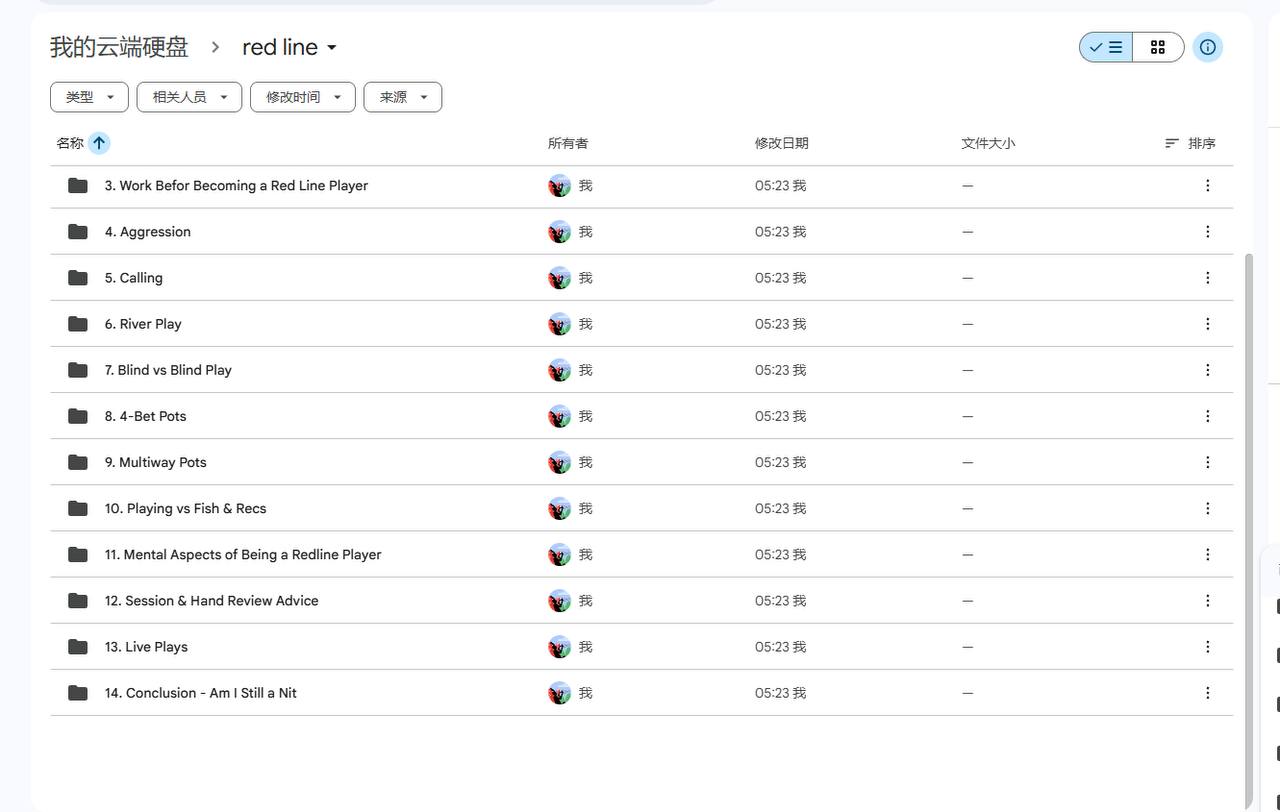
Every lesson below is taken from the real course folder, with file sizes. Click a section to open it. Lessons marked CC also include a .vtt subtitle file (16 lessons in total).
01. Introduction — 3 videos · 0.19 GB
- 1.1 Why Is Having a Winning Red Line Important?81.37 MB
- 1.2 What Does Having a Winning Red Line Do to Your Overall Game?83.21 MB
- 1.3 Why Not Just Rely on Blue Line Winnings or MDA?32.77 MB
02. Common Misconceptions — 3 videos · 0.11 GB
- 2.1 Are Red Line Players Always Bluffing?45.32 MB
- 2.2 Why Calling Matters Just As Much21.02 MB
- 2.3 Does Red-Lining Equal Higher Variance?48.89 MB
03. Work Before Becoming a Red Line Player — 6 videos · 0.46 GB
- 3.1 Knowing Your Preflop Charts148.28 MB
- 3.2 Understanding Your Range87.35 MB
- 3.3 Knowing When to Deviate54.67 MB
- 3.4 Be Willing to Make Costly Mistakes70.18 MB
- 3.5 Lots of Study and Solver Work41.76 MB
- 3.6 Be Willing to Put the Money In65.17 MB
04. Aggression — Preflop, Flop & Turn — 28 videos · 4.90 GB
- 4.1.1 3-Betting91.45 MB
- 4.1.2 4-BettingCC77.74 MB
- 4.1.3 Cold 4-BettingCC85.52 MB
- 4.1.4 5-Bet Shoving115.91 MB
- 4.1.5 Isolating Limpers58.22 MB
- 4.1.6 Squeezing95.02 MB
- 4.1.7 Defending vs SqueezeCC103.96 MB
- 4.2.1 Leading in the BB in Single-Raised Pots104.42 MB
- 4.2.2 C-Betting in Single-Raised Pots112.95 MB
- 4.2.3 Check-Raising in Single-Raised Pots245.77 MB
- 4.2.4 Flop 3-Betting in Single-Raised Pots132.29 MB
- 4.2.5 Raising in Single-Raised Pots171.25 MB
- 4.2.6 Leading in 3-Bet Pots OOP142.35 MB
- 4.2.7 C-Betting in 3-Bet Pots122.71 MB
- 4.2.8 Check-Raising in 3-Bet PotsCC123.34 MB
- 4.2.9 Raising in 3-Bet PotsCC202.65 MB
- 4.2.10 Flop 3-Betting in 3-Bet PotsCC193.88 MB
- 4.2.11 Stabbing IP in 3-Bet Pots159.45 MB
- 4.3.1 Double Barreling in Single-Raised Pots461.47 MB
- 4.3.2 Delay C-Betting in Single-Raised PotsCC181.13 MB
- 4.3.3 Check-Raising vs Double Barrel in Single-Raised Pots162.70 MB
- 4.3.4 Probing in Single-Raised Pots255.77 MB
- 4.3.5 Raising vs Turn Probes298.27 MB
- 4.3.6 Turn Leading in Single-Raised PotsCC218.79 MB
- 4.3.7 Double Barreling in 3-Bet PotsCC335.39 MB
- 4.3.8 Delay C-Betting in 3-Bet Pots348.14 MB
- 4.3.9 Check-Raising vs Double Barrel in 3-Bet Pots179.43 MB
- 4.3.10 Leading in 3-Bet Pots239.13 MB
05. Calling — Preflop, Flop & Turn — 11 videos · 2.08 GB
- 5.1.1 Flatting From the BTN and the BBCC61.37 MB
- 5.1.2 Nobody Folds to 4-Bets AnymoreCC243.78 MB
- 5.1.3 Fold More and 4-Bet More from OOPCC82.52 MB
- 5.2.1 FloatingCC134.64 MB
- 5.2.2 FoldingCC153.64 MB
- 5.2.3 BTN Calling vs UTG – CO Open on the FlopCC235.72 MB
- 5.2.4 Calling vs Check-RaiseCC208.11 MB
- 5.3.1 How to Properly Call the Turn?332.72 MB
- 5.3.2 How to Properly Fold the Turn?221.42 MB
- 5.3.4 Calling vs Turn Check-Raise242.47 MB
- 5.3.5 BTN Calling vs UTG – CO Open on the Turn212.55 MB
06. River Play — 22 videos · 4.04 GB
- 6.1.1 Why Are Blockers So Important?130.26 MB
- 6.1.2 Why Does Your Line and Story Matter So Much?193.53 MB
- 6.2.1 Betting Rivers IP78.90 MB
- 6.2.2 Betting Rivers OOP80.39 MB
- 6.3.1 Raising Rivers IP137.54 MB
- 6.3.2 Raising Rivers OOP151.63 MB
- 6.3.3 Leading Rivers91.42 MB
- 6.3.4 Bet – Bet – Bet in 3-Bet Pots203.40 MB
- 6.3.5 Bet – Check – Bet in 3-Bet Pots221.41 MB
- 6.3.6 Check-Raise – Bet – Bet in 3-bet Pots284.40 MB
- 6.3.7 Raising Rivers in 3-Bet Pots160.92 MB
- 6.4.1 Blockers or Unblockers?271.82 MB
- 6.5.1 Why Are Bad Folds Bigger Mistakes Than Bad Calls?177.55 MB
- 6.5.2 Benefits of Calling a Lot on the River57.60 MB
- 6.5.3 Calling vs River Check-Raise373.17 MB
- 6.6.1 Calling River vs Block Bet125.66 MB
- 6.6.2 Calling River vs Standard Sizes133.94 MB
- 6.6.3 Calling River vs Overbet110.86 MB
- 6.7.1 Calling River vs Triple Barrel230.72 MB
- 6.7.2 Calling vs Bet – Check – Bet355.53 MB
- 6.7.3 Calling vs Check-Raise – Bet – Bet132.30 MB
- 6.7.4 Calling River Raises430.45 MB
07. Blind vs Blind Play — 18 videos · 3.85 GB
- 7.1.1 Barreling as the SB344.27 MB
- 7.1.2 3-Betting the Flop as the SB278.58 MB
- 7.1.3 Protecting Your Flop Range as the SB293.21 MB
- 7.1.4 Protecting Your Turn Range as the SB233.46 MB
- 7.1.5 Bluff Catching Rivers as the SB212.21 MB
- 7.2.1 Flop Stabbing BvB136.43 MB
- 7.2.2 Turn and River Pressure as the BB212.10 MB
- 7.2.3 Turn Calling as the BB161.84 MB
- 7.2.4 Turn Raising as the BB118.43 MB
- 7.2.5 River Raising as the BB186.05 MB
- 7.2.6 Bluff Catching Rivers as the BB200.02 MB
- 7.3.1 Preflop and Flop as the BB in BvB 3-Bet Pots278.31 MB
- 7.3.2 Turn and River as the BB in BvB 3-Bet Pots587.57 MB
- 7.3.3 Preflop and Flop as the SB in BvB 3-Bet Pots194.09 MB
- 7.3.4 Turn and River as the SB in BvB 3-Bet Pots84.76 MB
- 7.5.1 Calling in BvB 3-Bet Pots— Facing Bet – Bet – Bet136.72 MB
- 7.5.2 Calling in BvB 3-Bet Pots— Facing Bet – Check – Bet165.29 MB
- 7.5.3 Calling in BvB 3-Bet Pots— Facing Check-Raise – Bet – Bet122.75 MB
08. 4-Bet Pots — 4 videos · 1.03 GB
- 8.1 Play as OOP With Initiative in 4-Bet Pots350.93 MB
- 8.2 Play as OOP Without Initiative in 4-Bet Pots256.62 MB
- 8.3 Play as IP With Initiative in 4-Bet Pots209.93 MB
- 8.4 Play as IP Without Initiative in 4-Bet Pots236.17 MB
09. Multiway Pots — 4 videos · 0.22 GB
- 9.1 Multiway Dynamics: C-Betting Goes Down43.67 MB
- 9.2 Multiway Dynamics: Folding Goes Up57.36 MB
- 9.3 Leading from the BB in Multiway Pots55.87 MB
- 9.4 Aggro on the River in Multiway Pots72.89 MB
10. Playing vs Fish & Recs — 8 videos · 0.56 GB
- 10.1 Theory Goes Out of the Window67.32 MB
- 10.2 Isolating Weaker Players82.76 MB
- 10.3 Raising vs Leads or Probes from Weaker Players62.43 MB
- 10.4 Facing Check-Raise in 3-Bet Pots from Weaker Players68.44 MB
- 10.5 Jamming River vs Leads from Weaker Players82.76 MB
- 10.6 Calling Super Wide in BvB Hands78.51 MB
- 10.7 Inducing the Fish in 3-bet Pots49.07 MB
- 10.8 Sizing Tells86.57 MB
11. Mental Aspects of Being a Red Line Player — 6 videos · 0.54 GB
- 11.1 Swings and Variance55.74 MB
- 11.2 Putting the Money in Drawing Dead54.97 MB
- 11.3 A Playstyle That Is Tiring for the Mind159.04 MB
- 11.4 Monitoring Your Stats for Your Own Sanity77.50 MB
- 11.5 Playing Without a HUD56.93 MB
- 11.6 In-Real-Life Benefits of Being a Red Line Player151.07 MB
12. Session & Hand Review Advice — 3 videos · 0.94 GB
- 12.1 How to Review Post Session?300.77 MB
- 12.2 How Do I Review with PIO Solver?337.71 MB
- 12.3 How Do I Review with GTO Wizard?323.12 MB
13. Live Plays — GGPoker & PokerStars — 12 videos · 4.34 GB
- 13.1.1 GGPoker Live Play: $200NL Rush & Cash434.75 MB
- 13.1.2 GGPoker Live Play: $200NL Rush & Cash (Part 2)416.43 MB
- 13.1.3 GGPoker Live Play: $200NL Rush & Cash (Part 3)377.74 MB
- 13.2.1 500NL Regular Tables Live Play329.26 MB
- 13.2.2 500NL Regular Tables Live Play (Part 2)429.55 MB
- 13.2.3 500NL Regular Tables Live Play (Part 3)438.22 MB
- 13.3.1 PokerStars $200NL Zoom Live Play310.13 MB
- 13.3.2 PokerStars $200NL Zoom Live Play (Part 2)310.40 MB
- 13.3.3 PokerStars $200NL Zoom Live Play (Part 3)312.61 MB
- 13.4.1 PokerStars $500NL and $1kNL Regular Tables337.61 MB
- 13.4.2 PokerStars $500NL and $1kNL Regular Tables (Part 2)352.74 MB
- 13.4.3 PokerStars $500NL and $1kNL Regular Tables (Part 3)395.77 MB
14. Conclusion — Am I Still a Nit? — 3 videos · 0.13 GB
- 14.1 Important Points to Remember50.13 MB
- 14.2 A Few Extra Tips41.29 MB
- 14.3 Am I Still a Nit?46.04 MB
Note: the original numbering skips 5.3.3 and section 7.4 — nothing is missing from the files; the course simply numbers them that way.
Who Run It Once Red Line Mastery Is For
- Winning blue-line regs stuck around 100NL–200NL who stack fish but bleed money in non-showdown pots.
- Players planning to move up to 200NL, 500NL and 1kNL — the coach says plainly that this is exactly what the course is intended for.
- Students who already use a solver or are ready to start, since the course leans on PioSolver and GTO Wizard throughout.
- Anyone whose tracker shows high fold-to-c-bet or fold-to-raise numbers — the benchmark lessons show what to fix first.
Not the best fit if you are happy at your current stakes and never want to move up — in the coach’s words, “it’s not a course for that.” Brand-new players should first build the basics, for example with Run It Once Hold’em Learning Path.
Comparing Red Line Courses?
Courses On Budget also carries Upswing Red Line Rocketship, Robmaf Redline Ninja Course and Saulo Costa The Redline Blueprint. Run It Once Red Line Mastery stands out for sheer coverage: separate river, BvB and 4-bet pot chapters, a complete hand-review workflow and 12 live-play videos up to $1kNL. For broader Run It Once training, see Run It Once Elite Hold’em 2024, Run It Once Hold’em 2025 and Expanding Your Range, or browse all cash game poker courses.
- 131 lessons covering every street, every pot type and both blinds
- Concrete target stats backed by the coach’s own 700K–800K-hand samples
- Dedicated chapters for river play (22), BvB (18), 4-bet and multiway pots
- 12 live-play videos on GGPoker and PokerStars from $200NL to $1kNL
- A full post-session review routine with PioSolver and GTO Wizard
- An honest mental-game chapter on variance and downswings
- Built for moving up — micro-stakes grinders may not need this much aggression yet
- Expects regular solver work and study time alongside the videos
- About 23.4 GB of video — plan your storage before downloading
- Subtitle files are included for only 16 of the 131 lessons
Run It Once Red Line Mastery: FAQ
What is the red line in poker?
It is your non-showdown winnings — money won or lost in hands that end without a showdown. The course treats it as half of your total results and teaches how to make it break even or winning.
What stakes is the course aimed at?
Players who want to reach 200NL, 500NL and 1kNL and beyond. The live plays are mostly 200NL to 1kNL, on GGPoker and PokerStars.
Do I need a solver?
It helps a lot. Lesson 3.5 calls study and solver work a prerequisite, and the review section shows the coach working in PioSolver and GTO Wizard.
How big is the download?
The course contains 131 MP4 videos in 14 sections, about 23.4 GB in total, plus 16 subtitle files.
If your graph shows a healthy blue line and a red line sliding downhill, this is the course written for that exact problem. Run It Once Red Line Mastery turns “be more aggressive” into a spot-by-spot system — 28 aggression lessons, 11 on calling, 22 on the river, 18 on blind vs blind — and then shows it working in 12 live sessions. The benchmark stats alone give you a checklist to run against your own database.
It asks for real work: solver study, honest review and a few swings along the way. For players serious about reaching 500NL and 1kNL, that is the point. Get it through Courses On Budget, and follow new poker releases on the poker updates page.
Browse the school: Run It Once Courses
Browse the category: All Poker Courses · Poker Courses List
External resource: runitonce.com
Recommended course stack:



Reviews
There are no reviews yet.