
What Is Goldbach Time?
Goldbach Time (GB Time) is Ajay Shanbhag’s interpretation of the Goldbach framework popularized by Hopiplaka — translated from price into time. The Goldbach numbers (3, 11, 17, 29, 41, 47, 53, 59, 71, 83, 89, 97) are mapped onto the minutes of every hour. Numbers below 50 act as discount arrays, numbers above 50 as premium arrays, and the market is read as moving along predictable “algo paths” from one number to the next.
Ajay is upfront about where the idea comes from: “all the credit should be given to Hopi Plaka for giving us Goldbach… How did I convert them to time? …is completely my interpretation.” He trades NQ (Nasdaq futures) on the 1-minute chart and shows examples on Bitcoin, EURUSD and gold in the live sessions. If you already study ICT trading courses, this is the timing filter built on top of the concepts you already use — fair value gaps, liquidity sweeps and order blocks.
The Core Ideas of Goldbach Time, Explained
1. The Clock Only Moves Forward
The first rule sounds obvious and changes everything: “Time is always positive, there’s no negative time, and the clock is always moving forward.” From any Goldbach minute, the next reaction is expected at the nearest number ahead on the clock — 11 leads to 17, not back to 00. You don’t need to memorize the entire path: “knowing two paths at a time is pretty necessary.”
2. Algo 1 and Algo 2 Paths
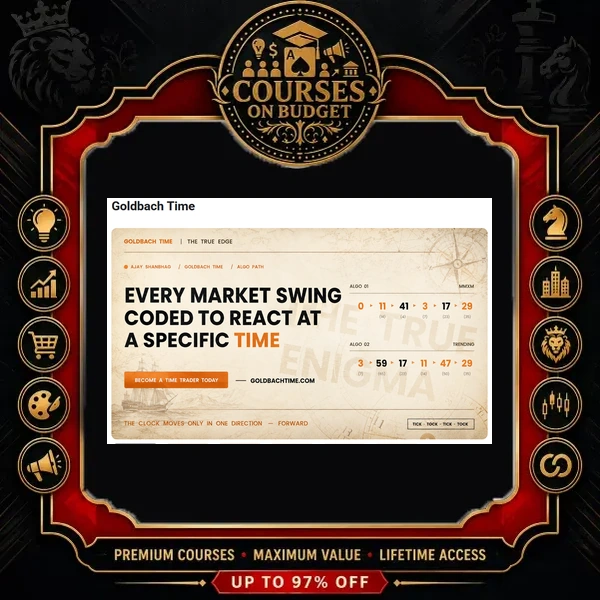
Algo 1, the “market maker model,” runs 00 → 11 → 41 → 03 → 17 → 29/71. Algo 2, the “trending model,” is traded mostly as the Algo 2 reversal: 29/35 → 47/53 → 11 → 17 → 59 → 3/7. Lessons show how to read these paths, frame higher-timeframe bias, determine swing points and handle multiple algos running in the same session.
3. CE Time — Where Execution Happens
Consequent encroachment, the ICT idea of a gap’s 50% level, is applied to the clock as the average of two consecutive Goldbach numbers. The resulting CE times — 7, 14, 23, 35, 44, 50 (equilibrium), 56, 65 and 77 — are the execution windows. In Ajay’s words: “The CE time is the highest manipulation the market can do once the path is met.”
4. GB Discoveries: Primes, Rejection Blocks, HIPPO, Circuit Breakers
The 16-lesson Discoveries module goes deeper: prime-number hours (3, 11 and 17 first), the rejection block — a wick that is also a swing high or low, which “initiates ALGO 2” — HIPPO hidden order blocks on the 9-minute chart, and circuit breakers that scale CME thresholds down to a ±0.35% band framing the day’s expected range. IMP 23/35 node candle counts and candle counting from the last liquidity sweep are taught as confluence, never as a standalone trigger.
Two Ready-to-Use Goldbach Time Trading Models
| Model | Level | Trigger | Risk logic |
|---|---|---|---|
| Path GBT (2-path model) | Beginner | A swing meets the next path at a CE time (e.g. 00→14, 14→23, 23→35) | Stop beyond the time candle; target the next path |
| FPFVG GBT | Intermediate | First presented fair value gap (15m+ or 27m), entry only when 1-minute highs/lows form at 00, 03/07, 29/35 or 71/77 | “The only advantage Goldbach Time gives you… is at what time to enter.” |
Practical rules repeat across both models: use minutes only (no addition or subtraction for beginners), the ±1 candle tolerance for a met path, rejection-block wicks as the best entry and the first FVG or order block as the second best, and the discipline to stop after one good trade: “If you get only one trade in a day, trade that and shut your system.” For your first two weeks, Ajay narrows focus to just the 17, 29, 35 and 23 combinations.
“How Would I Teach This to My Son?”
One of the most valuable lessons in the course is a 30-minute answer to criticism that the method was too complex. Ajay strips Goldbach Time to its bare minimum — CE minutes only, one trade a day, exit on the clock. “Dear son, remove everything and keep only minutes.” He also explains why he built it: “The only confusing part was where or when should I click the button? That is the only missing piece in ICT’s teaching.”
Exits follow the same clock logic. “11, 17, I’m out. I hold the trade for 6 minutes. In that 6 minutes, it can give me 100 points or it can give me only 5 points. I’ll take whatever it gives me.” That time-based exit is the cure for over-held, hope-driven trades.
Prop Firm Execution and Live Sessions
The Prop Firms lesson walks through execution for beginners on a funded-style account: start with one contract, respect the daily drawdown, use multiple contracts only to take partials. The 2025–2026 livestreams, Q&A sessions, dated price-action reviews and two recorded NY AM live trading sessions show the rules applied in real time — including losing trades. Ajay’s own advice is to verify everything on demo first: “Don’t trust me… you have to verify it yourself, whether it really works or not.”
Goldbach Time Curriculum — Full Video Index
All 65 videos, organized into 10 modules from the Beginner Series to recorded live trading (13.85 GB, MP4):
- 🎬 1. How I Arrived At GB Time
- 🎬 2. Basics Of Algo Path + Importance Of Clock
- 🎬 3. Consequent Encroachment (CE Time)
- 🎬 4. How To Memorise Algo Path
- 🎬 1. How To Read Algo Paths
- 🎬 2. How To Frame HTF
- 🎬 3. How To Trade Using GB Time
- 🎬 4. How To Trade Algo 1
- 🎬 5. How To Determine Swing Points
- 🎬 6. How To Trade NYO
- 🎬 7. How To Trade Multiple Algos
- 🎬 Candle Counting Theory and Examples
- 🎬 How To Trade IMP 23 35 Nodes
- 🎬 How Would I Teach This To My Son
- 🎬 16.07.2026 — 2-path model examples
- 🎬 06.08.2026 — Price Action Review
- 🎬 25.08.2026 — Price Action Review
- 🎬 26.08.2026 — Price Action Review
- 🎬 27.08.2026 — Price Action Review
- 🎬 1. Prime Numbers
- 🎬 2. Rejection Block
- 🎬 3. HIPPO & CE Times
- 🎬 4. Circuit Breakers & Equilibrium
- 🎬 5. Framing Bias
- 🎬 6. Trading Reversals
- 🎬 7. Catch Highs & Lows
- 🎬 8. Trading Algo Paths
- 🎬 9. Reverse & End Paths
- 🎬 10. Complete Path Mistakes
- 🎬 11. Algo End Path Setup
- 🎬 12. Algo 2 Reversal
- 🎬 13. Algo Path For Newbies
- 🎬 extra 1
- 🎬 extra 2
- 🎬 extra 3
- 🎬 29.09.2025 — Live Session
- 🎬 30.10.2025 — Live Session
- 🎬 31.10.2025 — Live Session
- 🎬 03.11.2025 — Live Session
- 🎬 08.11.2025 — Live Session
- 🎬 19.11.2025 — Live Session
- 🎬 23.05.2026 — Live Q&A Session
- 🎬 30.05.2026 — Live Q&A Session
- 🎬 06.06.2026 — Live Q&A Session
- 🎬 13.06.2026 — Live Q&A Session
- 🎬 26.06.2026 — Live Q&A Session
- 🎬 Extra livestream 1
- 🎬 Extra livestream 2
- 🎬 Extra livestream 3
- 🎬 Extra livestream 4
- 🎬 1. Path GBT Trading Model – Overview
- 🎬 2. Path GBT Trading Model – Application
- 🎬 FPFVG GBT Trading Model – Part 1
- 🎬 FPFVG GBT Trading Model – Part 2
- 🎬 FPFVG GBT Trading Model – Part 3
- 🎬 FPFVG GBT Trading Model – Part 4
- 🎬 Execution Trades For Beginners
- 🎬 18.07.2026 — Live Q&A Session
- 🎬 25.07.2026 — Live Q&A Session
- 🎬 01.08.2026 — Live Q&A Session
- 🎬 15.08.2026 — Live Q&A Session
- 🎬 23.08.2026 — Live Q&A Session
- 🎬 05.09.2026 — Live Q&A Session
- 🎬 1st Sep – NY AM Session – Live Trading
- 🎬 3rd Sep – NY AM Session
Who Is Goldbach Time For?
- ICT and SMC traders who already know liquidity sweeps, FVGs and order blocks — the course states clearly: “we are coming from ICT.”
- NQ and index futures day traders who want a precise entry and exit time instead of guessing.
- Prop firm candidates who need one structured, rules-based trade per day rather than overtrading.
- Goldbach / PO3 students who want the time dimension of the framework explained lesson by lesson.
- A unique, time-based entry and exit layer for ICT traders
- Two complete models: beginner Path GBT and intermediate FPFVG
- Clear, testable rules: no sweep, no trade; stop at the time candle
- Fresh recordings from 2025–2026, including live NY AM trading
- Honest teaching that credits its sources and shows losses
- Requires prior ICT knowledge — not a first course
- Focused on NQ; other markets appear only as examples
- Some Discoveries concepts are still being refined, as the author admits
- Long livestreams need note-taking to extract the rules
Frequently Asked Questions
What market does Goldbach Time focus on?
Do I need to know ICT concepts first?
New York time or another time zone?
How do I receive the course?
Is futures trading risky?
Goldbach Time is not another ICT rehash. It answers a single, specific question — at what minute should I execute? — with a clock-based system you can test on demo: algo paths, CE times, a sweep requirement, a stop at the time candle and an exit at the next path. With two complete models and over 44 hours of 2025–2026 recordings, it is one of the most focused timing courses for index futures traders. “The market humbles everyone, but we follow the rules.”
Explore more cheap trading courses, see the latest additions on the updates page, and get Goldbach Time through Courses On Budget.
Browse the category: Trading Courses · ICT Courses
Regulator resource: cftc.gov
Recommended ICT & prop-firm stack:



Reviews
There are no reviews yet.