
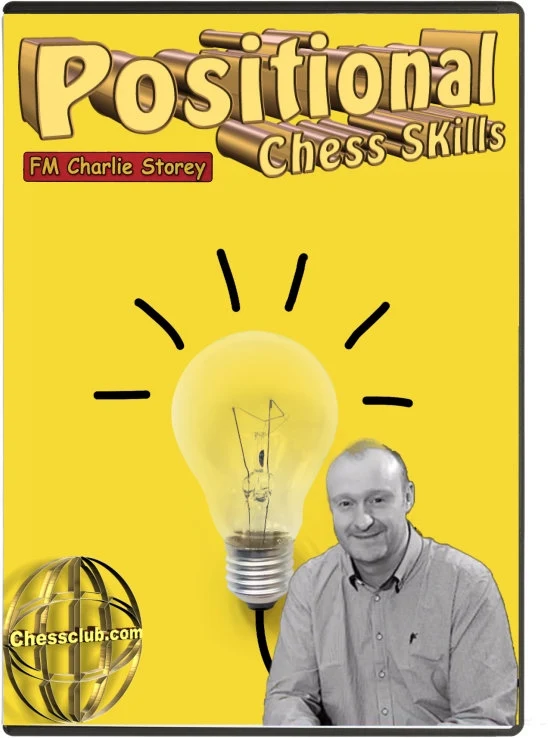
Positional Chess Skills Made Practical: Colour-Code Your Pieces
The official ICC page admits that positional skills are hard to pin down, and then promises “a video-course that tackles all the aspects of positional chess” — from evaluation and pawn structure to prophylaxis, planning and converting into good endings. Storey’s answer to the vagueness is a system. Every piece, pawns included, has four states: red (asleep on its home square), yellow, green and purple (its best possible post). Positional chess, in his words, is mostly the job of moving pieces up that scale and keeping the opponent’s pieces down.
From there the course builds twelve chapters of short, memorable principles, several of them deliberately provocative: pawn structure is overrated, never touch a wing pawn, never start a fair trade, use prophylaxis only as a last resort. Each chapter is illustrated with games by Ulf Andersson, a player Storey chose because “he has a very good habit of just stopping counterplay.” Many of those games start with g3, Bg2 and c4 — the set-up Storey calls the White Sniper skeleton, familiar to anyone who knows his Sniper opening course. More strategy titles are in our chess courses list.
| Course Fact | Details |
|---|---|
| Instructor | FM Charlie Storey — FIDE Master with two IM norms, trained teacher, creator of the Sniper system |
| Topic | Positional chess: evaluation, piece improvement, structure, prophylaxis, plans, endings |
| Video | 13 videos · 5h 51m total (introduction + 12 chapters of 21–34 minutes) |
| Model player | GM Ulf Andersson — nearly every example game in the course |
| Files | MP4 video only (800.8 MB) |
| Level | Aimed at players rated about 1400–2000, according to the coach |
| Publisher | Internet Chess Club (ICC), recorded March 2020 |
The Rules You Take Away
The colour-coding scale
Chapter 2 is the centre of the whole course — Storey says “we’re going to refer back to Chapter 2 all the time.” A knight is red on its starting square and purple when it reaches a supported post such as d6 or e6, or f6 next to the enemy king. Pawns get an extended scale, with four shades of purple for each step into the opponent’s half, the last one being promotion. The scale turns vague advice like “improve your worst piece” into something you can count during a game.
Three rules that sound wrong at first
Chapters 3–5 challenge habits. Pawn structure is “totally overrated” unless the colour coding of the pieces is equal. Wing pawns should only move when you can explain why — every wing-pawn move is a tempo not spent improving a piece. And you should never start a fair trade: if you capture my bishop and I recapture, my recapturing piece usually lands on a better square. Storey compares it to “getting an upgrade on a flight for no reason” and says players below 2000 hand out these upgrades all the time.
Prophylaxis last, and the “Threempo”
Prophylaxis — which Storey teaches juniors simply as “preventing” — gets its own chapter, with a clear priority: improve your own pieces first, prevent only when you cannot. Chapter 7 introduces the course’s most original idea, the Threempo: a small plan of about three moves that must gain a tempo along the way. Among the 50 to 1,000 mini-plans available in a typical middlegame, he argues, the ones that gain a tempo are the ones that work.
Learning from Ulf Andersson
The model games give the course one consistent style. Andersson converts one positional advantage into another in Chapter 8 — against a 1500-rated opponent, without having to calculate anything serious — wins with a slightly better knight against a 2540-rated player in Chapter 10, and in Chapter 11 shows how a positional player with White can avoid messy positions and neutralise a stronger tactician. Storey’s view is honest: if you cannot out-calculate your opponent, positional chess skills are how you stop them using their tactics.
Stereotypes, plans and the ending
The last chapters connect the rules to thinking. “Positional stereotypes” are Storey’s term for guidelines such as the bishop pair or a rook on the seventh — very good, he says, but precise calculation is better once you know them. Chapter 12, aiming for an ending, shows the risk-free White approach: a small opening edge, a positional plus in the middlegame, then a superior endgame where the colour code still tells you where pieces belong.
Positional Chess Skills: Lesson Index
Video · 13 Lessons · 5h 51m
Introduction and 12 Chapters
- Introduction — what positional skills are and how the course is built (14:11)
- Chapter 1 — Assessing and evaluating a position: the six key elements (31:05)
- Chapter 2 — Improve your pieces: the colour-coding scale (30:50)
- Chapter 3 — Pawn structure is overrated! (33:57)
- Chapter 4 — Never touch wing pawns! (24:27)
- Chapter 5 — Never start a fair trade (21:43)
- Chapter 6 — Prophylaxis as a last resort (24:33)
- Chapter 7 — Threempo! A small plan with a tempo (34:15)
- Chapter 8 — Changing positional advantages (29:02)
- Chapter 9 — Positional stereotypes (21:16)
- Chapter 10 — Positional plans: the superior knight (32:09)
- Chapter 11 — Combinational skill (29:46)
- Chapter 12 — Aiming for an ending (24:32)
Package
- 13 MP4 video files, one per lesson
- No PGN or PDF files are included in this package
- Total package: 800.8 MB
Who Will Gain the Most Positional Chess Skills Here
- Club players around 1400–2000, the range Storey built the course for.
- Players who lose to stronger tacticians and want a style that keeps the position under control.
- Sniper and fianchetto players — the Andersson games are full of g3, Bg2 and c4 structures.
- Coaches and parents of juniors who want a simple vocabulary (colour codes, fair trades, Threempo) to explain positional ideas.
If you are just starting out and need the basic positional terms first, First Steps in Positional Play is a gentler introduction. Players who want a much bigger library of model games can move on to The Complete Guide to Positional Chess.
- Builds positional chess skills on a concrete system (the colour code), not vague principles
- Short, memorable rules you can apply at the board
- One model player throughout, so the ideas form a single style
- Original concepts such as the Threempo and positional stereotypes
- Clear chapter-per-video structure, 21–34 minutes each
- Video only — the puzzles, annotated games and course guide from the ICC page are not in this package
- Rules are deliberately absolute; stronger players will want more nuance
- Almost all examples come from one player and favour fianchetto structures with White
FAQ
Do I need to play the Sniper to use this course?
No. Many Andersson games feature g3, Bg2 and c4, which Storey links to his Sniper set-up, but the rules on piece improvement, trades, wing pawns and prophylaxis apply to any opening.
What is a “Threempo”?
Storey’s name for a short plan, usually three moves long, that gains a tempo while improving a piece. Chapter 7 explains why such plans tend to succeed where slow plans are stopped by the opponent.
What files are included, and how do I receive them?
Thirteen MP4 videos (introduction plus twelve chapters), 800.8 MB in total. Digital files. Crypto payment only. Fast delivery is handled manually after payment confirmation. Download links remain available for 7 days; save your files locally.
Storey’s course is the opposite of an encyclopedia. It gives club players a small, memorable toolkit — colour-code your pieces, avoid fair trades, leave wing pawns alone, look for a Threempo — and shows it working in the quiet, counterplay-free games of Ulf Andersson. If positional chess has always felt like something you recognise but cannot apply, these positional chess skills give you a method you can actually use during a game.
It is video only, so have a board or a database ready, and check the coupons page before ordering.
Browse the category: Chess Courses · Chess Courses Cheap List
New releases: Courses On Budget updates
Official course page: shop.chessclub.com
Background reading: Prophylaxis (chess) on Wikipedia
Recommended positional stack:


Reviews
There are no reviews yet.