

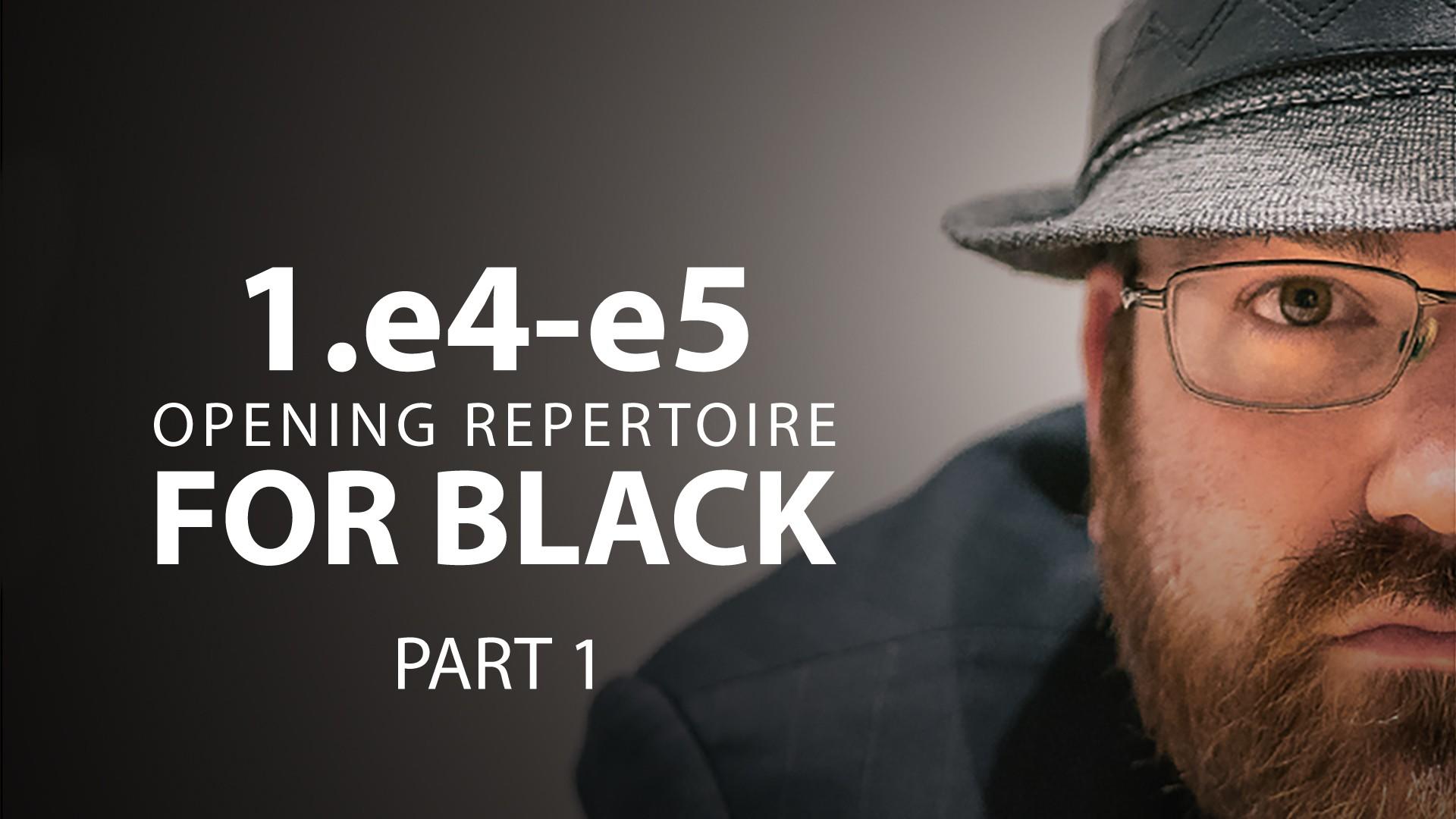
1.e4 e5 Repertoire Part 1: Beat the Sidelines with Active Development
Friedel opens the series by explaining its scope: the course covers “most everything that’s not the Ruy Lopez,” because he had already recorded a separate, extensive Lopez course. The 1.e4 e5 Repertoire Part 1 takes the first half of that territory — the early f4, d4 and c3 tries and the Bishop’s Opening family — and gives one recommended answer to each, built on the same principle every time: develop fast, hit the centre with …d5 when it works, and give a pawn back rather than fall behind in development.
Each lesson title on the Limitless Chess course page already states the recommendation — “Counter the King’s Gambit – Development Based Approach”, “Ponziani Opening – Sac a Pawn for Initiative With 3…d5”, “Vienna Game – Keep It Simple With 2…Nc6” — and the videos then walk through the critical replies, the traps and the endgames that come out of them. Friedel is open that he is “not gonna say that my approach … is the best,” only that it is the approach he trusts. Browse similar material in our chess courses list.
| Course Fact | Details |
|---|---|
| Instructor | GM Joshua (Josh) Friedel |
| Repertoire | 1.e4 e5 for Black — open-game sidelines (the Ruy Lopez is not part of this series) |
| Lines in Part 1 | King’s Gambit · Center Game · Danish Gambit · Ponziani · Vienna Game & Bishop’s Opening · Scotch Gambit / Two Knights with 4.d4 |
| Video | 5 videos · 2h 48m total (21–43 minutes per lesson) |
| Study files | MP4 video lessons only — no PGN in the Part 1 folder |
| Level | Intermediate to advanced players who already answer 1.e4 with 1…e5 |
| Platform | Limitless Chess |
What Friedel Actually Recommends
King’s Gambit: take the pawn, then counterattack
After 2.f4 Friedel accepts with 2…exf4 but rejects the greedy …g5 approach: White’s dream is Nf3, d4 and Bxf4 with a big centre, so Black’s job is to hit e4 before that happens. Against third moves that allow it, …Qh4+ is worth the tempo — his rule is that if White’s king has to go to e2, “it’s simply too much of a hassle,” and the queen then drops back to e7 to pressure e4. Against the serious 3.Nf3 and 3.Bc4 the answer is …Nf6 and an early …d5, with one exception he insists you memorise: when the f8-bishop has already left, e4–e5 is not always met by …d5.
Center Game and Danish: grab, develop, give back
The general rule here is simple: if White plays d4 without c3, take the pawn. Against the Danish, Friedel takes on c3 and on b2, then offers two routes — a very safe …d5 line that heads for a roughly equal endgame, or a greedier, more ambitious one — and also shows a sharp kingside attacking try where the defensive …Ng8 makes White’s initiative “just kind of evaporate.” As he puts it about the safe route: “Equal doesn’t mean draw, right? But it means that you’re doing quite well.”
Ponziani and Vienna: two different moods
Against the Ponziani he mentions the solid …Nf6 option, then recommends 3…d5 with a pawn sacrifice for the initiative, including lines where Black’s king walks into the centre and is still the safer of the two. The Vienna and Bishop’s Opening are combined because 2…Nc6 lets you meet both the same way: on 3.f4 take and strike with …d5, on Bc4 play …Nf6 with the fork trick …Nxe4, and remember the Nxd4 trap against an early Bd2. For a fuller White-side view of these lines see ABC of the Vienna.
Two Knights with 4.d4: the line Friedel used to play as White
The final lesson covers the Scotch Gambit / Two Knights complex after 4.d4 exd4, reached through …Nf6. Friedel admits these were his favourite White lines as a junior until he found how good Black is when prepared. Highlights are the IQP line after c3 and …d5, the endgames with doubled c-pawns he has “played … quite a few times,” the version with the black queen on h5 rather than a5, the no-nonsense …Bd6 that stops White’s Bg5 fun, and a little-known c4 idea he once tried in a US Championship game against Onischuk.
That sentence is the whole 1.e4 e5 Repertoire Part 1 in miniature. Friedel also names Ian Nepomniachtchi as a top player who still uses the King’s Gambit, the Center Game and early f4 lines, which makes Long Live the King’s Gambit a useful look at the other side of the board.
1.e4 e5 Repertoire Part 1: Course Index
Part 1 · 5 Lessons · 2h 48m
Video Lessons
- Lesson 1 — Counter the King’s Gambit: development-based approach (42:33)
- Lesson 2 — Center Game and Danish Gambit: target the centre (34:42)
- Lesson 3 — Ponziani Opening: sacrifice a pawn for the initiative with 3…d5 (21:17)
- Lesson 4 — Vienna Game and Bishop’s Opening: keep it simple with 2…Nc6 (39:04)
- Lesson 5 — Two Knights / Scotch Gambit: take on d4 and play …Nf6 (30:55)
Package
- 5 MP4 video files (75–151 MB each)
- Total package: about 596 MB
- Continues in Part 2: Four Knights, Scotch, Fried Liver and Italian 4…h6
Who the 1.e4 e5 Repertoire Part 1 Is Built For
- 1…e5 players who keep meeting gambits online and at weekend events and want one trusted answer to each.
- Players who prefer activity to pawn-grabbing — Friedel says plainly he is “not a huge fan of pawn grabbing” and builds every line around development.
- Club players moving up who know the main lines but lose points to the Danish, Ponziani or Vienna because they never studied them.
- Anyone planning the full series: Part 1 handles the early sidelines, Part 2 the Four Knights, Scotch, Fried Liver and Italian.
The 1.e4 e5 Repertoire Part 1 is not the right buy if you want a complete 1…e5 repertoire including the Ruy Lopez in one package, or PGN files to drill. For a broader, file-based Black repertoire, look at Jan Gustafsson’s 1.e4 e5.
- One clear recommendation per sideline, stated in the lesson title
- Consistent philosophy — rapid development and …d5 — so the lines are easy to remember
- Traps and exceptions are flagged, not buried
- GM’s practical experience: lines he has played, and lines he gave up as White and why
- Short enough to finish in a weekend
- Only half the repertoire — Four Knights, Scotch and Italian are in Part 2
- No PGN files in this part, so you build your own notes
- Under three hours, so some secondary moves are only sketched
- No test positions or drills
FAQ
What is the difference between Part 1 and Part 2?
The 1.e4 e5 Repertoire Part 1 covers the King’s Gambit, Center Game, Danish, Ponziani, Vienna / Bishop’s Opening and the Two Knights after 4.d4. Part 2 covers the Four Knights (4.Bb5 and 4.d4), the Scotch with 4…Nf6, the Fried Liver with …Na5 and the Italian with 4.d3 h6. Together they form one open-games repertoire.
Does it cover the Ruy Lopez?
No. Friedel says in the first video that the series covers everything except the Lopez, which he treated in an earlier, separate course.
What do I receive, and how is it delivered?
Five MP4 video lessons, about 596 MB in total. Digital files. Crypto payment only. Fast delivery is handled manually after payment confirmation. Download links remain available for 7 days; save your files locally.
The 1.e4 e5 Repertoire Part 1 is a focused, honest course: five lessons, six sidelines, one recommendation each, all built on rapid development and timely central counterplay. Friedel explains why he avoids greedy lines, flags the exceptions you need to memorise, and shows the traps that end games early. It is short and has no PGN, but it fixes the exact gap most 1…e5 players have.
Pair it with Part 2 for the Four Knights, Scotch and Italian, and check the coupons page before you order through Courses On Budget.
Browse the category: Chess Courses · Chess Courses Cheap List
New releases: Courses On Budget updates
Official course page: limitlesschess.com
Opening background: Open Game on Wikipedia
Recommended open-games stack:



Reviews
There are no reviews yet.