

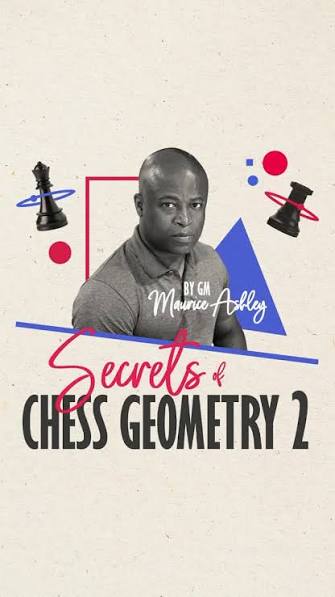
Secrets of Chess Geometry 2: The Pieces Take Centre Stage
Most tactics training sorts positions by theme: fork, pin, skewer. Ashley’s approach goes one level deeper and asks why those tactics work at all. In the introduction he explains the difference between the two volumes in one sentence: the first course “was all about the general themes” — collinearity, concurrency, the Novotny theme, the zigzag, domination — while this one is “very much about the pieces.” Each main chapter is built around a single unit and its geometry: how a rook controls blocks of squares, why a bishop owns only 32 squares yet can “slice and dice” a position, how the knight’s non-linear move creates surprises at every level.
If you have not taken the first course, the opening chapter recaps its key ideas over almost two hours, so you can start here. If you have, Secrets of Chess Geometry (volume 1) and this volume form a complete pair: themes first, then the pieces. Both sit in our Chess Courses category alongside Ashley’s How to Reassess Your Chess.
| At a Glance | Details |
|---|---|
| Instructor | GM Maurice Ashley — composer of many of the studies shown |
| Topic | Tactical geometry of each piece: lines, shapes, cross pins, zigzags, forks, domination, stalemate tricks |
| Video | 14 videos · 11h 58m total (intro, 11 chapters, outro) |
| Study file | Complete course PGN (240.52 KB) with the positions and lines |
| Practice | “Pause and solve” positions in every chapter, plus a closing Geometric Puzzles chapter |
| Level | Intermediate club players and up; strong players will enjoy the studies |
| Platform | Chessable (video course with PGN) |
Inside the Dance: What Each Piece Teaches
Lines and shapes, not just themes
Chapter 2 is the heart of the course. Everyone knows the “square of the pawn” and triangulation; Ashley shows that tactics are full of other shapes too — the T- and X-shaped cross pins, triangles that hold a defence together, the Z-path of a rook or queen. In the introduction, Re8+ followed by Rxa8 breaks the triangle that was holding Black’s position together. Once you start drawing these lines in your head, the coach argues, combinations “just sort of pop out.” He also warns about the flip side: the same box that traps a king can produce stalemate.
Rooks, bishops and the queen’s zigzag
Ashley admits that rooks used to bore him as a composer — and then spends an hour showing why the piece that covers all 64 squares is full of tricks. The bishop chapter (the longest of the first half at 1h 21m) starts with two bishops dominating a promoting pawn, and the queen chapter shows the full range of a piece that controls 27 squares on an empty board: zigzag checks that pick off a rook, queen-and-bishop endings that look drawn until a zigzag appears, and a position he watched live at the Warsaw Rapid & Blitz.
Knights, kings and “forkable” squares
The knight is Ashley’s favourite piece, and “Jazzy Knights” is the longest chapter at 1h 43m, opening with a famous Kubbel study. The key tool is the idea of a forkable square — borrowed from Dan Heisman — and the “attack then fork” mechanism. The king chapter goes well beyond “centralise in the endgame”: distant opposition, outflanking, stalemate defences, and long king walks across the board that decide studies and real endgames alike.
Major pieces, defence, mates and puzzles
“The Major Key” covers queen and rooks together, where king safety comes first, second and third. “The Art of Defense” looks for geometric saving moves — the stunning resource that turns the tables. Domination is covered earlier, in chapter 1B, with a study by Ashley based on the work of Genrikh Kasparyan, whose book on the subject holds 2,545 studies. The course ends with two short chapters: unusual geometric mates beyond the standard catalogue, and puzzles where no theme is announced.
That sentence is the promise of Secrets of Chess Geometry 2: train your eye on the pieces’ geometry until the invisible lines become visible in your own games.
Secrets of Chess Geometry 2: Chapter Index
Video Chapters
- Introduction — what is new in volume 2 (7:18)
- Chapter 1A — Chess Geometry: recap of collinearity, concurrency and the Novotny theme (1:03:53)
- Chapter 1B — Chess Geometry, continued: cross pins, backward vision and domination (52:24)
- Chapter 2 — The Lines and Shapes of Tactics (58:05)
The Pieces · 7 Videos
- Chapter 3 — Rocking Rooks (1:00:02)
- Chapter 4 — Bachata Bishops (1:21:38)
- Chapter 5 — Dancing Queens (1:11:17)
- Chapter 6 — Jazzy Knights (1:43:13)
- Chapter 7 — The Salsa King (1:33:16)
- Chapter 8 — The Major Key: queen and rooks (59:31)
- Chapter 9 — The Art of Defense (56:12)
Test Yourself · 3 Videos
- Chapter 10 — Geometric Mates (4:33)
- Chapter 11 — Geometric Puzzles (5:43)
- Outro — how to use what you learned (1:42)
Study File
- Secrets of Chess Geometry 2 — complete course PGN (240.52 KB)
- Total package: 6.37 GB (high-quality MP4 video)
Who Should Take This Geometry Course
- Players who finished volume 1 and want the same thinking applied piece by piece.
- Club players who miss tactics that look obvious afterwards — especially knight forks and long-range queen moves.
- Endgame and study lovers — many examples are compositions, several by Ashley himself.
- Visual learners who remember shapes and patterns better than lists of themes.
Secrets of Chess Geometry 2 is not a course for complete beginners or for players who want an opening repertoire or a structured strategy plan. If you want classic, theme-based tactical drills first, look at Magic of Chess Tactics by Müller and Meyer.
- A genuinely different way to train tactics: lines, shapes and squares
- Almost 12 hours of video — much longer than volume 1
- Works as a standalone: chapter 1 recaps the first course
- Beautiful studies, many composed by Ashley
- Energetic, entertaining presentation that keeps long chapters moving
- Chapters run 1–1.7 hours each; you need to pause and split them
- The mates and puzzles chapters are short (about 10 minutes together)
- Many positions are studies rather than practical game positions
- Large download (6.37 GB)
FAQ — Secrets of Chess Geometry 2
Do I need volume 1 first?
No. Chapter 1 (two videos, almost two hours) recaps the first course’s themes, so you can start here. Ashley still recommends volume 1 for the deeper treatment of collinearity, concurrency, the Novotny theme and zigzags.
How is this volume different from the first?
Volume 1 is organised by themes. Volume 2, Dance of the Pieces, is organised by pieces — rook, bishop, queen, knight, king, the major pieces together — plus a chapter on defence, and it is considerably longer.
What is included, and how is it delivered?
14 MP4 videos and the full course PGN. Digital files. Crypto payment only. Fast delivery is handled manually after payment confirmation. Download links remain available for 7 days; save your files locally.
Secrets of Chess Geometry 2 is the bigger, deeper sequel. Where volume 1 named the themes, this one teaches you to feel each piece — the rook’s blocks of squares, the bishop’s diagonals, the queen’s zigzags, the knight’s forkable squares and the king’s opposition tricks. It is long and occasionally study-heavy, but it is one of the few tactics courses that changes how you look at the board rather than adding more patterns to memorise.
Get the full video set and course PGN through Courses On Budget, and remember the coupons page.
Browse the category: Chess Courses · Chess Courses Cheap List
New releases: Courses On Budget updates
Official course page: chessable.com
About the author: Maurice Ashley on Wikipedia
Recommended tactics & geometry stack:


Reviews
There are no reviews yet.