

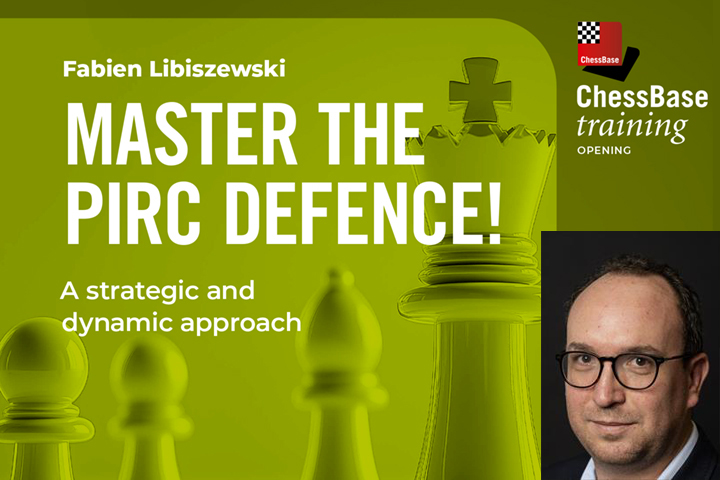
Master the Pirc Defence Review: The Verdict in 60 Seconds
Libiszewski’s 2025 course is a complete Pirc repertoire after 1.e4 d6 2.d4 Nf6 3.Nc3 g6, and its shape is its strongest argument: ten strategy and model-game chapters come first, then ten theory chapters, each followed by ChessBase training tools — “Find key moves”, repertoire training and practice positions — and finally seven exercises. That is more built-in practice than most opening courses offer. The trade-offs are format, because it is a protected installer rather than plain video files, and the honest caveat in the ChessBase review that the engine prefers White in some lines.
Structure and practice value score highest because every theory chapter has its own training section. Coverage loses a point only because we could not verify depth line by line. Format scores lowest: a protected package needs a ChessBase-compatible setup, and Mac users should check compatibility first. More defences to 1.e4 are listed in our chess courses list.
Meet the Coach
- French grandmaster, born 1984 in Saint-Étienne; GM title in 2009
- Peak FIDE rating 2547 (December 2016); third at the 2015 Reykjavik Open
- Active coach and captain of the French mixed team (per ChessBase)
- Actor and chess consultant for the film Le Tournoi (per Wikipedia)
This is not Libiszewski’s first course on the opening — the store also carries his earlier Pirc & Modern, which is organised differently and includes 1…g6 set-ups. The new course narrows the focus to the Pirc proper and is built around ChessBase’s training tools, which fits a coach who, according to ChessBase, is still active as a player and works with a national team.
How to Get the Course
How the 8h 14m Is Organised
Because the package is protected, we cannot show minutes per chapter. What we can measure from the official contents is how the theory is divided. For this Master the Pirc Defence review we counted the line sections in each theory chapter — 21 in total, not counting the training items — to see where the repertoire puts its weight:
The Austrian Attack gets a third of all line sections, which makes sense: it is the most forcing system against the Pirc and the one where a single gap can lose the game. The attacking set-ups with Be3, Bg5 and Qd2 come next. Around that theory, the course follows a clear learning path:
The training is spread just as deliberately. Counting from the same contents for this Master the Pirc Defence review: all ten theory chapters end with repertoire training, eight also have a “Find key moves” block, and six add practice positions — 24 training blocks in total before you even reach the seven exercises. Only the “Universal” chapter and the minor variations are limited to repertoire training, which makes sense for material that is more about recognising a plan than calculating a line. In other words, every theory chapter is followed by work for you to do, and the heaviest chapters — the Austrian Attack, 4.Bg5 and the Classical — get all three kinds of training.
Worked Example: Keeping the King in the Centre Against 4.Bg5
The ChessBase review walks through one line from the 4.Bg5 chapter, and it is a good illustration of the repertoire’s character. White’s plan in this system is a kingside attack with Qd2, long castling, h4–h5 and Bh6, so the recommended defence simply refuses to give White a target. Followed step by step:
- Rule: do not castle into the storm. Against 4.Bg5 Black plays 4…c6 and keeps the king in the centre, so the h-pawn attack has nothing to hit.
- Choose the moment for the centre. After 5.Qd2 Nbd7 6.f4, Black strikes with 6…d5, and on 7.e5 the knight jumps to e4.
- Punish the natural-looking move. After 8.Nxe4 dxe4 9.Qe3?, Black answers 9…f6 and opens the position: 10.exf6 exf6 11.Qxe4+ Kf7.
- Develop with tempo. After 12.Bh4 Bb4+ 13.Kf2 Re8 14.Qd3 Bd6 15.g3 Nb6, Black is a pawn down but every piece is active and White’s king is the one in trouble.
- The lesson. The review describes the result as a development advantage with compensation for the pawn — the kind of active, practical position the whole repertoire aims for.
The reviewer also lists what he liked about the theory in general: lines that need relatively little memorisation, are often unfamiliar to opponents, stay active for both sides and remain understandable to humans even when computer-checked. That is a useful description of the course’s philosophy, even though we could not check every chapter ourselves.
Second Example: An Early Queen Trade That Favours Black
The review’s other highlight is a model game from the strategy section, Mullon–Tkachiev from 2012. Many club players think of the Pirc as passive, and an early queen exchange looks like the worst case for Black: no counterplay, no attack, just a cramped position. The game shows the opposite. Once the queens are off, Black’s knights, bishops and f-pawn come into play within a handful of moves, the king is safely tucked away, and the advanced white pawn on e6 eventually falls.
That is why the strategy chapters matter in this course. Themes such as “Domination on the Dark Squares”, “The d6-d5 Push” and “Activity” are not abstract headings; they are the reasons Black’s pieces suddenly work in positions like this one. If you study the key games before the theory, the lines in the second half make much more sense.
The Index, Turned Into Study Paths by Goal
The course page has the full chapter list. Without per-chapter runtimes we cannot build a day-by-day plan, so for this Master the Pirc Defence review we turned the index into study paths by goal. Pick the row that matches your situation; the 8h 14m total means a complete pass takes roughly two to three weeks at a steady pace.
| If your goal is… | Start with | Then | Train with |
|---|---|---|---|
| Playing the Pirc next weekend | Introduction + Understanding the Pirc | Classical 4.Nf3 and the Austrian Attack | Find key moves in both chapters |
| Surviving the attacking systems | How to Defend Against a Kingside Attack | 4.Bg5, 4.Be3 lines and the “Universal” chapter | Practice positions after each chapter |
| Understanding the opening deeply | All strategy chapters + key games | Theory chapters in contents order | Exercises 1–7 at the end |
| Avoiding early surprises | Minor variations (3.f3, 3.Nd2, 3.Bd3) | Quiet systems 4.g3, 4.Bf4, 4.Be2 | Repertoire training |
Pirc Defence · Advanced
GM Fabien Libiszewski — Master the Pirc Defence
Ten strategy and model-game chapters, ten theory chapters covering every main White system, training sections, seven exercises, plus model-game and analysis databases. The complete chapter list is on the product page.
Test Yourself: Five Questions from the Contents
For this part of the Master the Pirc Defence review, the questions are built from the official chapter list and the ChessBase review, so they test whether you know the repertoire’s choices before you start. Tap a question to reveal the answer.
1. What is Black’s reply to 4.Bg5 in this repertoire, and what is the idea?
2. How does the course meet 4.Be3?
3. What does the “Universal” chapter deal with?
4. Which White system gets the most theory sections?
5. Which central pawn break has its own strategy chapter?
Master the Pirc Defence Review: Strengths and Gaps
Training built into every chapter
Most theory chapters end with three training blocks: “Find key moves”, repertoire training and practice positions. Add the seven exercises and the repertoire tools ChessBase includes, and you have a course designed to be worked through rather than watched. For an opening as flexible as the Pirc, that repetition is exactly what makes a repertoire stick.
Honest about the engine
The ChessBase reviewer, a FIDE Master, recommends the course “for players of all levels” but also notes that the computer gives White an advantage in some variations. His conclusion is that the positions are still “always fun to play”. We think that is the right frame for any Master the Pirc Defence review: this is a repertoire for players who want unbalanced games with Black, not for those who need engine equality in every line.
Where the course stops
The focus is the Pirc with 3…g6; Modern set-ups with an early …g6 are not the topic, and we could not verify the videos ourselves. If you want the Modern too, the author’s Pirc & Modern is the natural companion. For a sharper, attacking take on the same structure, compare Attacking with the Pirc.
Which Pirc Course Should You Pick?
The store has several Pirc and Modern courses, and two sister reviews in this batch cover other answers to 1.e4. If you are still deciding between a solid and a fighting defence, read our Caro-Kann Volume 2 index review next to this Master the Pirc Defence review. Within the Pirc, this table matches the courses to different needs; each title links to the product page with the full contents.
| If you need… | Choose |
|---|---|
| A complete 3…g6 Pirc with interactive training | Libiszewski — Master the Pirc Defence |
| Pirc and Modern set-ups from the same author | Libiszewski — Libiszewski’s Pirc & Modern |
| The Czech Pirc with …c6 | Grigoryan — Czech Pirc |
| An attacking approach to the Pirc | Bojkov — Attacking with the Pirc |
| The Pirc’s attacking lines from a top author | Marin — Play the Pirc Like a Grandmaster, Vol. 2 |
- Strategy first, then a complete repertoire against every main White system
- Training blocks after almost every theory chapter
- Seven exercises plus model-game and analysis databases
- Recent release (2025) in English and French
- Recommended by ChessBase’s reviewer for all levels
- Protected package — no plain video files to copy or time
- Engine prefers White in some lines
- Modern (1…g6) set-ups are not the focus
- We could not verify the videos line by line
FAQ
What is this Master the Pirc Defence review based on?
On the official ChessBase table of contents, the official running time, the package index and the review published on ChessBase. The course is protected, so we did not transcribe the lessons.
How long does the course take?
The official running time is 8h 14m. With the training sections and exercises, two to three weeks at a steady pace is realistic.
Will it run on my computer?
The package installs a ChessBase course. ChessBase lists Windows 10 or higher, with a Mac option for the download version, so check your set-up before ordering.
How is the course delivered?
Digital files. Crypto payment only. Fast delivery is handled manually after payment confirmation. Download links remain available for 7 days; save your files locally.
Our Master the Pirc Defence review finds a course with an excellent structure for an ambitious opening: strategy and model games first, a complete repertoire second, and training after nearly every chapter. The 4.Bg5 example shows the active, practical spirit of the lines. At 8.0 out of 10, the score reflects what we could verify — the structure and the training are clearly strong, while the protected format and the absence of transcripts keep it from going higher.
See the full contents and order through Courses On Budget; the coupons page is worth a look before you pay.
Browse the category: Chess Courses · Chess Courses Cheap List
New releases: Courses On Budget updates
Official page: shop.chessbase.com (official contents) · ChessBase review
About the coach: Fabien Libiszewski on Wikipedia
Recommended course stack:


