

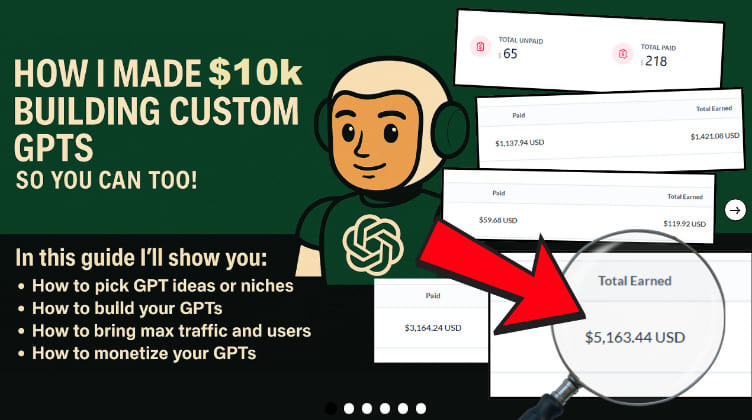
The GPTs Money Blueprint is a compact monetization system for custom GPTs built around niche selection, GPT creation, monetization, traffic, and scaling. The supplied 34-page guide explains tool-first affiliate ideas, keyword-demand research, trend-based concepts, GPT Builder setup, subscriptions, affiliate links, lead generation, GPT Store visibility, directories, and search-oriented promotion. This review separates the documented system from the creator’s own reported results and uses only the attached files. Browse more AI material at Courses On Budget.
Updated September 2026. This page is the GPTs Money Blueprint – Make Money with GPTs – ChatGPT Store Monetization System Kit Index Review 2026. The review is grounded in the supplied course index and transcripts; unlisted bonuses, guarantees, and outcomes are not assumed.
| Indexed package | 5 files / 36.37 MB |
| Core guide | GPTs Monetization Course v4, September 2025 — 34-page PDF |
| Checklist assets | 1-page monetization checklist in DOCX and PDF |
| Other indexed resources | Large HTM file and Notion link text file |
| Core system | Niche → build → monetize → traffic → scale |
| Product page | Open course |
GPTs Money Blueprint – Make Money with GPTs – ChatGPT Store Monetization System Kit Index Review 2026: What the Course Teaches
The guide opens by making a case for specialized GPTs: a custom GPT can be configured around one narrow job, preloaded instructions and knowledge, and a simpler user experience than asking a general model to solve everything from scratch. That premise leads directly to the first strategic step—choose the niche and the monetization logic before building the GPT.
Two discovery methods are documented. The “tool-first” method begins with a software product the creator already understands, checks whether it has an affiliate program, and then builds a GPT that handles a simplified or complementary task. The second method starts with keyword demand: use GPT Store suggestions or keyword tools to identify specific problems, then create narrowly named GPTs around those variations. A trend-hijacking section adds a faster, more opportunistic route for short-lived demand.
The build section uses ChatGPT’s GPT Builder and covers naming, descriptions, instructions, conversation starters, capabilities, optional Actions, previewing, and publishing. The monetization sections then describe recurring subscriptions through a third-party GPT monetization tool, relevant affiliate offers inside responses, and lead generation. Traffic guidance covers GPT Store discovery, directory submissions, niche communities, backlinks, blogs, micro-sites, social media, and long-tail naming. The final portion treats every GPT as a small experiment that can be tested, improved, or discarded.
GPTs Money Blueprint — ChatGPT Store Monetization System Kit
A step-by-step written system focused on discovering specific GPT ideas, building them with ChatGPT, connecting monetization methods, attracting users, and scaling the concepts that show traction.
- Tool-first, keyword-demand, and trend-based GPT idea discovery
- GPT Builder setup, instructions, starters, capabilities, Actions, preview and publishing
- Subscription, affiliate, and lead-generation monetization models
- GPT Store visibility, directories, backlinks, blogs and social traffic
- Scaling guidance plus a one-page monetization checklist
What the 34-Page Guide Is Really Optimizing
The central optimization target in the guide is not technical complexity; it is a tight match between a user problem and a monetization path. The niche-selection chapters repeatedly favor focused tools over broad assistants. The build chapter then recommends clear instructions, fallback questions, conversation starters, selective capabilities, concise outputs, and preview testing. That combination is designed to reduce friction: the GPT should be understandable from its name and description, useful immediately, and narrow enough that the creator can explain why an external tool, subscription layer, or follow-up offer is relevant.
The traffic section continues the same principle. Long-tail names are recommended because they communicate the job directly and can also improve discoverability. Directory submissions, community posts, backlinks, blogs, micro-sites, and social links are presented as ways to create external discovery for GPT Store pages that the creator does not control through Search Console. The result is a compact funnel model: specific demand leads to a focused GPT, the GPT solves a useful part of the problem, and monetization is attached only where it makes sense. For more courses in the same topic cluster, use the ChatGPT Courses Cheap list.
Curriculum Index Breakdown
How the Learning Path Is Structured
The course is unusually explicit about connecting product design to monetization. Instead of building a GPT and deciding later how it might make money, the first step asks who the GPT is for, what narrow problem it solves, and what monetization route can logically sit behind the result. In the tool-first example, the GPT handles a useful subset of a larger software workflow and then points users to the broader product only when the recommendation is relevant.
The guide also distinguishes between recurring revenue, affiliate revenue, and lead generation. The creator presents subscription figures and affiliate earnings as personal case-study evidence inside the PDF; those numbers are claims made in the course materials, not independent guarantees of what another buyer will earn. The safer takeaway is the architecture: a GPT can be a paid product, a referral funnel, or a front-end lead asset depending on how the experience is designed.
Traffic is treated as a distribution problem rather than an advertising requirement. The guide recommends clear GPT names and descriptions, directory listings, community exposure, and external links from owned or third-party pages. The SEO section explains why a GPT Store URL cannot be submitted through a property you do not control and therefore emphasizes backlinks and external discovery signals instead.
For current store pricing, use the product page and check the Coupons page. Coupon 5050 is the site checkout code referenced in this review.
Who Should Consider This Course
This guide fits a learner who wants a concise monetization playbook rather than a broad AI curriculum. Its scope is narrow: custom GPTs, the ChatGPT Store, monetization routes, traffic, and scaling. The product index also shows that most of the instructional value is concentrated in the PDF and checklist rather than in hours of video.
It is particularly relevant to people who already understand basic ChatGPT usage and want to connect specialized GPTs to affiliate programs, subscriptions, or lead capture. The material repeatedly stresses narrow problem selection, simple user experience, and relevant—not spammy—monetization. Anyone evaluating the income screenshots or reported results should treat them as the author’s case study, not as a forecast.
Course Content Compared by Learning Need
| Monetization/traffic need | What the guide teaches | Concrete mechanism in the PDF |
|---|---|---|
| Find a monetizable idea | Start from an affiliate tool, search demand, or a current trend | Tool-first / keyword-demand / trend-hijacking methods |
| Build without coding | Configure a custom GPT in ChatGPT | GPT Builder, instructions, starters, capabilities and publishing |
| Charge recurring access | Use an external GPT monetization layer | Subscription model described with GPT Tools |
| Earn referral revenue | Recommend relevant advanced tools inside GPT outputs | Affiliate links connected to the user’s goal |
| Capture leads | Use a free useful GPT as a front-end asset | Email capture and follow-up offer strategy |
| Get users without ads | Improve store discoverability and build external signals | Directories, communities, backlinks, blogs and social |
| Scale output | Run many small tests and keep refining winners | 3–5 GPT experiments per week is the creator’s stated focus |
Pros and Considerations
- Compact system that covers idea selection, build, monetization, traffic and scaling in one guide
- Three monetization models are documented: subscriptions, affiliate offers and lead generation
- Includes concrete GPT Builder configuration steps and prompt principles
- Traffic section covers store visibility, directories, communities and backlinks
- Includes a one-page monetization checklist in two editable/readable formats
- The indexed package is primarily a written guide rather than a large video course
- Creator revenue and usage numbers are personal case-study claims and should not be treated as guaranteed outcomes
- Some tactics depend on third-party platforms or services whose features can change over time
Related Courses On Budget Options
For broader ChatGPT training, open the AI & ChatGPT category. Related pages in the supplied sitemap include the ChatGPT Courses Package, Ruben Hassid — How to Prompt ChatGPT, and Jason West — ChatGPT Skool. Store changes and newly added courses are tracked on Updates.
For platform documentation mentioned directly in the course materials, see ChatGPT GPTs.
Frequently Asked Questions
What does GPTs Money Blueprint teach?
The attached guide covers niche selection, GPT creation, subscriptions, affiliate monetization, lead generation, GPT Store visibility, directories, SEO/backlinks, and scaling.
Is GPTs Money Blueprint a coding course?
No. The guide explicitly presents the workflow as no-code and builds custom GPTs with ChatGPT’s GPT Builder.
Which monetization methods are included?
The PDF documents three: recurring subscriptions through an external GPT monetization service, affiliate offers placed where relevant, and lead generation.
How does the course suggest getting traffic?
The guide discusses GPT Store discoverability, third-party directories, niche communities, backlinks, blogs, micro-sites, social media, and long-tail keywords.
Are the income figures guaranteed?
No. The revenue and usage numbers shown in the attached guide are presented as the creator’s own case-study results. They are not a guarantee of results for other users.
Where can I get GPTs Money Blueprint on Courses On Budget?
Use the product page linked in this review. For the additional checkout discount referenced by the site, check the Coupons page and use code 5050.
Final Verdict
GPTs Money Blueprint is a focused written system rather than a general AI course. Its value is the sequence: choose a narrow, monetizable use case; build the GPT with clear instructions and a simple interaction; select a subscription, affiliate, or lead-generation path; then distribute the GPT through store optimization and external discovery. The attached materials also make it possible to separate the framework from the creator’s reported case-study numbers. If your goal is specifically ChatGPT Store monetization, the curriculum stays on that topic and gives you a compact implementation checklist.
Browse more options through Courses On Budget, check the AI & ChatGPT category, and review the latest site updates.