
Secrets of Chess Geometry 2 Review: The Verdict in 60 Seconds
Maurice Ashley’s second geometry course is a tactics course in disguise. It does not drill fork after fork; it trains you to see lines, diagonals and king paths that ordinary pattern training ignores. The chapters are organised by piece, the examples mix composed studies with real games, and the presentation is lively from the first minute to the last. The price of that richness is length: most chapters run an hour or more, and the closing practice section is short. If you are willing to pause and work, few courses change the way you look at the board as much.
Depth earns a 9 because every chapter goes beyond textbook patterns into study-level ideas. Practice value gets a 7: there are pause-and-solve moments everywhere, but the dedicated mates and puzzles chapters last only about ten minutes together. Study files score well thanks to the full course PGN. That balance is the core of this Secrets of Chess Geometry 2 review. For other tactics courses, see our chess courses list.
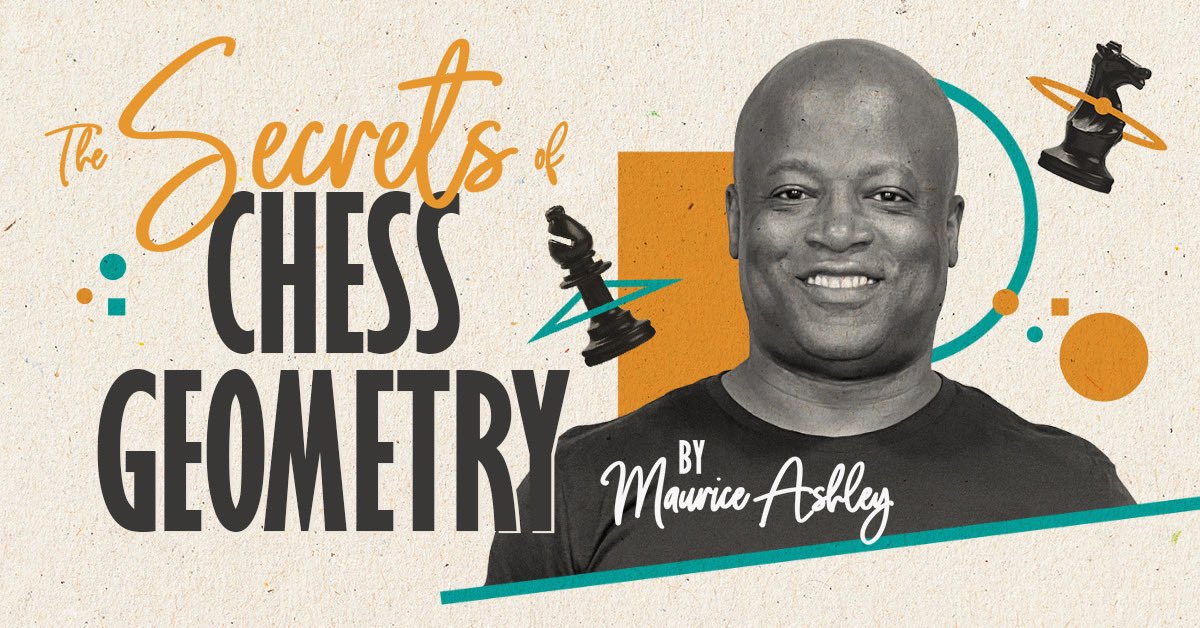
Meet the Coach
- Born 1966 in Jamaica; Grandmaster in 1999, described as the first Black grandmaster
- Commentator on both Kasparov–Deep Blue matches (1996, 1997) and many Sinquefield Cups
- Coached Harlem’s Raging Rooks and Dark Knights to national titles
- Composer of many of the studies shown in the course
The commentator is easy to hear. When Ashley tells the story of a World Championship ending, he narrates it like a broadcast — the hours of play, the pressure, what the loser must have been thinking — before he explains the geometry. And the coach of young Harlem teams shows in the outro, where he says he wishes he had been able to train this material “in an organized fashion” as a youngster.
How to Get Dance of the Pieces
Where the 11h 58m Goes
For this Secrets of Chess Geometry 2 review we timed every chapter and grouped the first four videos as the foundation block. Two numbers stand out. A quarter of the runtime goes into the recap and the general lines-and-shapes chapter before any single piece takes centre stage. And the knight and the king together take more than a quarter of the course, which makes sense: in our view these are the two pieces whose paths are hardest to visualise.
The course logic is a zoom: from the general themes of volume 1, to the shapes of tactics, to one piece at a time, then pieces in combination, and finally positions where nobody tells you the theme.
A Worked Example: Bronstein’s Blunder and the Diagonal King
The Salsa King chapter opens with one of the most painful moments in World Championship history, and it is the best illustration of what “geometry” means in this course.
- The rule. A king moving diagonally reaches a target as fast as one moving in a straight line, because the board is not ordinary flat geometry. Réti showed it in his famous 1921 study, which volume 1 covers in detail.
- The position. Game 6 of the 1951 match: Bronstein, with White, must stop Black’s passed pawns with king and knight. Ashley shows the easy draw — bring the knight back with check and plant it on d4, ready to give itself up for the pawn.
- The mistake. Bronstein plays Kc2, expecting …Kf3, after which his knight could return with tempo.
- The refutation. Botvinnik plays …Kg3, moving away from the pawn in order to come back to f2 without allowing a knight check. The pawn can no longer be stopped and Bronstein resigns.
- The cost. The match ended 12–12 and Botvinnik kept his title. Ashley’s point is that Bronstein surely knew Réti’s study — and still missed it after hours of tension.
- The training lesson. The chapter then shows a study where the defending king walks the “wrong” way, away from the enemy pawn, only to double back inside the square of the pawn and draw. Same geometry, other side of the board.
That is the method of the whole course: one geometric property of a piece, a dramatic example where a strong player got it wrong, and then a composed position that drills the idea until you see it without counting.
Second Example: Seeing Through the Pieces
The Art of Defense chapter introduces the skill Ashley calls seeing through the pieces. In his first example White threatens a crushing bishop check after a queen move to e6, and Black seems to have no defence at all. The saving move is a quiet pawn push to f3. It works because Black’s queen, looked at properly, already defends a1 — through the pieces standing in its way. A few moves later an X-ray defence, with the queen guarding a rook through a bishop, and a zigzag of queen checks finish the job.
The second example is even more geometric. A black rook on h2 gives check, and every way of dealing with it lets the queen use a different square on the same diagonal — first f4, then c7, then d6 — to pick off an undefended white rook. Three squares, one line. Once you see that picture, you will look for hanging pieces along diagonals in your own games.
The Index, Turned Into a 14-Session Study Plan
The product page lists every chapter with its runtime. To make this Secrets of Chess Geometry 2 review useful at the board, we split the long chapters into halves and set a task after each session. At three sessions a week the course takes about five weeks.
| Session | Watch | Video time | Then do |
|---|---|---|---|
| 1 | Introduction + Chapter 1A | 71:11 | List the volume 1 themes you already know |
| 2 | Chapter 1B | 52:24 | Find one cross pin in your own games |
| 3 | Chapter 2 — Lines and Shapes | 58:05 | Draw the shapes on a printed board |
| 4 | Chapter 3 — Rocking Rooks | 60:02 | Replay the rook positions from the PGN |
| 5 | Chapter 4, first half | 40:49 | Count the squares each bishop controls |
| 6 | Chapter 4, second half | 40:49 | Solve the paused positions before the answer |
| 7 | Chapter 5 — Dancing Queens | 71:17 | Mark every zigzag check route |
| 8 | Chapter 6, first half | 51:36 | Name the forkable squares in each position |
| 9 | Chapter 6, second half | 51:37 | Set up three knight studies from memory |
| 10 | Chapter 7, first half | 46:38 | Replay Bronstein’s ending on a board |
| 11 | Chapter 7, second half | 46:38 | Test the diagonal-king idea in pawn endings |
| 12 | Chapter 8 — The Major Key | 59:31 | Check king safety first in every example |
| 13 | Chapter 9 — The Art of Defense | 56:12 | Look for one saving move per position |
| 14 | Chapters 10–11 + Outro | 11:58 | Solve all mates and puzzles without hints |
Tactics & Geometry · Intermediate+
GM Maurice Ashley — Secrets of Chess Geometry 2: Dance of the Pieces
Fourteen videos organised by piece, from rooks to the king, plus defence, geometric mates, puzzles and the full course PGN. The complete chapter index with sizes is on the product page.
Test Yourself: Can You See the Lines?
Every Secrets of Chess Geometry 2 review should let you test the material yourself. These four questions come from the chapters; if you solve them quickly, you are ready for the deeper studies. Click a question to see the solution.
1. In game 6 of the 1951 match, what was Bronstein’s simple drawing idea instead of Kc2?
2. What does Ashley mean by “seeing through the pieces”?
3. In the Geometric Mates chapter, how does White finish after a double check with the knight on f7 and …Kg6?
4. In the first Geometric Puzzle, how does White promote after the rook starts checking?
Secrets of Chess Geometry 2 Review: Strengths and Gaps
A composer’s eye for the impossible move
Ashley composes studies, and it shows in the choice of positions: moves that look absurd, such as a king walking away from the pawn it must stop or a queen landing on an attacked square, are the core of the course. He always explains why the move works in words of geometry — lines, squares, triangles — rather than “the engine says so”, which makes the ideas transferable.
Energy that carries long chapters
Hour-long videos can drag, but Ashley’s commentary rarely does. He jokes, tells stories about the players, invites you to pause and comes back with the solution. The outro sums up the aim: look at the board differently and spot the shapes of tactics in your own games.
Where the course stops
No Secrets of Chess Geometry 2 review would be complete without the downside. The practice section is the weak spot: the mates and puzzles chapters together run about ten minutes, so most of your solving happens inside the main chapters. Many positions are studies rather than practical middlegames. If you want classic theme-based drilling, add Magic of Chess Tactics or Tactics Ninja; for geometry in the endgame, Van Perlo’s Endgame Tactics is the natural companion.
Which Tactics Course Should You Pick?
Board-vision courses solve different problems, so this Secrets of Chess Geometry 2 review ends with a short comparison. The table matches each one to a goal; each title links to a product page with its own index.
| If you need… | Choose |
|---|---|
| Geometry piece by piece, with studies and the course PGN | Ashley — Secrets of Chess Geometry 2 |
| The themes first: collinearity, Novotny, zigzags | Ashley — Secrets of Chess Geometry (Volume 1) |
| Classic tactical motifs, sorted by theme | Müller & Meyer — Magic of Chess Tactics |
| Hidden tactical ideas in middlegame positions | Bojkov — Hidden Tactics: Middlegame |
| Tactics that decide endgames | Oleksiyenko — Van Perlo’s Endgame Tactics |
- A genuinely new way to train tactics: lines, squares and paths
- One chapter per piece, so weaknesses are easy to target
- Famous game examples next to beautiful studies
- Full course PGN for replaying every position
- Energetic presentation that keeps long chapters moving
- Most chapters run an hour or longer
- Dedicated practice chapters last only about ten minutes
- Study-heavy for players who want game positions
- Large download for a video course
FAQ
Is this Secrets of Chess Geometry 2 review based on the real course?
Yes. Runtimes come from the 14 video files, and every example and quote comes from the full chapter transcripts; the historical game was checked against the record of the 1951 World Championship.
Is the course mostly studies or practical games?
Both. Many positions are composed studies, some by Ashley himself, but the course also uses real games, including a famous World Championship ending, to show the same geometry under tournament pressure.
How should I split chapters that run over an hour?
Watch the longest chapters in two halves of 40 to 52 minutes and replay the positions from the course PGN between sessions; the 14-session plan in this review does exactly that.
How is the course delivered?
Digital files. Crypto payment only. Fast delivery is handled manually after payment confirmation. Download links remain available for 7 days; save your files locally.
Our Secrets of Chess Geometry 2 review ends with a clear recommendation for improving club players. Ashley trains the part of tactics that pattern drills miss: the diagonal king path, the hanging piece on a long diagonal, the move that sees through the pieces in its way. At 8.3 out of 10 it is one of the most original tactics courses we carry, held back only by long chapters and a short practice section.
Follow the 14-session plan and order the course from Courses On Budget — and check the coupons page first.
Browse the category: Chess Courses · Chess Courses Cheap List
New releases: Courses On Budget updates
External resource: chessable.com (official course page)
Historical background: World Chess Championship 1951 on Wikipedia
Recommended course stack: