
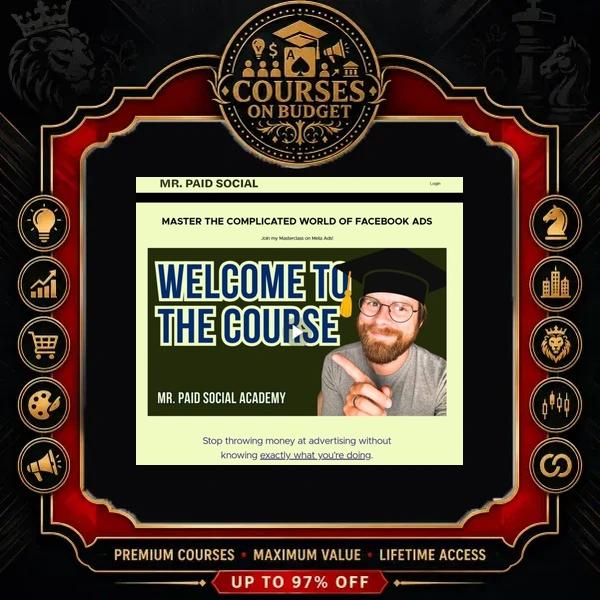
What the Mr Paid Ads Masterclass Is Built Around
Caleb says he spent a lot of money testing and failing “so that you don’t have to.” Mr Paid Ads is built for businesses of any size and for new media buyers who can launch an ad but have no framework to scale it. Experienced buyers get bid strategy, automated rules, Frankenstein iteration and seasonal plays like Q5.
Every module of Mr Paid Ads feeds one loop, the media buying cycle:
How the Meta Algorithm Picks Your Ad
The 31-minute algorithm lesson starts with the ad rank formula: bid × ad quality and relevance × estimated action rate × user value. Caleb recommends removing the bid so performance depends only on how good your ads are. In his words, “the pixel and creative drive everything.” Facebook optimizes for the objective you choose, which is why a traffic campaign brings in “clicky” users who rarely buy.
“I’ve been buying broad since 2015 […] In 2024, creative is your targeting. […] Interest targeting is dead. It’s been dead for a long time.” — Module 3, Lesson 1: Unpacking the Facebook Algorithm
The lesson also covers how the algorithm behaves once an ad is live:
- Learning phase: an ad set exits it after 50 conversions in 7 days. Big budget changes, pauses over seven days and targeting edits can send it back.
- Cruising altitude: like the first 10,000 feet after take-off, early CPAs and CPMs are bumpy and smooth out above the learning phase.
- The Facebook wave: when an ad set goes “ad viral,” it’s the one case where he raises budgets several times a day.
- Never edit a live ad: any change resets it and wipes its social proof.
- Poisoned pixel signals: in lead gen, cheap junk leads train Facebook to find more of the wrong people. The fix is to isolate the variable that changed, or to fire the pixel only after qualifying questions.
The Two-Campaign Media Buying Blueprint
All you really need, according to the scaling lesson, is two campaigns: a creative testing campaign and a top-performer / Advantage+ shopping campaign. Each testing ad set holds one creative style (text border, UGC video, article screenshot, meme, post-it) with 3–5 ads. That’s 25 unique ads, at a suggested $50 a day minimum per ad set. Each winner moves into Advantage+, gets a V2 ad set of new variations, and the cycle repeats.
Three Ways to Run Creative Tests
| Method | How it works | Caleb’s verdict |
|---|---|---|
| Big creative swings | Each ad in a style gets its own image and its own copy | Recommended to start, especially on a smaller budget |
| Single-variable isolation | Change only the copy, then the headline, then the media | Gives clear learnings but needs a bigger testing budget |
| DCO | 10 images × 5 copy × 5 headlines = 250 combinations in one ad set | Efficient at scale but more of a black box; pull the best combination out as a standalone ad |
Budget Math You Can Use Today
The Media Buying Masterclass gives a rule for minimum ad set budget: 7.14 × your CPA, which gets you to about 50 conversions a week. At a $5 CPA, that’s about $35 a day. When an ad set beats target by a wide margin, he doubles the budget daily until CPA is within 20–30% of goal. After that he raises it 20–30% at a time, every other day if you’re risk-averse. Raise budgets just before midnight, and skip bid caps unless holding a cost matters more than scale. Prefer campaign budgets? Compare this with a dedicated CBO blueprint.
Creatives That Scale: 18 Videos on Ads That Convert
At nearly four hours, the creative module is the biggest part of Mr Paid Ads and Caleb’s favorite. The brainstorm uses his own ads course as the live example. You pick five competitors and study them in the Facebook Ads Library, the TikTok Creative Center and Foreplay. You check Google Trends for angles, and you feed Trustpilot reviews into a GPT that turns customer language into ad copy.
Six Custom GPTs Included
- Competitive Analysis GPT for mapping what rivals run
- Reviews to Ad Copy GPT for mining sentiment from review files
- Creative Brief GPT, which builds a campaign, ad set and ad-level brief from three answers
- Viral Hook Generator, which writes new hooks or 10 variations of an existing one
- Ad Copy Generator, built on his ad copy frameworks
- Ad Policy GPT (Module 1), which gives an ad a risk score before Meta reviews it
Ad Styles, Copy Frameworks and Ugly Ads
The Top Ad Styles sheet (two parts, about 50 minutes) covers UGC sub-formats: “watch me do XYZ,” street interviews, PSA, podcast-style UGC, demos, founder’s story, notes-app ads, whiteboards, selfie images, testimonial screenshots and TikTok Shop ads. Unboxing is the style he’s had the most success with. One phone video of his wife unboxing clothes was reused so often that he estimates $10–15 million in ad spend went behind that single creative.
The ad copy lesson covers first person, feature-benefit, testimonial, urgency, statistic, top three reasons, before-and-after, challenge-a-norm and hook-only frameworks. He says short, witty pun/teaser copy combined with first person is where he has spent “the majority of my ad dollars.” The ugly ads lesson (“chameleon ads,” in his words) shows how to blend into the feed and still stand out. The Creative Masterclass adds cheat codes: use humor, you are not your target audience, typos often help, mine your ad comments for ideas, and use AI as a starting point only.
For production, the UGC checklist says to shoot on your phone, outdoors or at home, never in an office. Canva bulk creation turns one template into 100 headline variations. The AI UGC lesson breaks down his AI-actor video that passed 4 million views on TikTok. If UGC is your main channel, pair this with a dedicated UGC masterclass.
Reading the Numbers: Media Buying Analysis
The longest lesson (1 hour) works through a live lead campaign in his own ad account on day five, with low budgets and nothing out of the learning phase yet. You build one custom Ads Manager view. Cost per lead or purchase is the primary metric; link CTR, CPC, CPM and frequency are secondary metrics that explain it. He treats CPM as relative: a high CPM can mean you’re reaching a valuable audience.
- A kill decision, shown: a post-it ad set at $45 spent, a $63 CPM and a $7 CPC. Every secondary metric said turn it off.
- Hook rate = 3-second views ÷ impressions. Most ads he sees that do well sit “as close to 40% as possible.” Hold rate is built from ThruPlays.
- Don’t over-trust a cheap winner: a $4 cost per lead on low spend rarely holds once everything else is switched off.
- Breakdowns, saved reports and custom audiences show who actually converts.
Frankenstein Ads: Iterating on Your Winners
A Frankenstein ad is “composed of best components, best performing elements from a lot of different ads combined into one.” Swappable variables include the hook, script, clip order, B-roll, actor, lens, thumbnail, text overlay, primary text, CTA, audio, landing page and offer. Later you combine Frankenstein ads into “Frankenstein squared” ads. It’s how you put his rule into practice: a winner should get 10 to 20 tested variations.
Advanced Media Buying Strategy: Rules, Rip Currents and Q5
The custom rules lesson sets up three rules. One pauses ad sets when cost per lead goes above $20, but only after 8,000 impressions and only if CPC is also above $2. One turns ad sets back on at midnight if their budget is above $5. One turns campaigns back on if they spent anything yesterday. He calls rules “a first line of defense” that can fail. His team found that pausing during the day and resuming the next day worked, because an ad set paused for under seven days doesn’t re-enter the learning phase.
The Facebook rip current covers stretches when nothing works. The urge is to fight harder, but his advice is to swim parallel to the shore: consolidate to proven ads, cut tests, make fewer changes and launch only iterations of winners. The Media Buying Masterclass (two parts, about 71 minutes) adds Q5, December 26 to early January, when ad costs “fall to the floor.” In one account he went from $10,000 a day in Christmas week to $150,000 three days later.
“Never fight a rip current. Sometimes the best thing you can do when your ads are tanking is nothing. Live to fight another day.” — Module 5, Lesson 7: Media Buying Masterclass, Part 1
The rest of the module covers organic strategy and comment filters, running existing posts as ads instead of boosting them, and A/B tests. He uses Test and Learn only for big single variables and splits landing-page tests on your own backend. If you want more from the same Mr. Paid Social brand, see the Mr Paid Social Ad Alchemists program.
Foundations: Tracking, Policy and FTC Compliance
Module 1 covers the setup most courses rush. You create the Business Manager, add the pixel on Shopify or Squarespace, connect your pages, and set up the Conversions API with Stape ($10 a month per pixel on pay-as-you-go, per the lesson, which also cites a 13% cost-per-action improvement). An advanced video connects Stripe to CAPI through Make.com. The policy lesson focuses on the personal attributes rule. The FTC lesson covers real lawsuits, including a $2.7 million publicity-rights case.
Mr Paid Ads Course Index: What’s Inside
| Module | Lessons | Files & tools |
|---|---|---|
| 0. Intro 1 video · 4m |
Intro Video | Slack community and lifetime-upgrade link notes |
| 1. Foundations for Media Buying 9 videos · 1h 24m |
1 Setting Up the Business Manager · 2 Adding the Pixel to a Shopify Site · 3 Adding the Pixel to Squarespace · 4 Adding CAPI with Stape.io · 5 Adding Organic Pages to Business Manager · 5.1 Adding CAPI with Make.com + Stripe (Advanced) · 6 Meta Ads Policy · 7 How to Use the Ad Policy GPT · 8 Understanding FTC Compliance | Glossary of Terms PDF, Meta Set-Up Checklist PDF, Ad Policy GPT link |
| 2. Creatives that Scale 18 videos · 3h 44m |
Introduction · 1 Using the Competitive Analysis GPT · 2 Overview of TikTok Creative Center · 3 Using Google Trends for Brainstorming · 4 Using the Review GPT · 5 Using the Creative Brief GPT · 6 Using the Viral Hook Generator GPT · 7 Using the Ad Copy Generator GPT · 8 Using Top Ad Styles Google Sheet (Parts 1–2) · 9 Components of an Ad · 10 Ad Copy Frameworks · 11 Ugly Ads / Chameleon Ads · 12 UGC Content Checklist · 13 Using Canva for Bulk Ad Creation · 14 Creative Masterclass (Parts 1–2) · 15 How to Create UGC Videos With AI | 3 PDFs (ad styles, viral hooks, TikTok accounts); links to 5 GPTs, 2 Google Sheets and the creative doc |
| 3. Launch Strategy 7 videos · 2h 02m |
1 Unpacking the Facebook Algorithm · 2 Simple Blueprint for Scaling Campaigns · 3 Creative Renaming and Organization · 4 Using the Ad Builder Google Sheet · 5 Set Up Campaign and Ad Sets (Part 1) · 5 Building the Ads (Part 2) · 6 Handling Rejected Ads | Creative Testing Blueprint and Campaign Set-Up Template PDFs; algorithm and Ad Builder sheet links |
| 4. Test, Learn & Scale 5 videos · 1h 41m |
1 Media Buying Analysis · 2 Audience Breakdowns · 3 Customizing Facebook Reports · 4 Building Custom Audiences · 5 Frankenstein Ads | Metric Formulas PDF |
| 5. Advanced Media Buying Strategy 9 videos · 1h 57m |
1 Setting Up Custom Rules · 2 The Facebook Rip Current · 3 Organic Strategy · 4 Adjusting Budgets · 5 A/B Testing · 6 Analysis Paralysis · 7 Media Buying Masterclass (Parts 1–2) · 8 Thank You | The Facebook Rip Current chart, CBO vs ABO slides link, Meta set-up guide link |
| 6. Resources 15 files |
All extras in one folder | All module PDFs in one place, plus the Cruising Altitude, Media Buying Cycle and Rip Current charts |
Who Is This Media Buying Course For?
- Business owners running their own Meta ads who want a repeatable testing and scaling system
- New media buyers who can launch ads but have no framework for what to test, when to cut and how to scale
- E-commerce and lead-gen marketers who need clean pixel and CAPI tracking plus policy and FTC basics
- Experienced buyers after advanced plays: automated rules, Frankenstein iteration, rip currents, Q5
Not for: anyone who wants Google, TikTok or LinkedIn campaign management. TikTok shows up here as a research tool, and Google Search gets only a short mention for local services. It also won’t suit anyone hoping for a hands-off “set and forget” system, because Caleb says you’ll always be testing.
- Covers the full path from Business Manager setup to scaling, in nearly 11 hours
- Six custom GPTs plus ad styles, viral hooks and copy framework libraries
- Concrete numbers: 7.14 × CPA budgets, 50 conversions in 7 days, a 40% hook rate benchmark, budget step sizes
- Live analysis inside a real ad account, including kill-or-keep decisions
- Rare advanced material: custom rules, rip currents, Q5, poisoned pixel signals
- Meta only. Other ad platforms aren’t taught.
- The live demo is a lead campaign. Caleb says ROAS and e-com strategy aren’t covered in depth.
- Advanced budget-scaling rules are deliberately left out.
- GPTs and sheets are link files; Ads Manager screens date from 2024.
- The Resources folder repeats several module PDFs.
Mr Paid Ads Masterclass FAQ
What is the Mr Paid Ads Media Buying Ads Masterclass?
It’s a Facebook and Instagram (Meta) ads course by Caleb, the media buyer behind Mr. Paid Social. It runs across five modules: foundations and tracking, creatives that scale, launch strategy, test-learn-scale analysis and advanced media buying strategy, plus a resources folder of PDFs, charts and GPT links.
Is it suitable for beginners?
Yes. The course starts at “absolute zero”: creating a Business Manager, installing the pixel and setting up billing and pages. It then builds up to campaign structure and scaling. A few lessons, like CAPI through Make.com and Stripe, are labelled advanced.
How long does the course take?
The 49 videos add up to about 10 hours 55 minutes. The creative module alone runs 3 hours 44 minutes, and the Media Buying Analysis lesson is a full hour.
Does it teach Advantage+ and broad targeting?
Yes. Caleb recommends broad targeting with Advantage+ audience and placements, no bid caps at the start, and an Advantage+ shopping campaign for proven winners. DCO, CBO and lookalike audiences are covered too.
How is the course delivered?
Digital files. Crypto payment only. Fast delivery is handled manually after payment confirmation. Download links remain available for 7 days; save your files locally.
Most Meta ads courses teach either the buttons or the creative. Mr Paid Ads teaches both, then adds the judgment calls usually learned by losing money: when to cut, how much to scale, when to do nothing, and how to keep a winner producing variations. It’s Meta-only and lighter on e-com ROAS, but as a complete testing and scaling system it holds up.
Grab it today through Courses On Budget and start running your ad account on a framework instead of guesses.
Browse the category: Marketing Courses · Marketing Courses Cheap List
Recommended course stack:


Reviews
There are no reviews yet.