
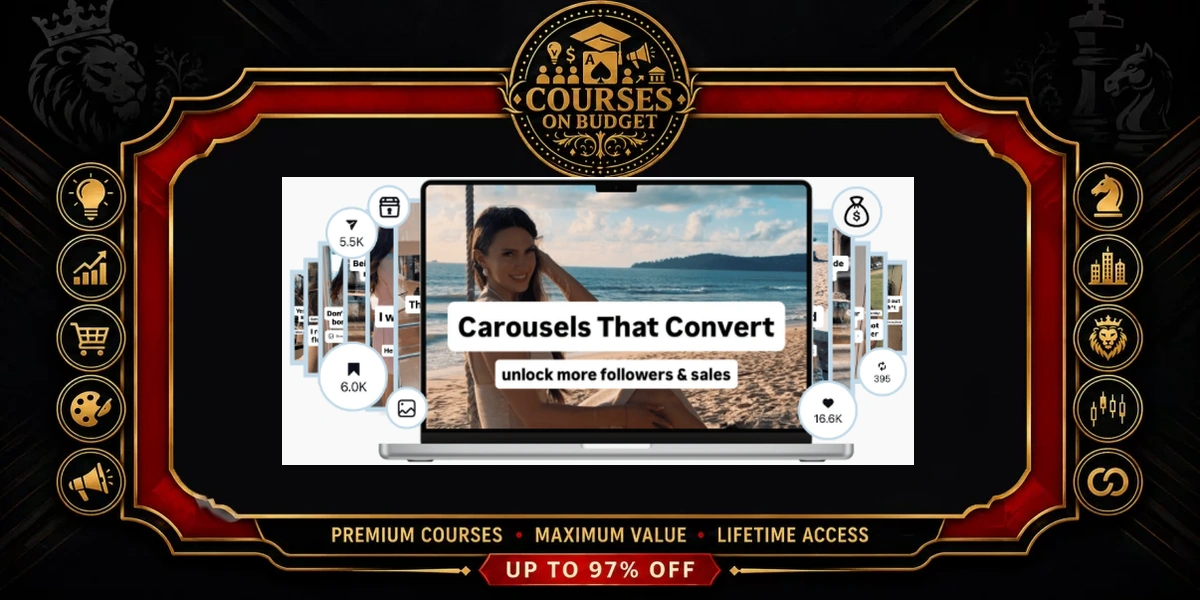
| Course | Carousels That Convert |
| Creator | Maria Wendt |
| Format | 8 modules · 25 videos (~2h 14m) · 1 PDF · 2.00 GB |
| Level | Beginner to intermediate Instagram creators and coaches |
| Core promise | Publish your first winning carousel before the course ends |
| Our take | A real operator’s playbook, flops included — strongest on hooks, slide 2 and story sourcing |
1. The big idea · 2. The decision chain diagram · 3. Worked example · 4. Six-lesson case study · 5. Hook lab · 6. The comment funnel · 7. Reach math · 8. Inside the index · 9. Self-test · 10. About the creator · 11. Verdict
The Big Idea: Low Effort In, Big Leverage Out
Carousels That Convert is built on one observation: carousels are the rare format where what you get back far outweighs what you put in. Maria Wendt says she needs no new filming and very little time, so she can make one anywhere. She posts one every day — seven a week, 31 in a month — and every single one falls into one of two jobs.
Nurture carousels (she also calls them storytelling carousels) win followers but rarely make money. Pitch carousels make money but rarely win followers. She almost split them into two separate courses, she admits, working from about seven pages of outlines, before deciding one course covering both made a better product.
The less obvious decision is the teaching order. Every carousel has two elements: the words (what you say) and the packaging (how it looks and is presented). Because packaging is “pretty much the same for both” types, while the words differ, the course teaches packaging first and only then splits into nurture words and pitch words.
“I put a lot of work into the hooks, but like the image is the first hook.” — Module 2, How To Pick The Right Image
The Carousel Decision Chain as a Diagram
Scattered across the eight modules of Carousels That Convert is one repeatable chain of decisions. Here it is in order, from the moment an idea appears to the moment it becomes four pieces of content:
notice an emotion
phone notes, no pushing
achieve · feel · do
keyword image + contrast
cover + slide 2
9 a.m. PST
email · Reel · Story
Steps 1–2: Ideas Come From Spikes, Not Brainstorms
She watches herself. An ordinary day runs flat; what she hunts for are the spikes — a flush of shame, a spike of love, a burst of rage. One example: she read a comment on her Reel, felt “a hot flush of shame” cover her face, and that feeling became a carousel about how we sometimes need to be triggered in order to grow. She also watches other people: if someone reacts with a “what?” moment in conversation, she logs it, because an in-person reaction predicts an online one.
“Pay attention to those spikes because your best stories are in those moments.” — Module 3, How I Come Up With Story Ideas
Steps 3–7: From Draft to Four Assets
Drafting happens later, in a place where she can “let your hair down”: for her, a four-hour session at one coffee shop, plus Ubers and planes. Then the packaging (an image that shows the story’s keywords, with enough contrast for the text), two hooks, a one-sentence caption and a 9 a.m. slot. The final step is what makes the effort pay: one finished carousel feeds an email, a Reel and Stories. Nurture and pitch posts simply alternate as she schedules the week.
Worked Example: A 5:30 a.m. Note Becomes a Nurture Carousel
The best way to understand the storytelling module is to follow one raw note all the way through. In Module 3 Maria Wendt opens her phone notes and shows an idea she wrote at 5:30 in the morning. Every row of the left column below is taken from the lesson; the last two rows apply the course’s own packaging and hook rules to it, because the lesson stops before the finished slides.
| Stage | The frugal-millionaires note |
|---|---|
| Raw note | “Last night I was talking to some friends. We’re all millionaires.” Plus one line: they had a long conversation about how frugal they all are. Nothing else is written. |
| The spike | Belonging — feeling seen and accepted, because she rarely meets people who live far below their means |
| Back story | No lifestyle creep: she says she lives on the same monthly amount as in 2019, drives the same paid-for car and has lived in the same apartment for seven years |
| What to achieve | Subtly show that people with money were good stewards before they had it |
| What NOT to do | Say it directly — that “is very easy to come across as judgmental.” Show the scene instead: millionaires at dinner, grateful for their frugality. |
| Hook check | She calls the note’s first line a good hook as is. It already carries a timeframe (“last night”), one of her Module 4 rules. |
| Packaging (rule applied) | Module 2’s rule says: list the keywords (friends, millionaires, frugal) and pick a photo that shows them — then fix the contrast behind the text. |
The lesson then shows why this “teach through a story” move transfers to any niche. Her fitness-coach example: telling people to eat less is about as helpful as telling them to stop spending money they don’t have. Instead, ask what you’re trying to achieve — a change in behaviour — and tell a story about a time you managed food well, or didn’t, that illustrates the lesson.
Two more filters sit on top. Keep the storyline simple, like the “based on a true story” notice in films where timelines are combined. And lean into what makes you different, not what you’re good at — a friend who lived on a boat for three years is her example of overlooked story material.
Case Study: One Storyline Traced Across Six Lessons
Her nose job surfaces in six different lessons of Carousels That Convert, each time illustrating a different rule. Read in sequence, it becomes a full case study of how one real-life event is mined for several carousels without ever feeling repetitive:
“Last week, my friend had a baby. I got a nose job. I would trade places with her in a second.” You can’t photograph “trading places”, and a photo of the friend would miss the point — the story is about not getting what you want. So the cover shows her at the doctor’s office in pajamas, signing a clipboard, old nose and all.
The friend is only referenced in the hook, yet Maria sent her the entire text before putting it on images, so the friend could edit it or say no.
“Why I’m getting a nose job this week” reached about 3,000 likes with an image ChatGPT made. She credits a sub-hook that is more intriguing than her weaker examples.
She shared what it cost and its pros and cons. On reveal day she was shaking at 9 a.m. and watching the clock to check comments — her signal that a post will be a good one.
The reveal photo had white stripes under white text. She asked ChatGPT to turn only the stripes navy, and only on the first slide, where contrast matters most.
“I’m finally ready to show you my new nose” with the sub-hook “The grand reveal”, the nose hidden for intrigue; slide 2 shows no face at all and opens with her nerves, so it works even for someone who sees it cold.
The takeaway is bigger than any single rule. One honest life event produced a teaser, a reveal and a story about timing — each with its own image logic, its own hook and its own ethical check. That’s how a daily posting rhythm stays fed, and it’s the part of this Maria Wendt Carousels Index Review we’d point any storyteller to first.
Hook Lab: What Her Flops and Rewrites Teach
The hook lessons are valuable because she shows misses next to hits. She tests placements in the Instagram Stories editor — usually one or two versions, and once three for the same ocean story: “It took me 21 years to see the ocean for the first time”, “I didn’t see the ocean until I was 21 years old” and “I saw the ocean for the first time when I was 21 years old”. She judges each on sound, readability and how it looks on screen.
| Hook from her feed | What she takes from it |
|---|---|
| “I made a decision to not date until my divorce was finalized” + “This is controversial” | The word “controversial” always catches attention — people “love the drama” |
| “I traveled to four countries in 10 days” + “I blacked out” | A short, shocking sub-headline draws the eye |
| “Yesterday I almost took revenge on someone” + abuse of power | Charged words — revenge, abuse, power — are eye-catching on their own |
| The ocean story, slide 2: “I grew up on a hay farm in Ohio” | Underperformed despite multiple images; her guess is that viewers couldn’t tell it was her in the photo |
| “Expensive things I own… and why they’re worth it” (saved from another creator) | “And why they’re worth it” kills the tension. Her rewrite for her own version: “How I wasted $80,000 last week as a millionaire” |
That last rewrite is a mini-lesson in tension. Her planned version lists money she “wasted” — around $70,000 on mentorship, a family trip to Disneyland — then turns it into gratitude. Everyone already knows some expensive things are worth it, she argues; how a millionaire wastes money is far more interesting.
The Comment-Keyword Funnel, Seen From the Inside
In Maria Wendt’s pitch carousels the “sale” is just a comment. A keyword comment sends people toward the offer — in her lesson example, her AI Money Maker course. What stands out is how much care goes into keeping that promise honest.
- Honest CTA wording: “Comment Moneymaker and I’ll show you what to do” is accurate, because the landing page does exactly that. “Comment to get a free copy of everything” would not be truthful.
- Point the way: a small graphic pointing in the swipe direction is “a little pro hack” for getting the swipe.
- Watch for keyword trains: one commenter types the wrong phrase (“awesome work”, “planner”), copycats follow, and the automation never triggers for them. She compares it to people at Disney World joining a queue without knowing what it’s for. Her fix is deleting stray comments early, and she gives the keyword in two places.
- Show something: a pitch without any visual element pulled about 1,000 comments; she counts the missing element as one of the reasons.
She’s candid about scale here. The keyword-train problem is driven by volume, so it’s far less likely on a small account. And her pitch for turning on Instagram bonuses came with a modest figure she gives as her own: $880 that month.
The Reach Math That Makes Repurposing Safe
Fear of repeating yourself disappears once you see her numbers. A strong carousel of hers reached about 165,000 views — on an account she puts at 800,000 to 900,000 followers. Most followers never see any given post, so she says she could republish it exactly as it was. A pitch carousel rebuilt as a two-swipe Reel reached a different crowd again: half of its views came from non-followers.
“If you’re going to put effort into anything, put effort into the content that is the foundation of all the other content.” — Module 6, Why Attention To Detail Is Everything
| Carousel part | Becomes… |
|---|---|
| Big headline | Email subject line, shortened when long (“I can’t date” instead of the full divorce hook); the Reel’s on-screen text |
| Sub-headline | Email preview text, written in lowercase, followed by a name tag for personalisation |
| Slide text | The email body (pasted into Google Docs) and the Reel caption, minus anything that refers to images |
| Finished draft | Duplicated in Instagram drafts, so a winner can be re-cut later with new footage |
For the Reel she uses about three seconds of existing footage, her filter, short hook text and music. Viewers read the long caption while the clip loops, which is why these Reels pick up views.
Know Your Speed Before You Chase Trends
Her save folder holds only 22 carousels. Her trend copies rarely work because, as a self-described slow mover, she’s never the second or third creator to post them. So she saves evergreen formats to reverse-engineer: “I’m 36 today. Here’s what I wish I knew at 26”, “11 things I wish I started 11 years ago”, timeline stories, and contrast lines like “Post everything, get judged. Post nothing, get judged.”
Inside the Carousels That Convert Index
The full file-by-file list is on the product page. Here’s the shape of it instead: 26 files, 25 of them videos, totalling about 2h 13m 32s. Almost a third of the runtime goes to storytelling — a clear signal of where Maria Wendt thinks carousels are won.
Four Files to Open First
- The Second Hook Nobody Talks About (Slide 2) — 6m 44s. The single most actionable insight; fix slide 2 on your next post.
- How To Pick The Right Image — 10m 35s. The keyword method for choosing a photo, with three before-and-after examples.
- The Simple Formula Behind Every Story I Tell — 11m 50s, the longest lesson. Her real notes app and the three questions she asks before writing.
- How To Repurpose Carousels Into Emails & Reels — 8m 35s. A screen-recorded walkthrough from notes to Google Docs to a scheduled Reel.
If you have only half an hour, those four files cover roughly 38 minutes and most of the method. In this Maria Wendt Carousels Index Review, they’re the ones we’d watch twice.
Self-Test: Would Your Next Carousel Pass Her Checks?
Six questions, all answered in the course. Decide before you click. Miss two or more, and this Maria Wendt Carousels Index Review has probably found your gap.
1. Why does slide 2 need its own hook?
Because a viewer who skipped the post may be served it a second time, starting from slide 2. An info dump there wastes that second chance.
2. How do you choose the cover image?
List the story’s keywords and pick a photo that visibly supports them. An old photo is fine if it fits; a random pretty one isn’t.
3. Which pitch CTA is better: “Comment X for a free copy” or “Comment X and I’ll show you what to do”?
The second. It’s truthful and ties straight into a landing page that shows people what to do.
4. Your story mentions your sister in one sentence. What now?
Send her the full carousel text first, make any changes she asks for, and drop the post if she says no.
5. How many slides does a pitch carousel need?
Two, “like 99% of the time”: something eye-catching, then a long paragraph with the ask. Her three-swipe test added about 30 minutes and performed only average.
6. You feel nervous posting a story. Good or bad sign?
Good, by her rule. If her fingers aren’t shaking, the post probably won’t be that good — as long as it’s your own story to tell.
About the Creator: Maria Wendt
At the time of filming, Maria says her Instagram account was close to a million followers and that she runs an eight-figure business she is working to scale to nine. She still makes every carousel herself, in the Instagram app, calling them her diary. She grew up on a hay farm in Ohio, was homeschooled all 12 years and talks openly about faith, divorce and single motherhood. She also runs a group coaching programme she calls the Inner Circle. Signature belief: “if my fingers are shaking as I go to post something, it’s a sign I should share it.”
How to Get the Course in 4 Steps
Instagram Growth
Maria Wendt — Carousels That Convert
The daily carousel system behind a near-million-follower account: nurture carousels for followers, pitch carousels for sales, image packaging, hooks and second hooks, repurposing and a live build in the native Instagram app.
- The Packaging — keyword images, contrast, one image or many
- Nurturing Carousels — story ideas, the three questions, vulnerability
- The Hooks — headline, sub-headline and the slide-2 second hook
- Pitch Carousels — three rules and the two-swipe format
- Pro Tips — save folder and repurposing into emails and Reels
- How To Make The Carousels — start-to-finish build
What to Learn Next
The course covers carousels end to end, but each part of the chain has deeper material in the catalog. Pick by the gap you feel most:
- Sharper copy behind the story: Maria Wendt — Words Into Money
- More hook practice for video: Kallaway — Short Form Hooks Workshop
- Turning carousel hooks into subject lines: Justin Goff — 13 Most Profitable Email Hooks of All Time
- A second view on carousel strategy: Squared Academy — Instagram Carousel Masterclass
Want the brand strategy that sits underneath her storytelling? Our Maria Wendt Profitable Personal Brand index review covers it.
- A complete decision chain, from emotion spike to four assets
- Real notes, real hooks and real flops shown on screen
- Slide-2 second hook and honest CTA wording few courses teach
- Clear ethics for vulnerable stories and other people’s privacy
- No paid design software needed
- Benchmarks come from a near-million-follower account
- Conversational, unscripted delivery with tangents
- No templates or worksheets — videos plus one PDF
- Built on personal stories; not for faceless pages
- Closing video is a pitch for her Inner Circle coaching
Maria Wendt Carousels Index Review FAQ
Does the Carousels That Convert method work on a small account?
The decisions do — image choice, hooks, slide 2 and honest CTAs don’t depend on size. Expect smaller numbers than hers, and note that she says problems like keyword trains are mostly a high-volume issue.
Is this Jordan Dooley’s Carousels That Convert?
No. The two courses share a title but come from different creators. Jordan Dooley’s version is listed separately as Jordan Dooley — Carousels That Convert.
Does Maria Wendt use AI to write her carousels?
No. She says ChatGPT can’t tell her story. She uses it to recolour clothing or walls for contrast, and once showed a hook image ChatGPT made, but she writes every word herself.
How long does the course take?
About 2h 14m across 8 modules and 25 videos. Storytelling takes the biggest share (40m 13s); the start-to-finish build runs just over six minutes.
How is the course delivered?
Digital files. Crypto payment only. Fast delivery is handled manually after payment confirmation. Download links remain available for 7 days; save your files locally.
Carousels That Convert is less a design course than a decision course. Notice the emotional spike, jot it down, write where you can relax, choose an image that shows the story’s keywords, earn the swipe twice, ask for the comment honestly — then squeeze an email, a Reel and Stories out of the same work. Maria Wendt shows her real feed, her notes and her misses, which makes the rules easy to trust and easy to copy. If you post on Instagram and want each post to work harder, this is a focused two hours.
Get it through Courses On Budget and build your first carousel this way before the last module ends.
Browse the category: Marketing Courses · Maria Wendt Courses · Marketing Courses Cheap List · Marketing Reviews
Platform used in the course: Instagram
Recommended course stack:
7 Maria Wendt programs in one place — instant download, forever license, no subscription.
Browse all Maria Wendt courses →