

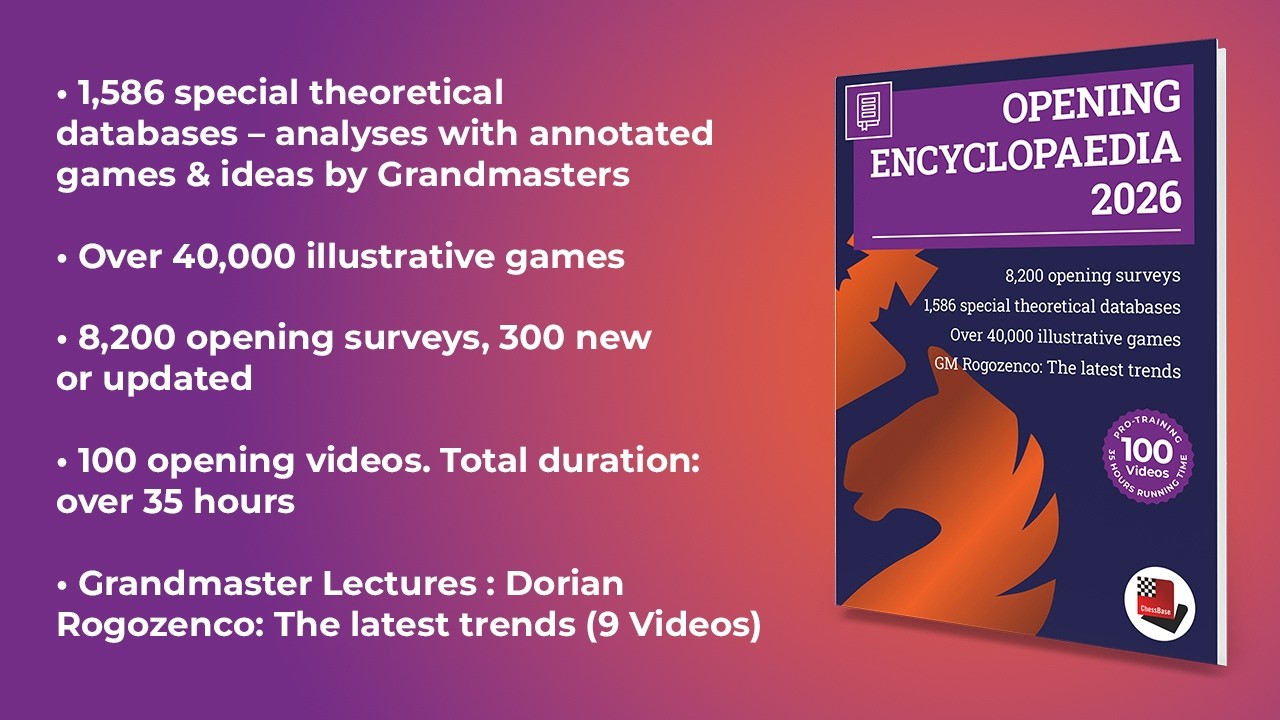
Opening Encyclopaedia 2026 Review: The Verdict in 60 Seconds
The Opening Encyclopaedia is not a course with a beginning and an end. It is a reference shelf: 1,586 theory databases written by titled players, thousands of surveys, model games and, in this package, more than 38 hours of video. Used well, it answers the question every tournament player asks before a game — what is the current state of this line, and who played it recently? Used badly, it is a hard drive full of files you never open. The 2026 edition earns its place mainly through fresh video: ten trend lectures on the period from February 2025 to February 2026 and a large block of recent ChessBase Magazine clips.
Coverage is perfect: every ECO code from A00 to E99 has articles. Freshness gets an 8, because the videos are new while most theory articles are years old (see the chart below). Structure and practice value score lower for honest reasons — there is no guided path and no test section, so you must bring your own method. This Opening Encyclopaedia 2026 review gives you one. For single-author opening courses instead, browse our chess courses list.
Meet the Lead Presenter
- Born 1973 in Chișinău; plays for Romania
- Olympiad player for Moldova (1994, 1996, 1998) and Romania (2000)
- Author of Anti-Sicilians: A Guide for Black (2003) and The Sveshnikov Reloaded (2005)
- Presents the ten trend videos of this edition, per ChessBase
His background shows in the Sicilian lecture. The author of a book on the anti-Sicilians argues that only one of them is still a real test for Black: the Rossolimo with Bb5 after …Nc6, which at the top level scores around fifty percent for White and is chosen mainly to avoid the Sveshnikov. The other 91 videos come from ChessBase Magazine authors, led by Mihail Marin and Daniel King; Rogozenco adds the overview. ChessBase quotes him calling the encyclopaedia “the best product around in the field of opening theory” — the publisher’s own author, so read that as an opinion.
How to Get the 2026 Edition
Who Presents the 38h 28m, and How Fresh Is the Theory?
The product page sorts the videos by opening family. For this Opening Encyclopaedia 2026 review we asked two other questions. First, whose voice will you actually hear? Marin alone records about 15% of the runtime, and Mikhalchishin contributes sixteen short extras that average under seven minutes. Second, how recent are the written articles? We read the date in every theory file name — the result is the second chart.
The age chart is the most useful thing to know before you buy. Only about one article in twenty is dated 2025 or 2026, and roughly 30% were written before 2010. That is not a flaw in a reference work — the Ruy Lopez structures of 2008 still matter — but it means the videos, not the articles, carry the 2026 news. The B-codes, home of the Sicilian and Caro-Kann, are the largest group with 410 articles.
A Worked Example: the New Look of the QGD Exchange
The best test of a trend lecture is whether it changes how you play a familiar line. Rogozenco’s Queen’s Gambit video does exactly that with one of the oldest structures in chess, and it is the example we would show anyone who asks for an Opening Encyclopaedia 2026 review in one page.
- Start from a fact, not an opinion. When White has already played Nf3 and then exchanges on d5, the traditional move is Bg5. In 2025, Rogozenco notes, not a single top-level classical game featured it; White developed the bishop to f4 instead.
- Explain why. After …c6, e3 and …Bf5, recent games found new ideas with Nh4, and they work better when the bishop stands on f4. One line, where …Nh5 hits both h4 and f4, is met by h3, and the engine still gives White chances.
- Switch to the other branch. With the knight still on g1, White develops it to e2 later. Here Black’s modern treatment includes an early …h6 and Bh4, and even a queenside expansion with …b5 that “looks completely antipositional” yet was played in 2025.
- Show White’s answer. In Rodshtein–Sargissian from the World Cup, White pushes the a-pawn instead of preparing the classical b4 minority attack. The real plan is f3 and e4; if Black replies …a5, the usual …c5 counterplay loses appeal because the b5-square becomes available to White’s pieces.
- Draw the lesson. The game was a fresh position, close to equal, and Black held. The point is not a refutation but a new map of an old structure.
That is the method of all ten trend videos: statistics from top events, the reason behind the shift, one or two model games and an honest evaluation. You then open the matching theory article and surveys in the databases to go deeper.
Second Example: Ding’s London, Expanded Into a System
Daniel King’s video on the London System shows how a ChessBase Magazine clip differs from a trend lecture. He starts from game 6 of the Ding–Nepomniachtchi World Championship match, where Black took on d4 and played …Bf5 to deny White’s bishop its best diagonal. Ding answered with Bb5, the bishops on d6 and f4 came off, and the game turned on two outposts: e5 and c5.
King then widens the picture with games by Gata Kamsky, whom he calls the real specialist in this system. White gains ground on the queenside, plays Qf3 to protect c3 so that b4 can follow, and tries to land a knight on c5; only after that does the attack on the king begin, as Ding’s h-pawn showed. King adds that the same structure is a sound choice for Black too, which makes the video useful for both sides of the London.
The Index, Turned Into Study Routes by Goal
The complete video and database index is on the course page. A list of 101 videos does not tell you where to begin, so for this Opening Encyclopaedia 2026 review we grouped real titles by the repertoire problem they solve. Runtimes are measured from the files; each route takes two to four evenings, followed by the theory articles for the same ECO codes.
| Your goal | Watch | Video time | Then open |
|---|---|---|---|
| Get the 2025–26 overview | All ten Rogozenco trend videos | 228 min | Articles dated 2025–2026 |
| Update 1.e4 e5 for Black or White | Rogozenco Petroff + Italian, Kasimdzhanov Two Knights + Petroff, King Petroff, Marin Open Spanish, Ris Delayed Exchange | 198 min | C42–C99 articles |
| Play the Najdorf | Rogozenco Sicilian, Engel 6.Bd3 I–II and 6.h3, Marin 6.f4, Zwirs on Van Foreest–Giri | 163 min | B90–B99 articles |
| Hold the QGD and Slav | Rogozenco QGD, King QGD Exchange, Mendonça QGD, Sokolov Slav and D17, Bauer Marshall Gambit | 162 min | D10–D69 articles |
| Play or meet the London | King on Ding and Kamsky, Bauer Anti-London, Werle London, Marin Queen’s Pawn with e3 | 141 min | Surveys for D02/A46 |
| Defend with the Caro-Kann or French | Rogozenco Caro-Kann + French, Ris Advance …f6, King 5.Nxf6 exf6, Marin and Mendonça on the French Advance | 160 min | B12–B19, C02 articles |
| Fight 1.d4 with Indian defences | Rogozenco KID + Nimzo, Marin KID Fianchetto, Werle Nimzo 4.f3 and Classical KID, Engel Nimzo Bd2 | 176 min | E20–E99 articles |
Six videos appear in both video folders, so do not be surprised by repeats; the 101 unique files above are the real count. And keep a notebook: the trend lectures name the games, and the games database lets you replay them with the engine running.
Opening reference · Club to master
ChessBase — Opening Encyclopaedia 2026
Theory databases for every ECO code, opening surveys, Opening Tutorials and 101 unique MP4 videos, including the 2025–26 trend lectures. The complete database and video index is on the product page.
Test Yourself: Four Questions From the Videos
This part of our Opening Encyclopaedia 2026 review checks whether you are following current theory. All four answers come from the videos; if you know them, the trend lectures will feel like a quick update, and if not, they are where to start.
1. In the QGD Exchange with Nf3 already played, which bishop move replaced Bg5 at the top level in 2025?
2. Why does Rodshtein’s a4 make …a5 less attractive for Black?
3. Which anti-Sicilian does Rogozenco call the only serious challenge for Black?
4. In Daniel King’s London video, which square does White want for a knight before turning to the kingside?
Opening Encyclopaedia 2026 Review: Strengths and Gaps
Lecturers who argue with the engine
The trend videos never simply read engine numbers. In the King’s Indian lecture Rogozenco admits the computer shows a White edge in almost every line, then shows why young elite players keep choosing it and scoring well, and he calls the claim that the opening is simply losing “completely wrong”. In the introduction he explains why so many new ideas appear: the engines rate almost everything as equal, so sidelines are as playable as main lines.
A reference that rewards a method
The databases are the long-term value: one article per line, with annotated games showing typical plans, plus the surveys and the Opening Tutorials for choosing an opening. They need ChessBase or Fritz, and their worth depends on how often you prepare. A player who studies one opening per month gets far more from the package than one who watches a few videos and stops.
Where the package stops
Any honest Opening Encyclopaedia 2026 review has to name the limits. There are no exercises, no repertoire chosen for you and no guarantee that an article reflects the latest games. If you want one coach to pick the lines, Kasimdzhanov’s Trends in the Modern Openings or a single repertoire such as Power Play 23: a QGD repertoire for Black is the better fit. If you mainly want games, the Mega Database is the tool.
Which Opening Product Should You Pick?
The store carries several editions and many single-author repertoires, so we end this Opening Encyclopaedia 2026 review with a short buyer’s guide. The table matches each product to the job, and every title links to its own file list.
| If you need… | Choose |
|---|---|
| Current theory plus the 2025–26 trend lectures | ChessBase — Opening Encyclopaedia 2026 |
| The same reference format, earlier season | ChessBase — Opening Encyclopaedia 2023 |
| A large game collection for preparation | ChessBase — Mega Database |
| A guided tour of modern opening trends | Kasimdzhanov — Trends in the Modern Openings |
| A ready repertoire against 1.d4 from a video author of this edition | Marin — Semi-Tarrasch: A Universal Weapon |
- Articles for every ECO code, A00 to E99
- 101 unique videos, 38h 28m
- Ten fresh trend lectures on February 2025 to February 2026
- Strong video authors: Marin, King, Sokolov, Kasimdzhanov, Ris
- Works inside ChessBase for real preparation
- Databases need ChessBase or Fritz on a PC
- Only about 5% of articles are dated 2025–2026
- No exercises and no guided study path
- Six videos are duplicated across the two folders
FAQ
Is this Opening Encyclopaedia 2026 review based on the real files?
Yes. Video counts and runtimes come from the 101 unique MP4 files, the article counts and dates from the theory folder itself, and the examples and quotes from the video transcripts, checked against ChessBase’s own announcement.
Do I need ChessBase to use it?
For the databases, yes: the theory articles, surveys and tutorials open in ChessBase or Fritz. The videos are ordinary MP4 files that play on any device.
Is the 2026 edition worth it if I own an older one?
Mostly for the new material: the ten 2025–26 trend lectures, the recent ChessBase Magazine videos and the newest theory articles. If you rarely use the databases, an older edition still covers the classical lines.
How is the course delivered?
Digital files. Crypto payment only. Fast delivery is handled manually after payment confirmation. Download links remain available for 7 days; save your files locally.
Our Opening Encyclopaedia 2026 review sees a strong reference with a clear centre of gravity. The databases give you a dated article for every opening and the surveys to check it; the videos — above all Rogozenco’s trend lectures and the recent ChessBase Magazine clips by Marin and King — tell you what changed this season. At 8.2 out of 10 it is the right tool for a ChessBase user who prepares regularly, and less useful for anyone who wants a teacher to choose the lines.
Pick one study route, check the complete index and order the edition from Courses On Budget — after checking the coupons page.
Browse the category: Chess Courses · Chess Courses Cheap List
Video authors on COB: Daniel King · Mihail Marin
New releases: Courses On Budget updates
External resource: en.chessbase.com (official announcement)
About the presenter: Dorian Rogozenco on Wikipedia
Recommended course stack: