

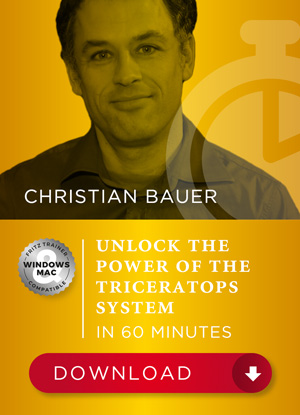
Triceratops System Review: The Verdict in 60 Seconds
After 1.d4 Nf6 2.Nf3 g6, Bauer plays 3.Nbd2 and keeps the c-pawn at home. The appeal is economy: instead of learning the King’s Indian and the Grünfeld separately, you prepare for three Black replies — 3…d5, 3…Bg7 and 3…c5 — and get rich positions with few early exchanges. The three theory chapters are dense and well chosen, full of games from 2018–2024. What you do not get is training material: there are no tests, and some lines move quickly through many games. It is a well-built starter kit, scored as one.
Structure scores well because each Black reply gets one chapter of almost equal length. Depth reflects the format: 76 minutes cannot go deep into three systems. Practice value is the weakest mark, since there are no exercises, and the PGN file earns the study-files score. For a broader 1.d4 set-up to pair it with, see our chess courses list.
Meet the Coach
- French grandmaster, born 1977
- French champion in 1996, 2012 and 2015
- Author of opening books including Play 1…b6, The Philidor Files and Play the Scandinavian
- Also wrote Candidate Moves: A Grandmaster’s Method (2018), per Wikipedia
Bauer has spent much of his career writing about offbeat but sound systems, and this course has the same flavour. It also has a practical edge: he still plays the line himself. In the 3…d5 chapter he explains exactly what he prepared for a game against Maxime Vachier-Lagrave, based on a rapid game the French star had played against Yuri Kuzubov — a rare look at real grandmaster preparation inside a one-hour course.
How to Get the Course
Where the 76 Minutes Go
The product page lists the five files. For this Triceratops System review we looked at how evenly the time is spread, because in a 60 Minutes course balance matters more than length. The answer is very even:
Bauer says 3…d5 is Black’s most popular reply, because it stops e4 for good, so that is where we suggest you start rather than following the file order. The study path we recommend looks like this:
Worked Example: The 5.e4 Surprise Against 3…c5
The most practical idea in the course is a surprise weapon, and Bauer recommends it mainly against opponents who are not well prepared. After 3…c5 he considers 4.dxc5 the only serious move. Against 4…Qa5 the main line is 5.a3, but 5.e4!? sets real problems. Here is the line he walks through, step by step:
- Spot the open diagonal. Black’s bishop has not reached g7 yet, so the long diagonal from b2 to h8 is the target. Every white move in this line works towards it.
- Gambit the pawns. After 5…Nxe4, White plays 6.b4!, deflecting the queen: 6…Qxb4 7.Rb1 Qa5 8.Rb5, hitting the queen again with gain of time.
- Avoid the trap. 8…Qxb5? is a mistake: 9.Bxb5 Nc3 seems to win the white queen, but 10.Bb2! Nxd1 11.Bxh8 leaves White much better.
- Assess the main line. The better 8…Qa4 9.Bb2 Rg8 10.Nxe4 Qxe4+ 11.Be2 leaves White a pawn down but with a big lead in development, and Black’s king has no obvious safe place now that the rook has left h8.
- Know the alternative. Black can also take on c5 instead of e4; then White chooses between the sharp e5 and the calmer Bd3, with play for development in both cases.
The lesson is not that 5.e4 refutes anything — Bauer gives the engine assessments honestly, and some lines are only “objectively a bit better for Black”. The point is that a quiet-looking system can still contain a sharp option you can choose on the day, depending on your opponent.
Second Example: Black’s …a5 Plan Against the b4 Squeeze
Against 3…d5 4.e3 Bg7 5.b4, White’s plan is to gain queenside space and put the bishop on the long diagonal. Black can strike first with …a5, …b5 and …c5. Bauer shows how Jan-Krzysztof Duda handled it against Vachier-Lagrave in a 2023 rapid game in Berlin: White exchanged on c6 and, because of Black’s move order, placed his bishop on a3 in one go instead of going b2 and then a3. After Black castled, put a rook on e8 and played …e5, Duda took on e5 and brought a rook to b1 to target the weakened b-file.
For our Triceratops System review, Bauer’s next comment is what makes the example useful. He adds the alternative: c2–c4 at the right moment, trading the weakness on d5. The knight that recaptures on c4 can later jump to b6 or d6. That pattern — b4, an exchange on c6, and then a timely c4 — runs through the whole chapter, and in the Fedoseev–Nepomniachtchi game you see where it leads: White’s bishop on a3 outshines Black’s g7-bishop, which is left staring at a well-protected d4-pawn.
The Index, Turned Into a 3-Session Study Plan
The course page lists every file in order. Following that order is not the best way to learn, so for this Triceratops System review we rearranged the chapters by how often you will face them. Three sessions of under 30 minutes of video each are enough; the real work is replaying the PGN afterwards.
| Session | Watch | Video time | Then do |
|---|---|---|---|
| 1 | Introduction + 3…d5 chapter | 27:02 | Replay the b4 / Ba3 / c4 games from the PGN |
| 2 | 3…Bg7 chapter | 26:07 | Note when d5 gains a tempo and when to close the centre |
| 3 | 3…c5 chapter + conclusion | 22:58 | Play the 5.e4 gambit out against an engine |
Anti-King’s Indian · 60 Minutes
GM Christian Bauer — The Triceratops System
Five videos on 1.d4 Nf6 2.Nf3 g6 3.Nbd2 against 3…d5, 3…Bg7 and 3…c5, with a PGN file of the lines. The complete file index with sizes is on the product page.
Test Yourself: Four Questions from the Chapters
For the practical part of this Triceratops System review, here are four questions taken from the videos. If you know the answers, you already understand the system’s logic and the course will mostly add model games. If not, they show what the hour will teach you. Tap a question to reveal the answer.
1. After 3…c5, why does Bauer reject 4.c3?
2. After 3…Bg7 4.e4 d6 5.Bb5+ Nc6, why not push d5 at once?
3. With 5.Bd3 and both sides castled, Black plays …c5. What does White usually do?
4. Against 3…d5 4.e3, which rare reply does Bauer find reasonable, and how often had it been tested?
Triceratops System Review: Strengths and Gaps
Current, elite model games
For a short course, the game selection is impressive. The chapters draw on Carlsen, Aronian, Grischuk, Gelfand, Nepomniachtchi, Vachier-Lagrave, Navara and Kuzubov, with many games from 2018 to 2024. Bauer often comments on where a top player could have improved — for instance noting, with the engine, that h3 or Qb3 would have been a bit better than Rc1 in an Aronian game — which keeps the material from being just a game list.
Honest assessments
Bauer rarely claims more than a slight edge. He calls several lines “very close to equal” and describes many final positions as balanced. That honesty helps: you know this is a system for rich, playable positions, not a forced advantage. Any fair Triceratops System review should make that expectation clear.
Where the course stops
There are no exercises, the chapters move fast through many games, and the course only covers …g6 set-ups after 2.Nf3. You will need separate answers to 1…d5 and 2…e6. If you want a complete low-theory 1.d4 repertoire around it, look at Keep It Simple: 1.d4; if you want a system with test positions, the London System with 2.Bf4 Reloaded also offers an attacking 3.Nc3 answer to …g6.
Which Anti-King’s Indian Course Should You Pick?
Several courses in the store offer a way around heavy King’s Indian and Grünfeld theory. Here is how they compare; every title links to the product page with its full file list.
| If you need… | Choose |
|---|---|
| One quiet formation against KID and Grünfeld in about an hour | Bauer — The Triceratops System |
| A London System with test clips and a 3.Nc3 line against …g6 | Williams — The London System with 2.Bf4 Reloaded |
| The Réti positions the introduction compares with | Ramirez — The Reti: A Flexible Attacking Opening |
| A full, straightforward 1.d4 repertoire | Sielecki — Keep It Simple: 1.d4 |
| A practical 1.d4 repertoire for White | Krykun — 1.d4 Practical Repertoire for White |
- Three Black replies, one formation — very little to memorise
- Evenly balanced chapters of 21–26 minutes
- Recent model games from elite players
- A sharp 5.e4 option inside a quiet system
- PGN file with the lines
- Only 76 minutes — an overview, not a full repertoire
- No exercises or tests
- Covers only …g6 set-ups after 2.Nf3
- Some chapters move fast through many games
FAQ
Is this Triceratops System review based on the real course?
Yes. Runtimes come from the five video files, and every line, example and quote comes from the full transcript, checked against the official ChessBase page.
Is an hour enough to play the system?
Enough to start. Three short sessions cover the plans; replaying the PGN and a few practice games against an engine will make the lines stick.
Does it replace a full 1.d4 repertoire?
No. It answers King’s Indian and Grünfeld players after 1.d4 Nf6 2.Nf3 g6. You still need lines against 1…d5, 2…e6 and other set-ups.
How is the course delivered?
Digital files. Crypto payment only. Fast delivery is handled manually after payment confirmation. Download links remain available for 7 days; save your files locally.
Our Triceratops System review comes out positive, with clear limits. In 76 minutes Bauer gives you a coherent way to sidestep two of Black’s most theoretical defences, a sharp 5.e4 option, and a set of current elite games to learn from. At 7.0 out of 10, it is a strong 60 Minutes course — just treat it as a starting point and add practice of your own.
Get the videos and PGN through Courses On Budget, and visit the coupons page before you check out.
Browse the category: Chess Courses · Chess Courses Cheap List
New releases: Courses On Budget updates
Official page: shop.chessbase.com (Unlock the Power of the Triceratops System)
About the coach: Christian Bauer on Wikipedia
Recommended course stack:

