
What Is Yanovsky Management OS?
Most owners never fail at hiring a manager — they fail at teaching one. The course opens with a conversation the instructor says he has more than any other: “Did you teach him how to do it?” Usually the answer is no, because the schedule, the recipes, the vendor numbers and the standards all live in the owner’s head. Every new manager gets a title, a set of keys and a guess.
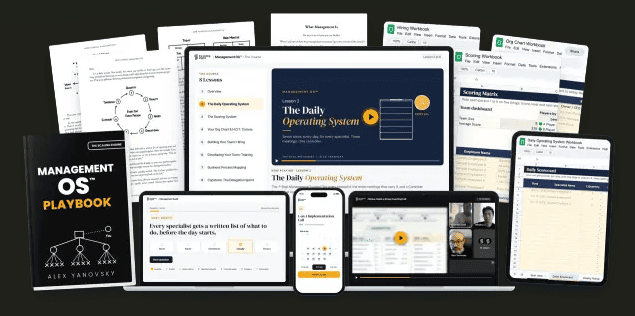
Yanovsky Management OS replaces the guess with a system your managers run every day. It defines management in one sentence — put a number on what happened, work out why, and decide what happens tomorrow — and then installs that order (result → analysis → action) through a daily scorecard, an employee scoring matrix, an honest org chart, a hiring pipeline, a 30-day manager ramp, written process maps and a final delegation sprint. Each lesson produces a tool, and the 16 tools live in seven workbooks that open in Google Sheets.
If you are comparing systems, this pairs naturally with the five-meeting management playbook inside Donald Miller’s Business Made Simple, while Yanovsky Management OS goes deeper on frontline scoring and manager development for multi-shift operations.
Instructor card
- States in Lesson 1 that he scaled Sushi Master to 735 locations, 10,000 employees, $200 million a year in sales and a $509 million valuation.
- Every location, he explains, ran on the same daily discipline — the seven-step system taught in Lesson 2.
- The hiring lesson includes material from Wesley Lee, who runs a multi-location restaurant group and built its high-volume hiring system.
- The bonus section records Alex teaching the 7-Step system live plus two real group coaching calls.
The Seven-Step Daily Scorecard
Lesson 2 is the part your managers can start running tomorrow. Every day, each first-level manager (the course calls them M1) scores every specialist on seven things. It takes about five to seven minutes per person. Steps 1–3 measure effort, steps 4–5 measure results, and steps 6–7 turn the numbers into a decision.
Worked example: one server, one Tuesday dinner
| Step | What the scorecard shows | Why it matters |
|---|---|---|
| 1 · Quantity | 8 of 10 tasks done — “didn’t finish side work, late rush at nine” | The note is where the coaching happens |
| 2 · Quality | Excellent | Effort and quality are judged separately |
| 3 · Hours | Worked 7 of 8 scheduled hours | Productivity, not presence |
| 4 · Operational | Plan 45-minute table turns, actual average 62 (from the POS) | The number comes from the system, not the person |
| 5 · Financial | Plan $1,200 in sales, actual $980 | Plan against fact, every shift |
| 6 · Category | Suggested by the sheet, confirmed by the manager | Feelings stop deciding who stays |
| 7 · Tomorrow | Shadow the fastest server for two hours on efficiency | Result → analysis → action |
The Employee Scoring Matrix and H.O.T. Canvas
Lesson 3 rates the whole person on five equally weighted criteria — work ethic, performance, learning ability, independence and teamwork — on a 1–5 scale. The plain average drops everyone into a level, and the course then adds a second read: results against effort. Two people can both score 2.6; a hard-working new hire who improves every week gets investment, a year-long employee who isn’t trying gets an exit plan.
| Level | Average score | What you do |
|---|---|---|
| A player | 4.5 – 5.0 | Promote, reward and protect |
| B player | 3.8 – 4.4 | Keep coaching and developing |
| C player | 3.0 – 3.7 | Targeted training and regular feedback |
| D player | 2.0 – 2.9 | Written improvement plan with goals and a deadline |
| E player | below 2.0 | Performance process and a replacement plan |
Lesson 4 then makes you draw the org chart you actually have — including the dotted lines where people technically report to a manager but text you anyway. In the course example, 11 of 14 people have a line straight to the owner. The H.O.T. Canvas (Hats, Outcomes, Tasks) fills in what flows through those lines and flags four problems: hats with no outcomes, outcomes with no owner, one person wearing five or more hats, and overlap. The Replacement Ladder ranks which seat you hire for first.
“Built is an event. Running is the business.”
— Lesson 8, Capstone — The Delegation Sprint
Hiring, Training and Process Maps: The Numbers
- Hiring math (Lesson 5): roughly 200 candidates to make three or four hires, $350–$450 to acquire each inbound hire and about $2,000 more to train them — so a hire who walks out in month two has cost around $2,400. Inbound engines are for frontline roles; outbound is for managers.
- The 30-day M1 ramp (Lesson 6): week 1 learn the systems, week 2 run with support, week 3 run solo, week 4 own the shift result. Each week earns the next.
- Process maps vs. SOPs (Lesson 7): two to three hours to document a process once, against 312 runs a year for a process that happens six times a week. The first three maps: opening and closing, front-of-house service flow and back-of-house production.
- The Delegation Sprint (Lesson 8): an audit of 16 deliverables — not “does it exist” but “did it run last week”.
- Org math (bonus call): about one manager per ten specialists — 100 specialists need 10 M1s and one M2; 1,000 specialists need 100 M1s, 10 M2s and one M3.
Complete Yanovsky Management OS File Index
Every file in the Yanovsky Management OS download, grouped the way the course is installed. Lesson videos and their slide PDFs are merged into one line; runtimes come from the recordings.
- 01. Take The System Audit · PDF
- 01. Overview · Video · PDF · 12m 34s
- 02. Copy of Daily Operating System Workbook · XLSX
- 02. The Daily Operating System · Video · PDF · 15m 52s
- 03. Copy of Scoring Workbook · XLSX
- 03. The Scoring System · Video · PDF · 10m 51s
- 04. Copy of Org Chart Workbook · XLSX
- 04. Your Org Chart H O T Canvas · Video · PDF · 15m 28s
- 05. Building Your Team Hiring · PDF · Video · 19m 02s
- 05. Copy of Hiring Workbook · XLSX
- 06. Copy of Training Workbook · XLSX
- 06. Developing Your Team Training · PDF · Video · 15m 26s
- 07. Business Process Mapping · Video · PDF · 16m 24s
- 07. Copy of Process Mapping Workbook · XLSX
- 08. Capstone The Delegation Sprint · PDF · Video · 6m 58s
- 08. Copy of Capstone Checklist · XLSX
- 01. The Management OS Playbook · PDF
- 01. Book Your Free 1-on-1 Implementation Call · DOCX
- 01. The 7-Step Management System · Video · PDF · 40m 35s
- 02. Group Coaching Call- The Employee Scoring Matrix · Video · 5m 15s
- 03. Group Coaching Call- The Org Chart · Video · 5m 03s
- 01. Inside the Accelerator · PDF
Digital files. Crypto payment only. Fast delivery is handled manually after payment confirmation. Download links remain available for 7 days; save your files locally.
A store-wide coupon is currently active — see the coupons page before checkout. New arrivals are posted on the updates page.
Is Yanovsky Management OS Right for You?
- Restaurant owners still standing on the floor every shift
- Multi-unit operators promoting cooks and servers into shift leads
- Owners who rate staff “by feel” and want one honest number
- Operators who need SOPs and process maps written for the first time
- Solo businesses with no staff to manage
- Anyone wanting a long theory course — the core runs under two hours
- Readers who expect the 1-on-1 call or the Accelerator inside the files
- Non-hospitality teams unwilling to translate restaurant examples
- Action → analysis → result
- Result → analysis → action
- Analysis → action → result
Show the answer
- A player
- B player
- C player
Show the answer
- Targets
- Training
- Tasks
Show the answer
Yanovsky Management OS Pros and Cons
- Every lesson ends in a concrete tool — 16 tools across 7 workbooks
- Real operating numbers instead of motivation (scorecards, hiring cost, ramp)
- Short enough to install in a week; the playbook includes a worked restaurant example and a printable checklist
- Bonus live teaching plus two real group coaching calls
- Examples are restaurant-specific throughout
- Depth lives in the workbooks and playbook rather than long video
- The 1-on-1 call and the Accelerator are offers referenced in documents, not recordings
- Requires daily discipline from managers — the course says so itself
Yanovsky Management OS — FAQ
Is Yanovsky Management OS only for restaurants?
What software do the Yanovsky Management OS workbooks need?
How long does Yanovsky Management OS take to go through?
Is the 1-on-1 implementation call included?
How is it delivered?
Yanovsky Management OS is short, specific and unusually tool-driven. If your restaurant only runs while you stand in it, the seven-step scorecard and the Scoring Matrix alone change how your managers spend their first five minutes every day — and the playbook gives you the full installation order in one document.
Get the complete file set — lessons, workbooks, playbook and bonus calls — through Courses On Budget, and check the business courses list for more operations training.
Browse the category: Business Courses
All business courses: Business Courses Cheap List
New releases: Updates page
Recommended course stack:




Reviews
There are no reviews yet.