
Most traders who try to trade pullbacks with options do the same thing: they spot a clean bull flag, buy a short-dated call, watch the stock go exactly where they predicted — and still lose money. Adam Grimes has been trading for roughly 25 years and teaches the exact mechanics that fix this. All three of his programs are available on Courses On Budget.
Why Being Right About Direction Is Not Enough
There is a specific failure mode that ruins more pullback trades than bad chart reading ever will. Grimes describes it from his own early career: he believed a market was going up, he bought calls, the market did go up — and the position still lost money. The reason had nothing to do with analysis. It was the math of the instrument. Time decay is a guaranteed, baked-in cost that starts working against a long option the moment it is opened.
This matters because pullbacks are, by nature, short-duration trades. A quick pullback might resolve in two days. A long hold for a daily swing trader is around ten trading days. Traders almost never hold a pullback for three months. So the question is not “should I use options” in the abstract — it is “which option structure survives a two-to-ten day holding period without decay eating the edge?”
That is the entire subject of this guide. It draws on material from three programs — the Pullbacks Masterclass, the full Options Course, and The Art and Science of Trading — and lays out the workflow end to end, from chart pattern to filled option position.
Step 1 — Qualify the Pullback Before You Think About Options
No option structure rescues a bad setup. Grimes is blunt about this in The Art and Science of Trading: we are not trading the pattern itself. The chart is a representation, not the market. What is actually being traded is the buying and selling imbalance that produced the shape on the screen. That distinction is why the same visual pattern can be a high-quality trade in one context and garbage in another.
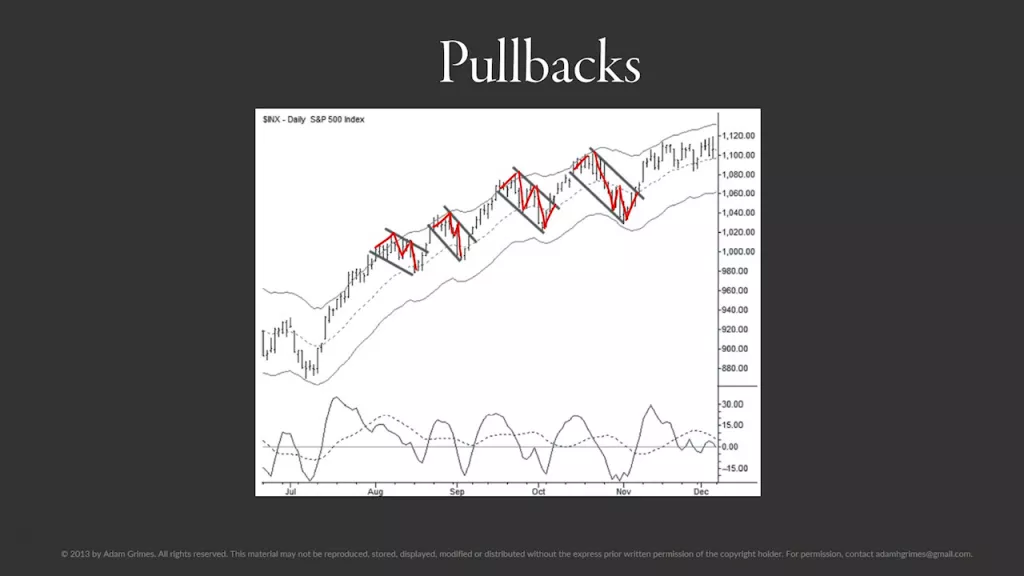
He separates pullbacks into simple pullbacks — market moves up, comes off, goes higher — and complex pullbacks, which take two or more legs to resolve. He also flags the nested pullback, where a pullback on the daily is simultaneously the first pullback after a breakout on the weekly, and the reluctant bounce, where price drifts sideways after a move rather than snapping back violently. A vicious snapback is a lower-quality candidate than a market that goes quiet and then rolls over.
Equally important: pullbacks fail in recognisable ways. A flat failure is when you enter and price simply goes nowhere. And critically, many “failed” pullback trades are not failures at all — they are the pattern turning into a complex pullback. Recognising that in real time is what allows a trader to limit the loss instead of panicking out at the worst point.
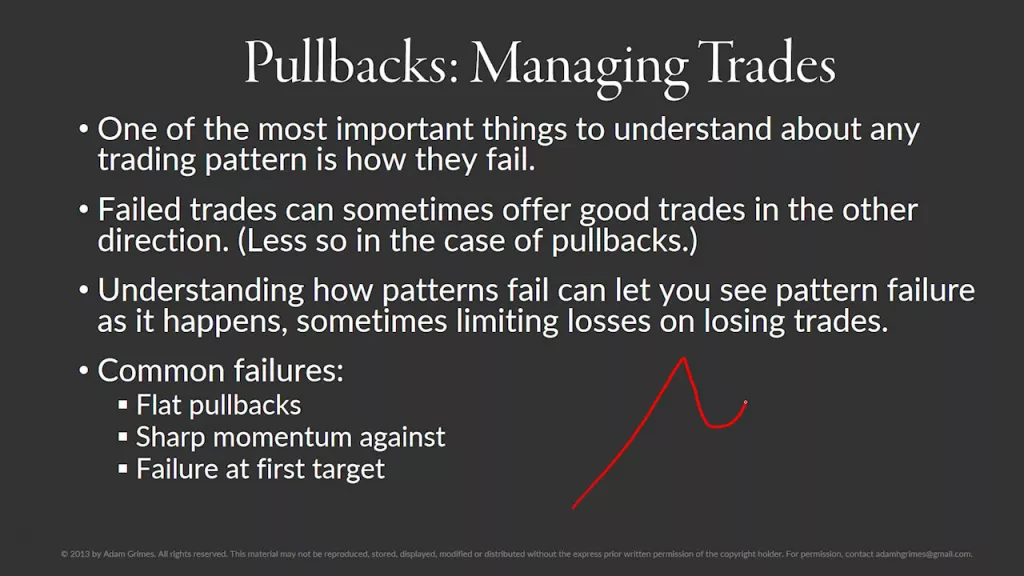
The five mistakes Grimes hammers in the Masterclass are worth memorising before any option is bought:
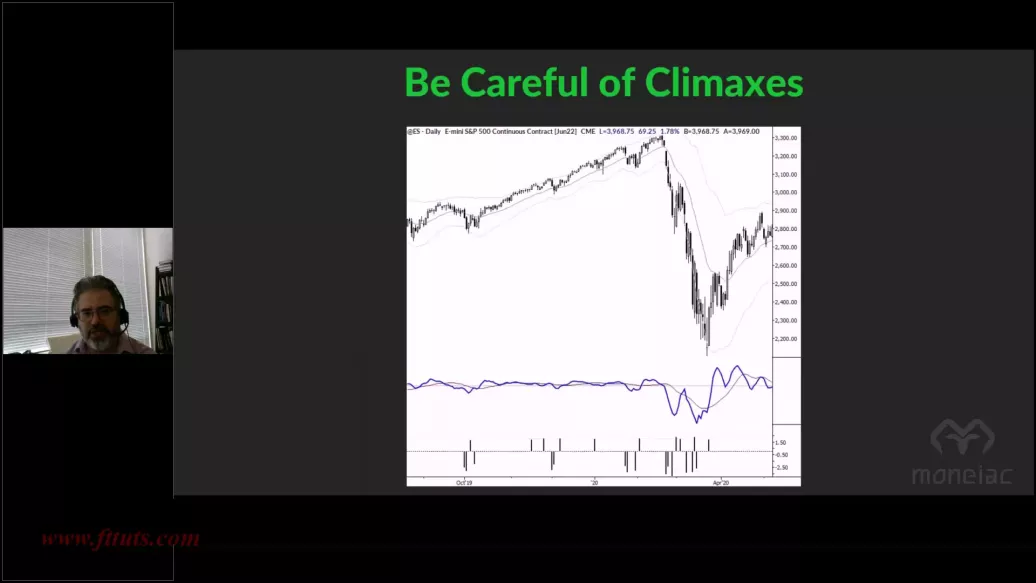
- Trading pullbacks after climaxes. His very first trade ever was this mistake — a huge move in wheat, followed by what he thought was a pullback. It was not.
- Trading too big. The fastest way to destroy an account in one or two trades.
- Being too early or too late. Too early is more common, driven by fear of missing out.
- Overstaying. Holding long after the pattern has done its work.
- Ignoring failure signals on entry. The market often tells you immediately.
If you want a second, indicator-based lens on the same pattern, the Amit Seth pullback course with ADX and RSI pairs well with this framework and is also stocked in the trading category.
Step 2 — Size the Trade in Shares First, Always
This is the step almost every option trader skips, and it is why their position sizing is arbitrary. Grimes sizes the trade as if he were buying stock, then converts.
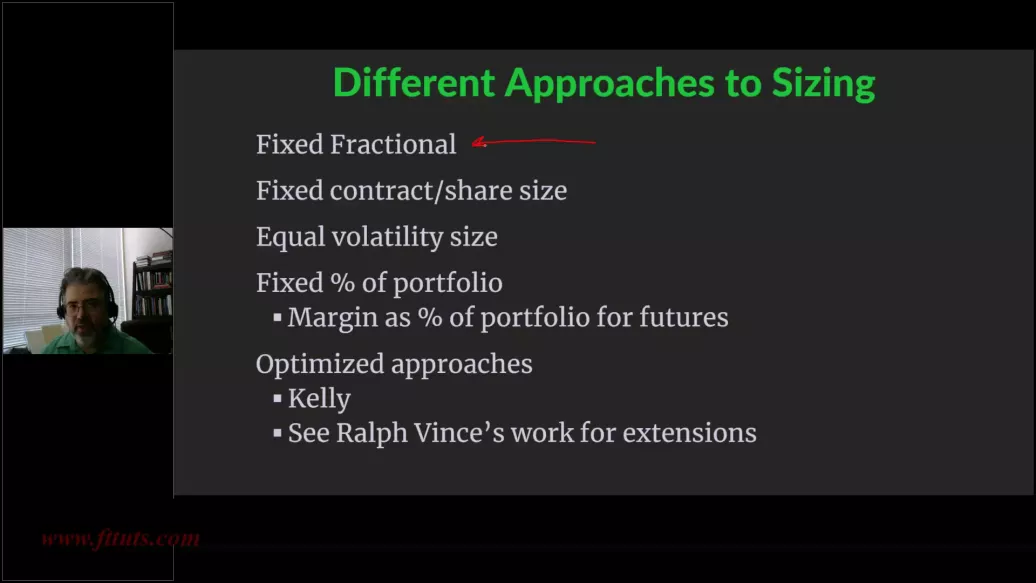
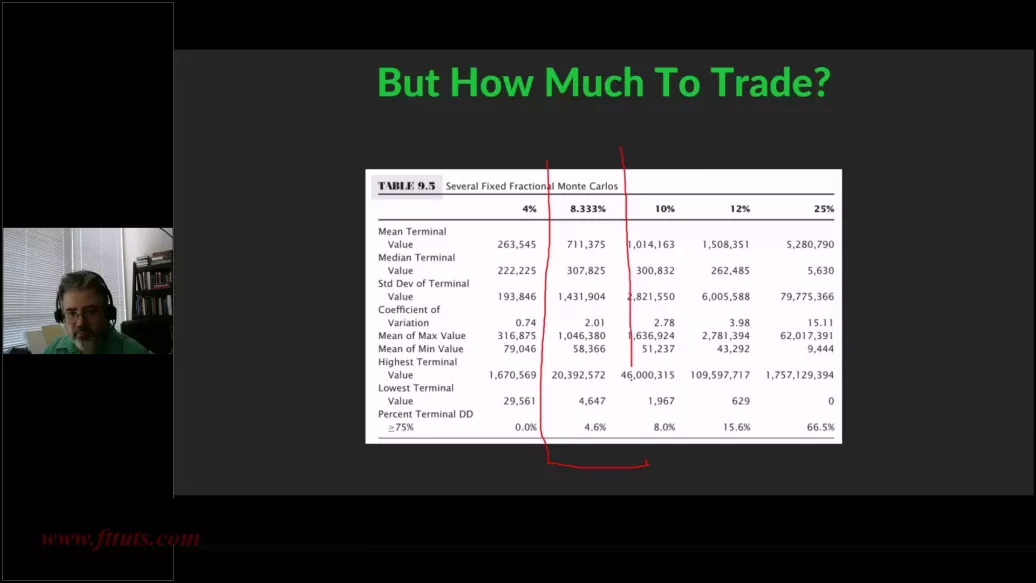
For most accounts he is direct that fixed fractional sizing is the right answer: you decide what percentage of the account you lose if the stop is hit, and you size backwards from that.
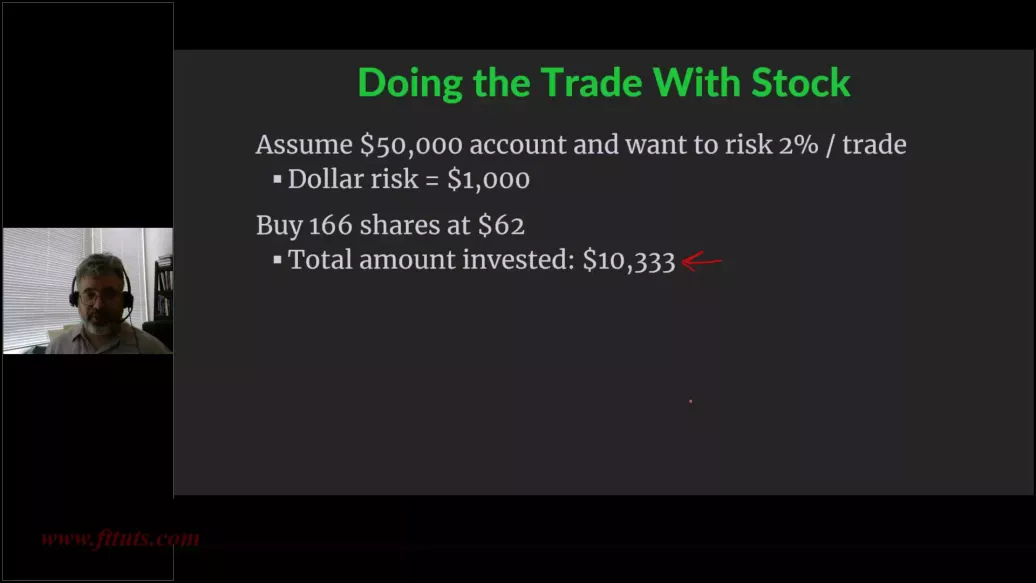
Take his worked example. A $50,000 account risking 2% per trade. The stock is bought at $62 with a protective stop at $56 — a $6 risk per share. That produces a position of 166 shares, which commits roughly $10,000 of capital to risk $1,000.
He anticipates the objection directly. Portfolio managers look at fixed fractional sizing and conclude something is wrong, because in a quiet market the position can approach a very large share of account equity. But that is a category error: portfolio risk thinking and tactical directional trading are two different mindsets, and dragging long-term investing logic into a three-day trade produces bad decisions. What does matter is net exposure — five long stock trades are usually tightly correlated in an event, and in a shock like COVID you can take five losses in a row even on five primo patterns.
Step 3 — Convert Share Risk Into Deltas
The bridge between stock sizing and option sizing is delta. A delta of 20 means the option’s daily P&L behaves roughly as if you owned 20 shares. Delta cannot exceed 100, and in most cases it is well below.
Grimes adds the caveat most beginner material leaves out: delta changes. Buy a 50-delta call today and tomorrow it might be 52 — or 23. That makes delta an imperfect measure, but still the correct one. The rule is simple: calculate your position size in shares, then acquire that same number of deltas through options.
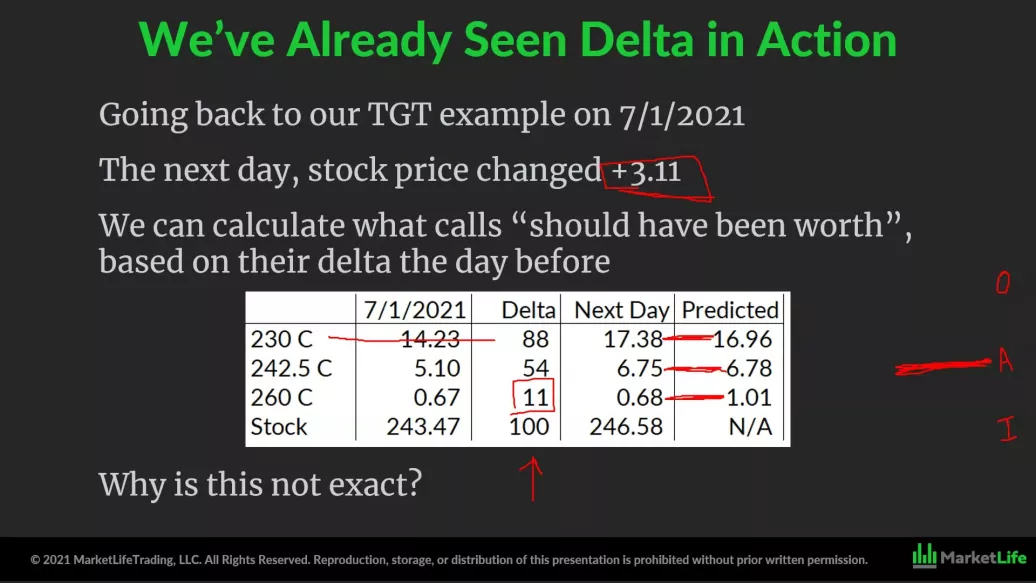
Only two Greeks matter for this workflow — delta and theta. Everything else is refinement. The full nine-module Options Course covers gamma, vega, moneyness and position Greeks in depth, but for pullback execution you can operate on those two.
Step 4 — The Vertical Spread Method
A call vertical is built by buying a call and selling a call at a higher strike. Grimes prefers the precise term “call vertical spread” over the looser “bull call spread”. It is a directional strategy that behaves like being long the underlying, with defined risk limited to the debit paid.
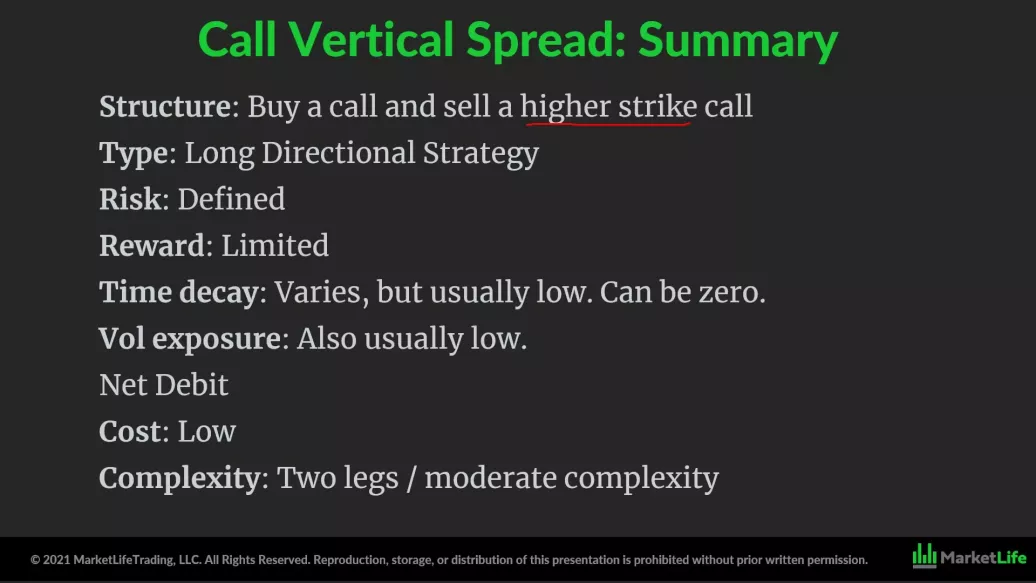
Delta nets out. Buy a 50-delta call, short a 20-delta call, and you are net long 30 deltas. Your share equivalent is the net delta of the spread — trivial to read in any decent platform.
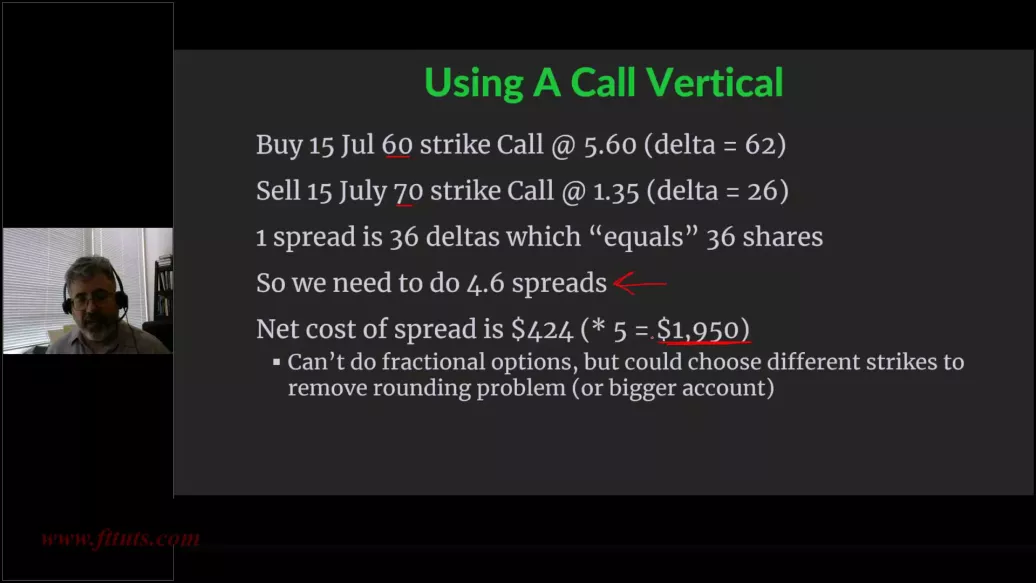
Now run the same Western Digital trade through it. Buy the 60 strike, sell the 70 strike. To match the 166-share position you need the spread roughly 4.6 times. Since fractional spreads do not exist, call it five. Total net cost: just under $2,000 — versus the $10,000 the stock position tied up.
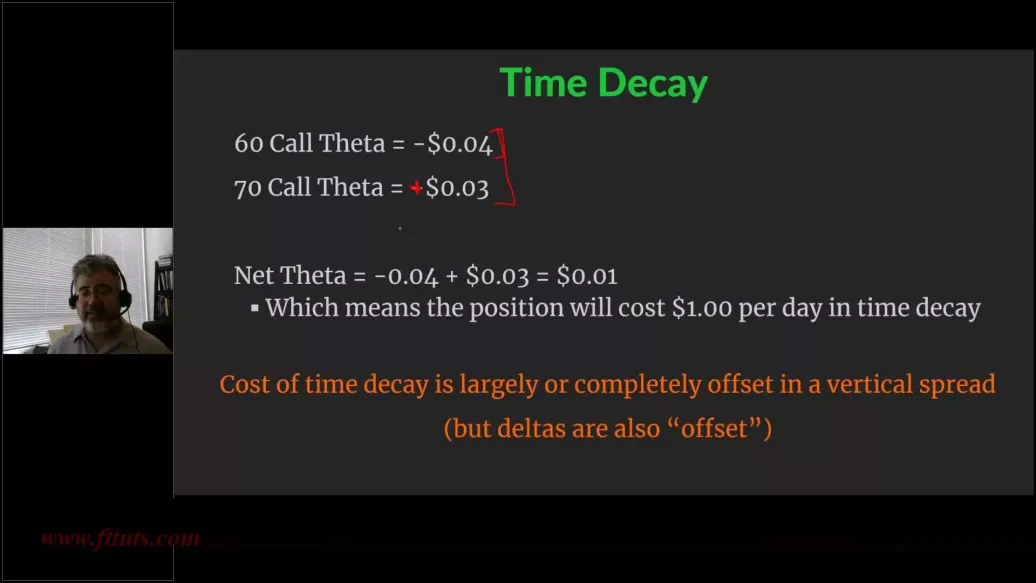
The theta story is where verticals earn their reputation. The 60-strike call decays about four cents a day; the 70-strike call about three cents. But you are short the 70 strike, so that decay works for you. Net theta drops to roughly a cent — and with the right construction a vertical can even be theta-positive. The single biggest cost of buying options largely disappears.
And the risk is hard-capped. If the entire market gapped to zero overnight, the maximum loss on that spread is the debit. On the stock version, the full $10,000 is theoretically exposed. Grimes frames this as disaster protection: on a $400 stock there is a vanishingly small but real chance of an overnight event that halves it. It will probably never happen in a full career. With defined-risk options it cannot happen at all.
The Cost Almost Nobody Prices In
Here is the part that stops the vertical from being a free lunch, and Grimes walks through it on a live options chain. These are not illiquid contracts. The 60-strike call quotes 5.20 bid / 5.60 ask. The 70-strike quotes 1.35 bid / 1.50 ask.
Buy the spread at the market and immediately reverse it at the market, and the round-trip cost is the full width of both spreads. In practice you can often work an execution somewhere in the middle. But traders coming from currencies, stocks or futures are frequently shocked the first time they see option bid-ask spreads — and if you are putting the vertical on five times, you are paying that friction five times over. Liquidity can also deteriorate exactly when you need to exit quickly.
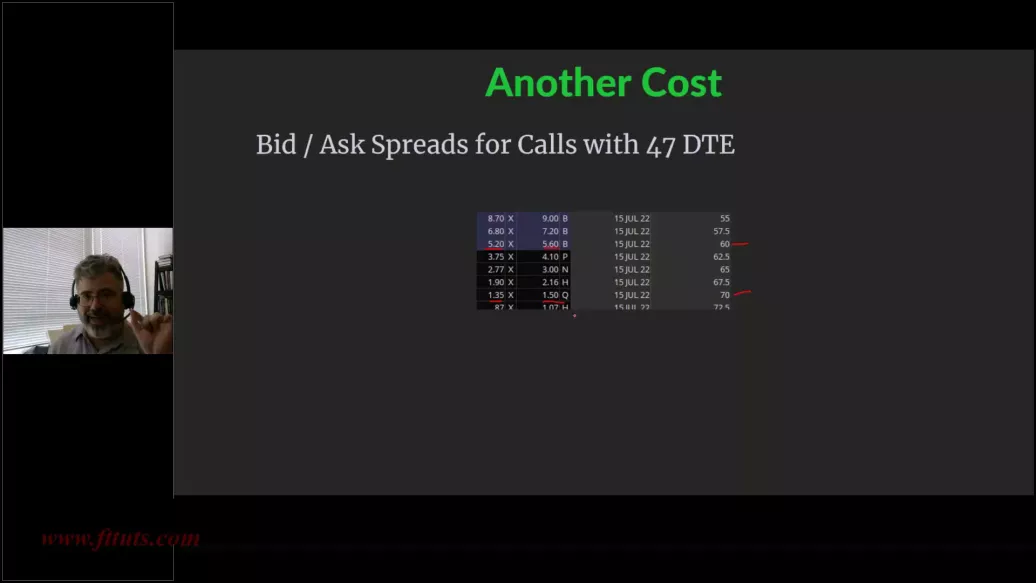
So the vertical trades one cost (theta) for another (execution friction, multiplied by size).
The 2026 Update — Why Grimes Now Argues for Simplicity
This is the most valuable and least expected part of the Masterclass, and it is a genuine evolution in his thinking over the past year — described in his own words as a return to simplicity.
The mechanism is theta’s relationship to time and moneyness. Theta is highest near expiration and highest at the money. On his comparison table, a near-the-money strike at 47 days to expiration carries roughly twice the daily decay of the same strike at 145 days. Look at it as theta per delta and the conclusion inverts the standard advice: a longer-dated at-the-money option lets you hold the position for about half the daily cost of the shorter-dated one.
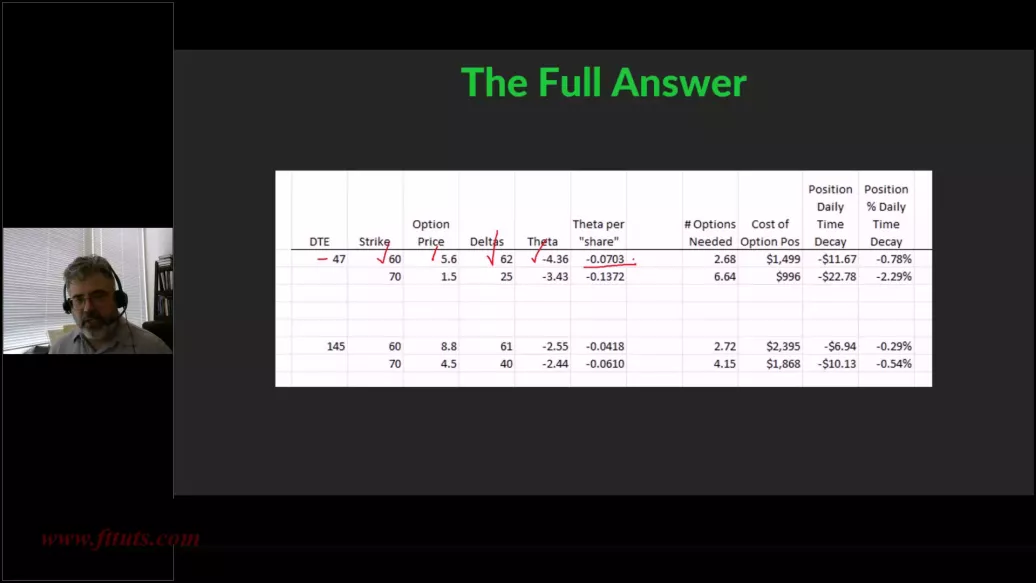
The 47-day 60-strike call in his example prices at 5.60 with 62 deltas. Yes, going further out costs more per contract and gives up some leverage — but leverage is usually not the actual reason for the trade.
So the decision rule that comes out of it:
- Average hold under two weeks → a single longer-dated at-the-money call or put is often the better structure. Simpler, one bid-ask spread instead of five, defined risk, manageable decay.
- Average hold of several weeks to months → the vertical makes more sense, because compounding daily theta over that horizon gets very expensive.
Grimes notes that experienced option traders will be uncomfortable accepting the decay on single strikes. His counter is that you should honestly total the bid-ask friction you have been paying on multi-leg spreads before assuming the vertical is cheaper. It frequently is not.
The final check is your own data: measure your actual average holding period before choosing a structure. That single number decides the answer.
So Should You Use Options on Pullbacks at All?
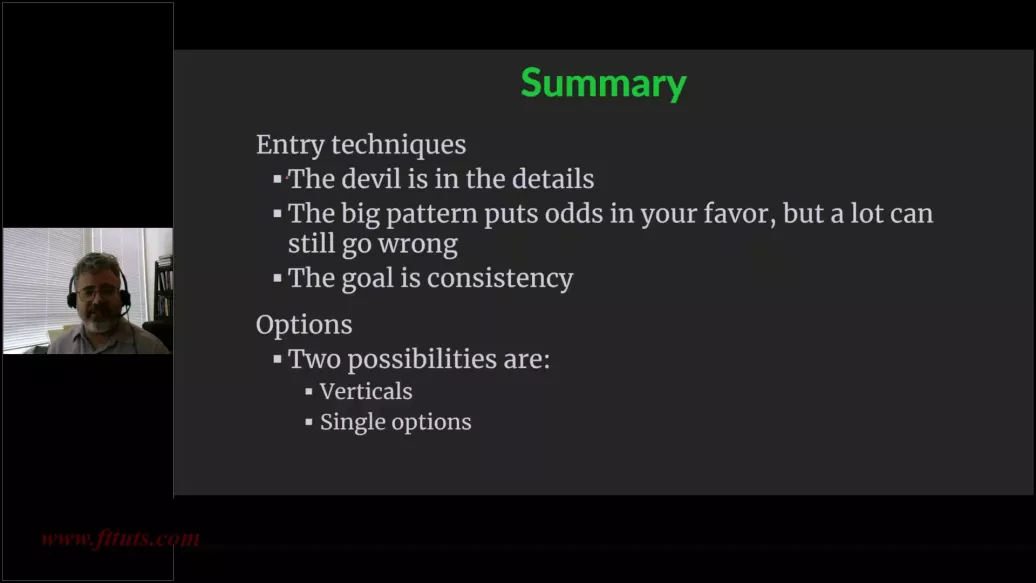
His summary is genuinely two-sided. Yes, because options precisely define and limit the loss, provide disaster protection against overnight gaps, and supply leverage. No, because they add complexity and transaction costs that a plain stock position does not carry — and leverage cuts both ways.
There is also a fourth use worth knowing: buying a put as a stop on a long position, or a call as a stop on a short, selecting the strike where your stop would have gone. Strike granularity means you rarely place it exactly where you want, but the concept of synthetic and equivalent positions is one of the most useful mental tools in the entire trading course catalog.
The Three Adam Grimes Courses
Adam Grimes — The Art and Science of Trading
Nine full modules, six units each, building from chart reading fundamentals up through complete pattern systems and trading psychology. This is the foundation course — it teaches you to read imbalance rather than memorise shapes, and it contains the quantitative work behind the patterns.
- Module 1–2: Introduction and Chartreading 101, then Chartreading Going Deeper
- Module 3: Market Structure and Price Action
- Module 4: Trading Pullbacks — simple, complex and nested variations
- Module 5: Trading Antis · Module 6: Failure Tests
- Module 7: Breakouts · Module 8: Pattern Failures
- Module 9: Practical Trading Psychology
Adam Grimes — Pullbacks Masterclass
Six live sessions running roughly 1h15m to 1h25m each, delivered over two weeks with two sessions per week. Every day includes Q&A and current live market examples rather than textbook charts. This is the course that contains the options-for-pullbacks material covered above.
- Day 1: How to Trade Pullbacks — what makes a consistently profitable trader, five common mistakes
- Day 2: How to Trade Pullbacks — trend structure and how pullbacks evolve inside it
- Day 3: Sizing and Trade Selection — fixed fractional sizing, risk of ruin, Kelly
- Day 4: Entry Techniques and Using Options — verticals, deltas, theta, the simplicity update
- Day 5: What Happens After a Pullback, and Trade Management
- Day 6: Putting It All Together — Q&A driven review
Adam Grimes — Options Course
Twelve sections and roughly 76 lessons taking options from contract basics to practical execution. It is structured for traders, not quants — pricing theory is included specifically to show where models break and where the edge sits, not to turn you into a market maker.
- I–II: Intro to Options, advantages, disadvantages, misconceptions, thinking in probabilities, directional vs non-directional style
- III: Option Pricing — intuitive pricing, Black-Scholes, uncertainty, where models fail and where there is an edge
- IV: Volatility — two kinds of volatility, the vol surface, the VIX, implied move, is an option expensive or cheap
- V–VIII: Simple directional strategies, hockey stick diagrams, ATM vs OTM, Understanding Delta, Theta and Vega, Position Greeks
- IX: Core Strategies — long call, long put, call vertical, put vertical, credit verticals, ladders, ratios, short put, using options as stops
- X–XII: Covered calls and collars, straddles, butterflies, synthetics, the box, condors, calendars and diagonals, plus liquidity, strike and expiration selection, and trade management
Which Course Should You Start With?
- You cannot yet define a pullback precisely → start with The Art and Science of Trading. Modules 1–4 build the reading skill everything else depends on.
- You read charts fine but your entries are inconsistent → Pullbacks Masterclass. Day 3 and Day 4 alone rebuild sizing and execution.
- You have the setups but options keep losing money on you → Options Course, then Day 4 of the Masterclass.
- You want the complete workflow → all three. Read the chart, size in shares, convert to deltas, choose the structure by holding period. Grab all three in one order and apply coupon 5050 for an extra 50% OFF.
- Worked numeric examples, not vague theory — account size, stop, share count, strikes, deltas and theta all shown
- Options material is built specifically for directional swing traders, not premium sellers
- Live market examples and Q&A rather than curated textbook charts
- Honest about costs: bid-ask friction and complexity are stated plainly, not hidden
- Three courses interlock into one complete workflow
- Deliberately repetitive by design — the same ideas are revisited from different angles across sessions
- Teaching style is conceptual, so there is no plug-and-play mechanical signal to copy
- The Options Course is long and demands real study time
- Options section assumes you can already identify a quality setup
The reason this material stands out is that it closes the gap almost every other course leaves open. Chart courses stop at “here is the pattern.” Options courses stop at “here is the payoff diagram.” Nobody connects them with real numbers. Grimes does: a $50,000 account, 2% risk, a $62 entry with a $56 stop, 166 shares, then the exact conversion into net deltas and the exact comparison of a five-lot vertical against a single longer-dated at-the-money call.
The single most actionable takeaway is also the cheapest to implement: measure your true average holding period on pullback trades. Under two weeks, stop paying five bid-ask spreads on multi-leg structures. Over that, the vertical earns its complexity. That one measurement will change your execution costs more than any new indicator. All three courses are available through Courses On Budget, with fresh drops listed on the Updates page.
Browse the category: Trading Courses Cheap
All trading products: Trading Category
External resource: adamgrimes.com
Recommended course stack:
3 Adam Grimes programs in one place — instant download, forever license, no subscription.
Browse all Adam Grimes courses →