

This guide turns the actual Aaron Lynch classroom material into a practical framework for studying gold in 2026. It focuses on the methods repeatedly demonstrated in the supplied recordings: market structure, 50% retracements, balancing time, seasonal dates, time by degrees, geometric angles, Square of Nine confirmation and disciplined trade planning. Start from Courses On Budget, browse the Trading course category, or bookmark this Gann Trading Strategy for Gold guide.
Gann Trading Strategy for Gold: What the Course Material Actually Teaches
A useful Gann study does not begin with a mystical number or a prediction. In the supplied Aaron Lynch sessions, the process is much more structured. The instructor repeatedly starts with the position of the market, trend, swing structure and the relationship between price and time. Gold is reviewed alongside Newcrest Mining and broader index markets because the course uses connected markets to build context before discussing a possible setup.
That distinction matters. The recordings do discuss the Square of Nine, seasonal dates, time by degrees and geometric angles, but they are not presented as standalone shortcuts. In the Square of Nine discussion, Lynch explicitly treats it as one tool inside a larger Gann toolbox and warns against jumping straight to advanced squares without understanding trend, swing charts, stop placement and basic market structure. Later, he describes Square of Nine work as confirmation that can increase confidence when the rest of the analysis is already aligned.
For a 2026 gold trader, the practical takeaway is therefore not “find one magic date.” It is to build a repeatable sequence in which price geometry and time cycles create a pressure zone, then require the market itself to confirm whether that zone matters.
1. Begin With Gold’s Position, Not With a Forecast
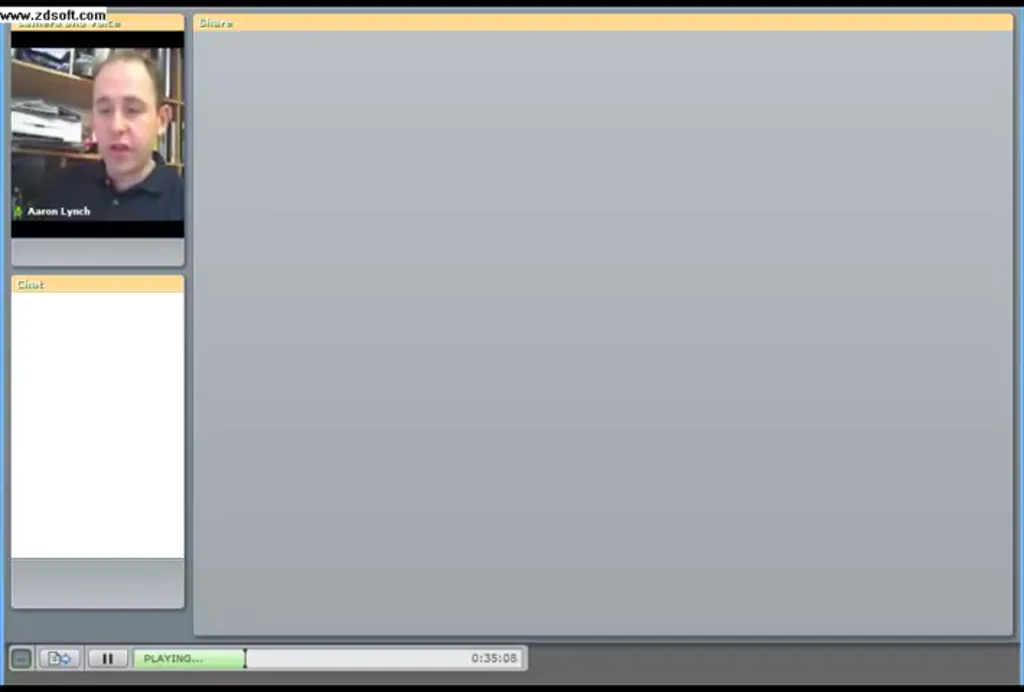
Across the classroom recordings, the instructor repeatedly reviews the major indexes, gold, oil and the selected trading markets before moving into a forecast. In the gold discussions, swing structure is used to distinguish higher bottoms, lower tops and confirmed trend changes. The course also compares gold with Newcrest Mining, while acknowledging that Newcrest can behave differently because it is an equity as well as a gold-related market.
This is the first filter for a modern application. Before measuring a Square of Nine level, identify the important highs and lows, the current swing direction, recent gaps and whether price is moving with or against its previous range. A Gann calculation becomes more useful when it answers a specific question about a market that is already structurally understood.
2. The 50% Retracement Is a Core Pressure Test
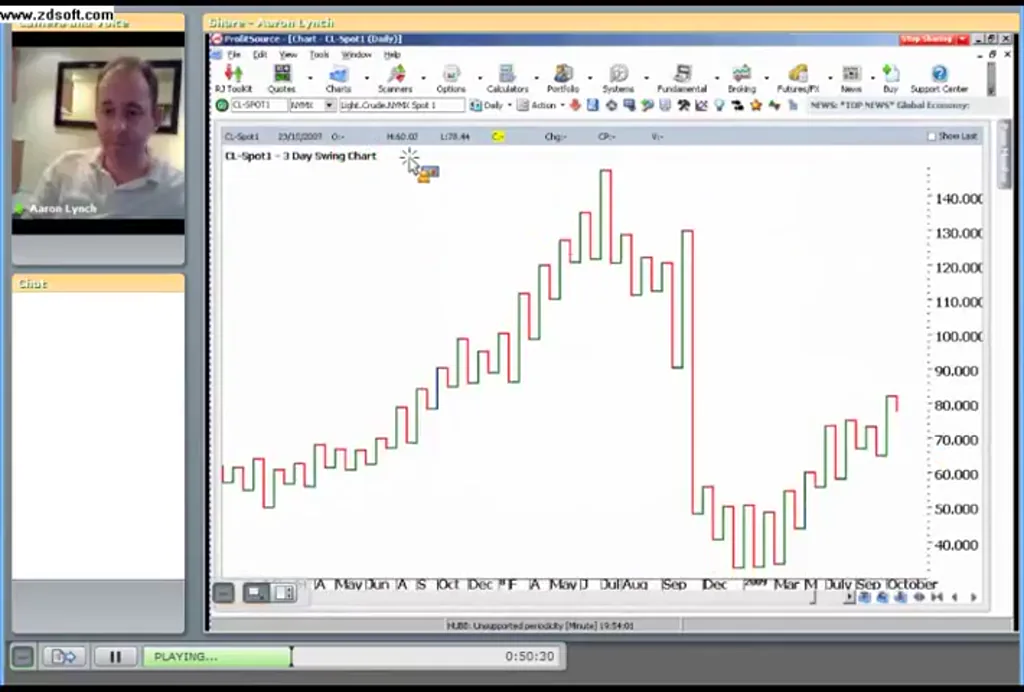
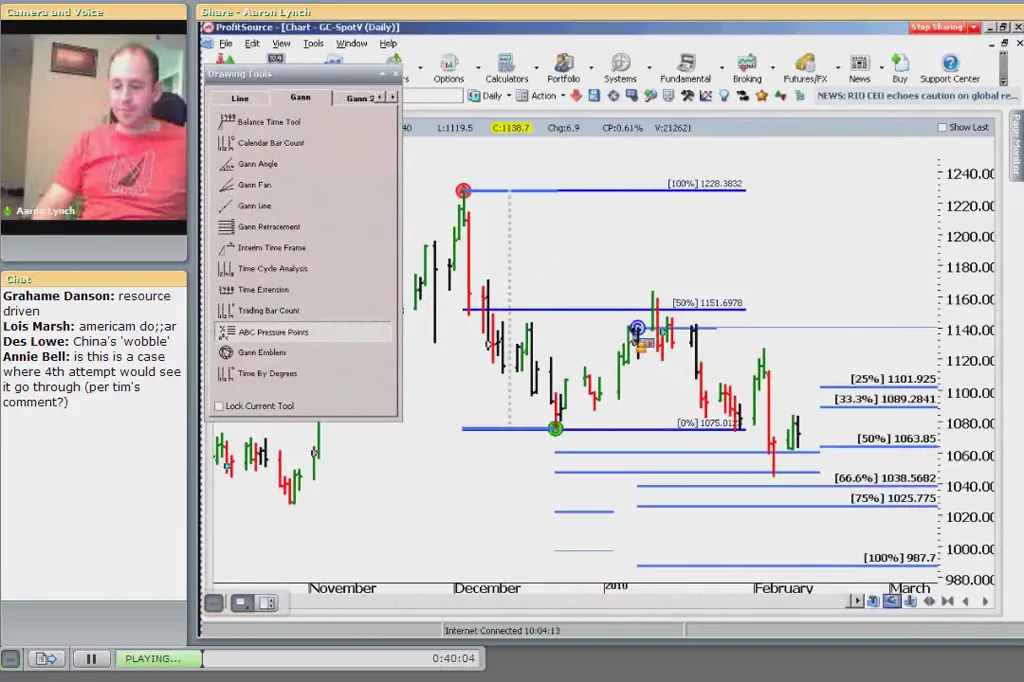
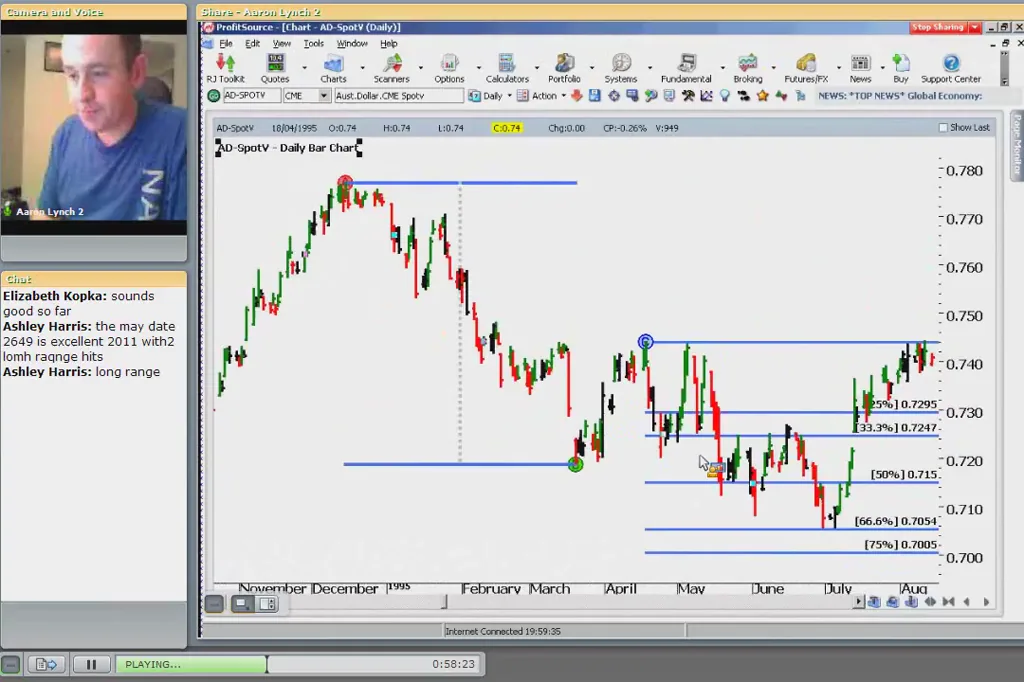
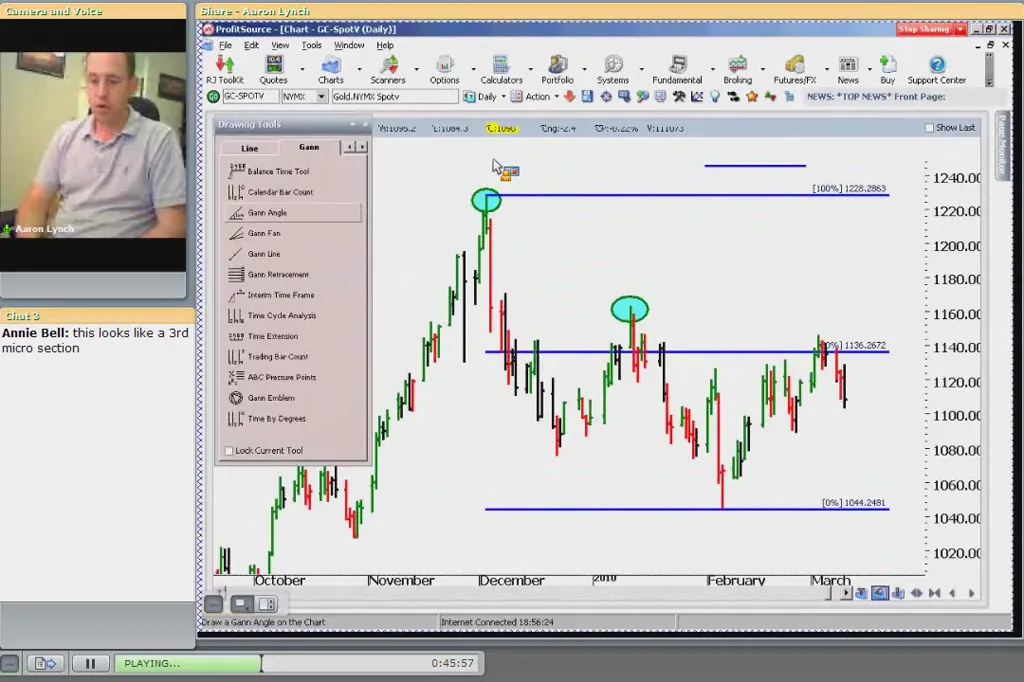
The 50% concept appears repeatedly through the supplied sessions. Lynch uses 50% retracements in price and also balances time in fractional relationships. Historical examples in the recordings include markets turning around 50% levels, repeated moves being measured against previous ranges, and forecasts being strengthened when price and time relationships cluster near the same area.
The important lesson is confluence. A 50% price level is not automatically a trade. The recordings show the instructor asking what else is present: a seasonal date, an angle, a repeated range, a gap, a lower top, an ABC structure or a change in volume. The stronger case develops when several independent measurements point to the same zone.
3. Balancing Time Turns a Chart Into a Calendar
Balancing time is one of the most reusable ideas in the coaching series. The instructor measures the duration between important tops and bottoms, then projects fractions or multiples of those time spans forward. In one classroom example, multiple balancing-time scenarios cluster in the period leading into a seasonal date. The emphasis is not that one calculation must be exact; it is that several time relationships can create a window worth watching.
For gold study in 2026, this suggests a disciplined workflow: record the duration of major swings, compare current swing duration with prior moves, and mark dates where 50%, 100%, 150% or other course-relevant time relationships converge. Those dates become observation zones, not guaranteed reversal points.
4. Seasonal Dates and Time by Degrees Add a Second Clock
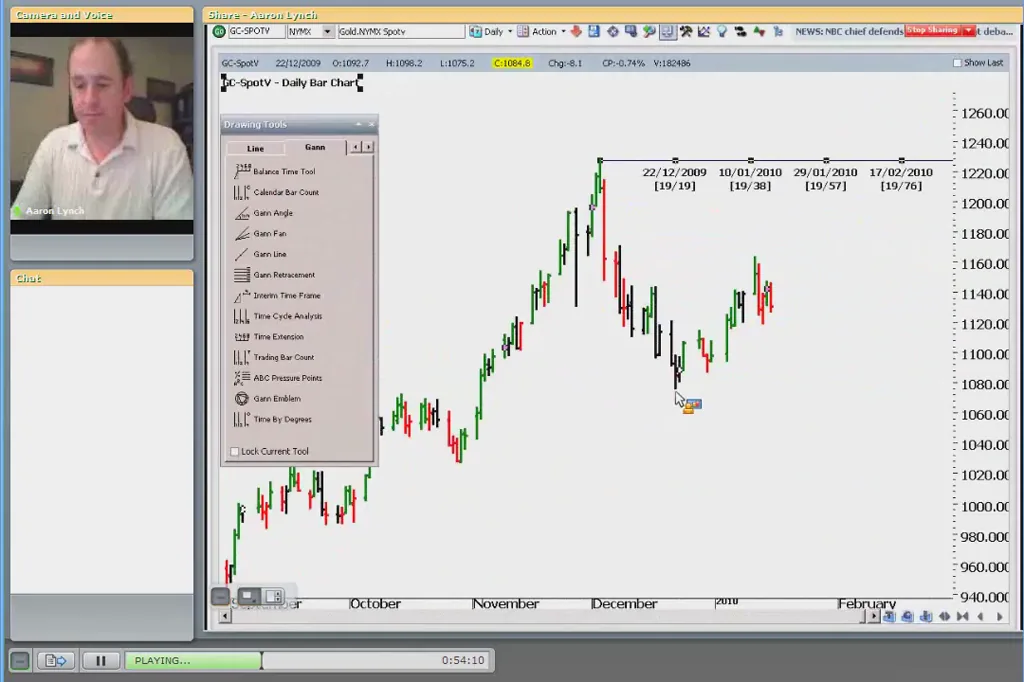
The course devotes substantial attention to seasonal dates and time by degrees. Students are encouraged to work through market history manually, colour-code recurring dates and identify which seasonal periods repeatedly coincide with important changes in trend. Lynch also discusses using the “birth” of a contract as an anchor from which degree counts can be projected.
One gold example in the material identifies a December 22 low as a seasonal-date bottom, followed by a first higher bottom and an ABC opportunity. When a market repeatedly responds to certain seasonal windows, those windows deserve attention in future analysis. The course also stresses learning the market’s personality by doing the historical work rather than relying only on automated tools.
5. Geometric Angles Measure Strength, Weakness and Price-Time Geometry
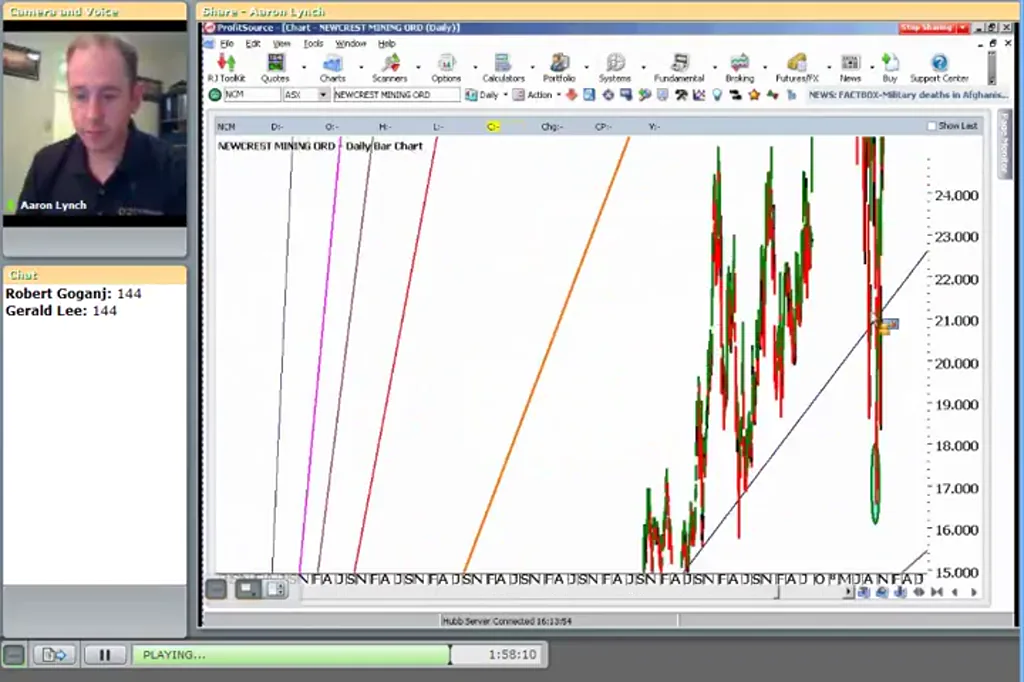
A major part of the supplied coaching is devoted to what Lynch calls third-dimension work: geometric angles, squares, boxes, speed angles and the squaring of highs, lows and ranges. The geometric-angle lesson is particularly explicit that charts can become useless when traders draw too many angles. The goal is not to create a web of lines that explains every historical turn. The goal is to use a clean set of reference angles to judge the market’s strength or weakness and to study how price is behaving relative to time.
This is where the title “price geometry” earns its place. Geometric angles give the trader a framework for comparing the rate of price movement with the passage of time. If a gold move is accelerating, stalling or failing around a meaningful angle while other time-and-price tools are also active, the chart is offering a more coherent decision point than any isolated indicator.
6. Square of Nine Works Best as Confirmation, Not as a Shortcut
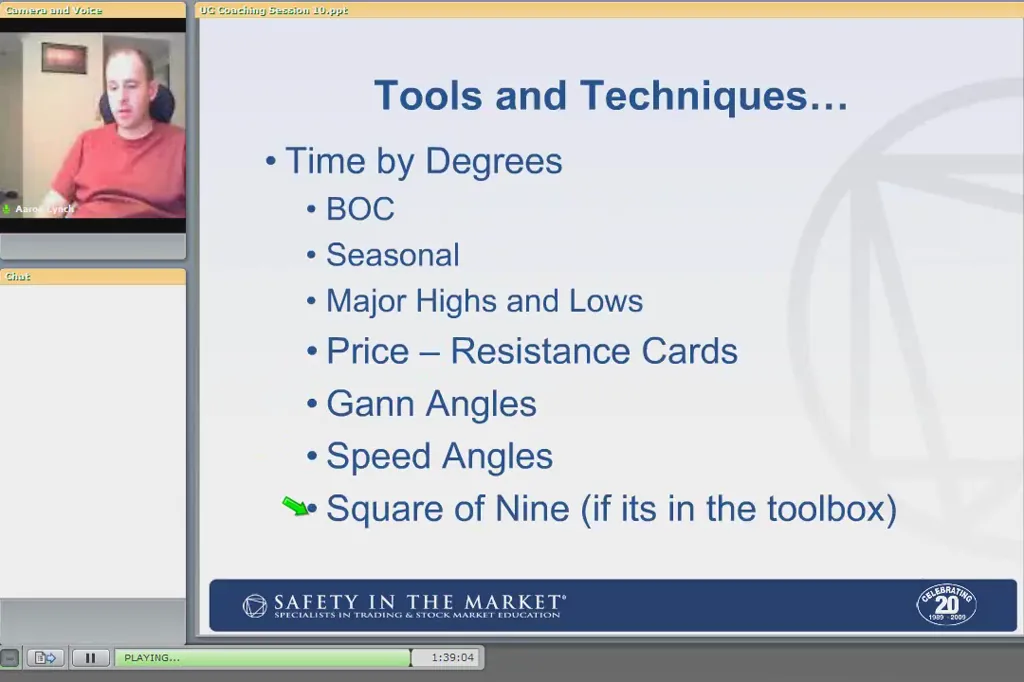
The Square of Nine is the most recognisable Gann tool in the article title, but the supplied material gives it a deliberately restrained role. In session nine, Lynch notes that traders often discover the Square of Nine before they understand basic trend, swing charts or stops. He describes advanced squares as later-stage tools in his own progression. In session ten, the guidance becomes operational: if Square of Nine is already in your toolbox, use it to check prices and dates, but do not treat it as the element that makes or breaks a forecast.
That is a strong framework for 2026. Build the analysis first. If a Square of Nine price or date aligns with a 50% retracement, a geometric angle, a repeated range and a time-cycle window, it can add confidence. If it is the only reason for a trade, the course material itself argues for more caution.
7. Confirmation: ABC Structure, Swing Turns, Gaps and Volume
The classroom examples do not stop at forecasting. Lynch repeatedly returns to execution: first higher bottoms, first lower tops, ABC trades, gaps, reversal days and changes in volume. In the bonus session, the discussion around gold and Newcrest combines 50% work, time-by-degrees relationships and forecast dates, then asks what would actually confirm the move. The answer is market behaviour.
This prevents a common analytical error: being directionally convinced before price has confirmed the thesis. A time-and-price cluster can tell you when to pay attention. A lower swing top, breakout, gap or volume expansion can tell you that other market participants are beginning to validate the idea.
8. Turn the Method Into a Written Trading Plan
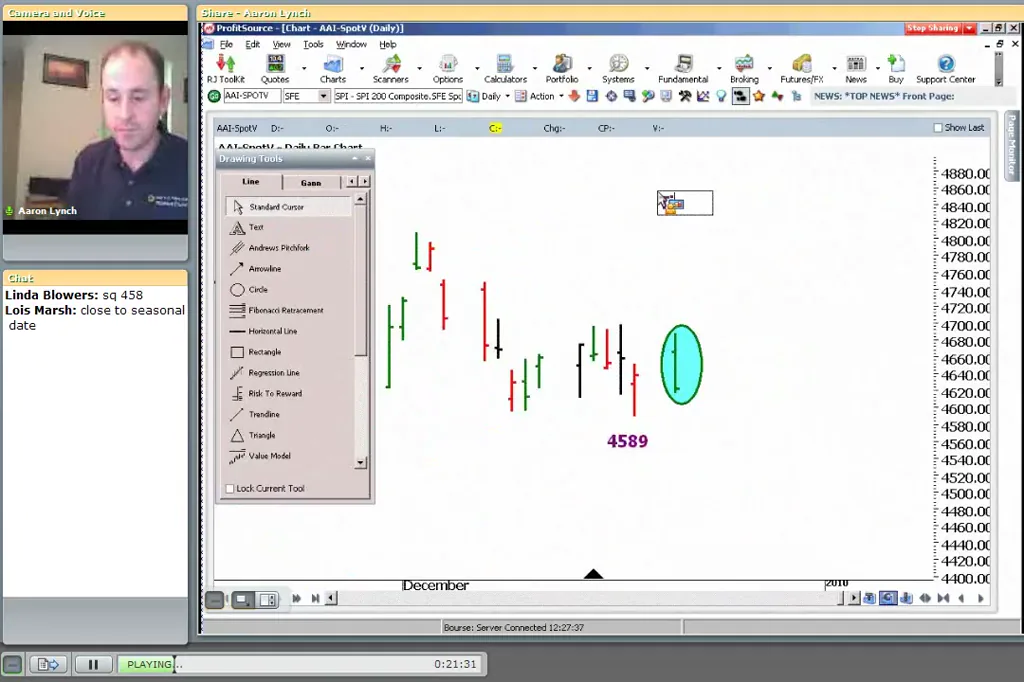
The bonus session contains one of the most commercially useful sections of the material: a detailed discussion of trading plans. Lynch separates the business plan from the market-specific trading plan and argues that a trading plan should express the philosophy of why a trader acts, not merely list mechanical button presses. He gives an example from oil in which 50% time-and-price retracements are the underlying philosophy, while the specific entry may come from a gap, an opener’s rule, a close-based rule or a first higher bottom.
He also stresses creating the plan away from the market. That reduces the temptation to rewrite rules after a recent win or loss. Applied to gold, the plan can be concise: define the market structure you require, the time-and-price confluence you will monitor, the confirmation that triggers action, the invalidation point and the position-management method. This converts Gann analysis from chart decoration into a process.
The Two Aaron Lynch Courses Behind This Guide
Aaron Lynch — Ultimate Gann Course
The supplied recordings cover applied market reviews and a progressive Gann workflow using trend, ABC structures, 50% retracements, seasonal dates, balancing time, time by degrees, geometric and speed angles, squaring techniques, Square of Nine confirmation and trading-plan construction. Gold and Newcrest Mining appear repeatedly as worked examples alongside the Australian dollar and broader markets.
- Geometric angles and squaring time and price.
- Seasonal dates, time by degrees and balancing time.
- Square of Nine used as a confirmation tool.
- Trading-plan philosophy and confirmation-based execution.
Which Course Should You Start With?
- Choose Ultimate Gann Course if you want the full classroom progression: market context, time cycles, geometry, forecasting, execution and trading-plan work.
- Choose Geometric Trading Course if your buying intent is specifically focused on the geometric-angle material; note that the supplied transcript set overlaps with the same coaching sequence used above.
- Before buying, compare the detailed Aaron Lynch Ultimate Gann Course Index Review 2026 and Aaron Lynch Geometric Trading Course Index Review 2026.
- For more alternatives, browse the complete Trading Courses Cheap list and the latest Courses On Budget updates.
- Combines price structure with time analysis instead of relying on one indicator.
- Uses 50% retracements, repeated ranges and angles as measurable reference points.
- Treats seasonal dates and time cycles as observation windows rather than automatic entries.
- Requires market confirmation through swings, ABC structures, gaps or volume.
- The Square of Nine is not presented as a beginner shortcut or standalone system.
- The examples in the supplied recordings are historical and are not live 2026 trade signals.
- The method requires manual chart work, practice and market-specific research.
- A forecast still needs a written risk and execution plan before capital is committed.
Final 2026 Gold Workflow
A professional Gann Trading Strategy for Gold in 2026 can therefore be reduced to a clear sequence: establish trend and swing structure; mark 50% price relationships and repeated ranges; test geometric or speed angles; measure balancing-time relationships; identify seasonal or time-by-degrees windows; use Square of Nine only where it adds confirmation; and finally demand a tradeable signal from price itself. The course material repeatedly reinforces patience, confirmation and the value of having a plan before entering the market.
This article is educational and does not provide a current gold forecast or personalised financial advice. If you trade futures, verify current instrument and contract information directly with the CME Group Gold futures resource before placing a trade.
The strongest idea in the supplied Aaron Lynch material is not a single Gann calculator. It is the discipline of combining market structure, price geometry and time pressure, then waiting for confirmation. That makes the material relevant to a gold study workflow without pretending that historical examples are current signals.
To study the full classroom material, buy the Aaron Lynch Ultimate Gann Course or the Aaron Lynch Geometric Trading Course through Courses On Budget. Use coupon 5050 at checkout for the site’s 50% promotional discount.
Browse the category: Trading Courses
Full trading list: Trading Courses Cheap
External resource: CME Group — Gold Futures
Recommended reading: