
Play Like Bobby Fischer Review: The Verdict in 60 Seconds
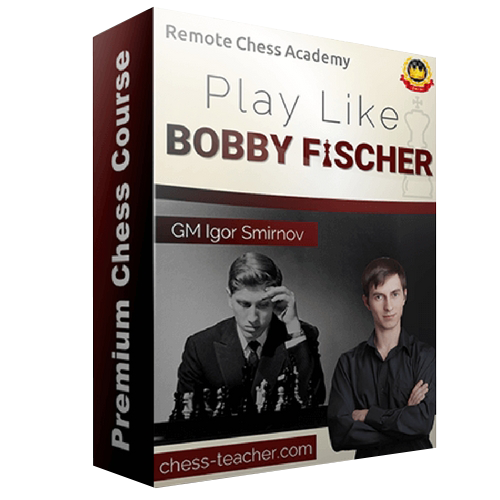
Igor Smirnov’s course is short, clear and deliberately simple. It reduces Fischer’s positional style to a checklist — one rule per piece, plus two rules about attack and defence — and then proves in the last lesson that the checklist explains a world-class game. For a club player who “doesn’t know what to do” after the opening, that is exactly the right medicine. For a strong player it is too thin; the course is a foundation, not a study of Fischer’s games in depth.
Structure gets a 9: every lesson ends with a rule, lesson 10 collects them and lesson 11 applies them. Depth gets a 6 because the rules are simplified on purpose and the games are explained, not analysed. Practice value and study files score well thanks to the 10 task-and-answer pairs, the lesson PGNs and the e-book. That is the honest shape of this Play Like Bobby Fischer review. To compare it with other Remote Chess Academy titles, see the GM Igor Smirnov collection.
Meet the Coach
- Chess grandmaster and coach (per the official course page)
- Holds a Master’s degree in psychology
- Founded the Remote Chess Academy, an online chess school
- Author of many video courses, articles and webinars for the academy
The psychology degree explains the tone of lesson 9. Smirnov does not begin defence with variations; he begins with attitude. He puts two Fischer quotes on screen — about fighting spirit and about making opponents “squirm” — and turns them into a motto for the student: return every stroke of your opponent. The idea that defence is a mindset before it is a calculation runs through the whole second half of the course.
Getting the Course in Four Steps
Where the 3h 20m Goes
The product page lists the lessons and files. For this Play Like Bobby Fischer review we looked at the balance instead. Just over half of the runtime — lessons 2 to 7 — goes to the six piece rules. A quarter goes to the two initiative lessons on attacking fast and striking back, and the last two videos turn the rules into a checklist and a full game. The bishop lesson is the longest; the pawn-structure lesson is the shortest.
The red bars are the placement rules, the dark bars the initiative and application lessons. The learning path is easy to follow:
Video is only half of the package. The practice folder holds ten task PGNs, each paired with a separate answer file, and the answers are far longer than the tasks: the smallest answer file is under 4 KB, the largest, for task 9, is almost 32 KB of commentary. Do not judge a task by the size of its question file. The lesson PGNs let you replay every example, and the e-book gives you a printable version of the rules to keep next to the board during your own games.
A Worked Example: Predicting Fischer Against Petrosian
Lesson 11 is the test of the whole method. Smirnov takes a game from the 1971 Candidates final, which Fischer won 6½–2½, and asks you at almost every move: what do the rules suggest? Here is the chain of ideas he follows.
- Develop by value. A simple opening rule: start with the least valuable units and move upward — central pawns, knights, bishops, then rooks, queen last.
- Develop with pressure. Fischer’s Bb5 is preferred to a quieter square because it develops and puts pressure on Black at the same time; when Black pins a knight, h3 asks the bishop to decide, and Petrosian gives up the bishop for a knight.
- Damage the structure. When the bishop is attacked and cannot retreat without losing a central pawn, Fischer takes the knight, leaving Black with disconnected queenside pawns — future targets.
- Activate the rooks. Smirnov points out the classic amateur mistake: developing the minor pieces, castling and then forgetting the rooks. Fischer puts a rook on the open e-file, doubles, and plays b3 to stop Black’s a-pawn from freeing the other rook.
- Improve the worst piece, remove the best enemy piece. White’s knight has no forward squares, so it heads for c5. Black’s centralised knight is his best piece, so Fischer prepares f3 to chase it. When a tactic spoils that plan, he switches to c4, opening the c-file against the weak pawns.
- Squeeze. Black’s rook ends up tied to a weak pawn, his knight to another, and the second rook has no squares. White simply improves his king and pieces.
The value of the lesson is not new analysis of a famous game; it is seeing that ordinary rules, applied in the right order, explain a contender’s play move by move. That is the confidence the course wants to give a developing player.
Second Example: Return Every Stroke
Lesson 9 starts from a familiar club situation. In one of Fischer’s games with Black, White attacks a knight that can neither retreat nor be defended comfortably — a retreat drops f7, a natural defence invites more threats. Smirnov asks you to forget the knight for a moment and list the forcing moves: checks, captures, threats. Fischer gives a queen check, and when White steps aside, the queen protects the knight while attacking White’s queen. Black then simply finishes development a pawn up.
The rest of the lesson repeats the pattern in sharper positions: a rook that counter-attacks the queen instead of retreating, a bishop move that answers a threat with a bigger threat, and a queen move into an attacked square that works because of a knight fork. The rule is easy to remember and hard to apply, which is why the course gives it a full lesson.
The Index, Turned Into a 7-Day Study Plan
The course page lists every file. What the list cannot tell you is how to combine videos and tasks, so for this Play Like Bobby Fischer review we built a week from the real runtimes, under 45 minutes of video a day. The task folders are not labelled by lesson, so we spread them evenly; solve each task before opening its answer file.
| Day | Watch | Video time | Then do |
|---|---|---|---|
| 1 | Lessons 1–2 | 42:23 | Task 1; count bishop squares in your last game |
| 2 | Lessons 3–4 | 28:34 | Tasks 2–3; check rook files and flight squares |
| 3 | Lesson 5 | 25:34 | Task 4; find a strong square for each knight |
| 4 | Lessons 6–7 | 25:13 | Tasks 5–6; list targets not protected by pawns |
| 5 | Lesson 8 | 24:28 | Task 7; replay the early-attack examples |
| 6 | Lesson 9 | 24:25 | Task 8; write the forcing moves before defending |
| 7 | Lessons 10–11 | 29:26 | Tasks 9–10; compare answers with the rule sheet |
Positional play · Beginner–Intermediate
GM Igor Smirnov — Play Like Bobby Fischer
Eleven video lessons, ten practical tasks with separate answers, the lesson PGNs and a printable e-book. The complete file index is on the product page.
Test Yourself: Four Rules From the Lessons
A useful Play Like Bobby Fischer review should help you check your own level. These four questions come straight from the course. If you answer them without hesitation, you know the basics and the tasks will be the real test. The answers are hidden under each question.
1. In what order does Smirnov suggest developing your forces?
2. Your piece is attacked. What should you look at before retreating or defending it?
3. What are the three king rules in the summary lesson?
4. What did Fischer do with an excellent enemy piece, according to lesson 11?
Play Like Bobby Fischer Review: Strengths and Gaps
Rules you can use at the board
The best feature of the course is how little you need to memorise. Lesson 10 fits the whole method on one screen, and Smirnov connects it to a single picture: improving your pieces automatically brings enemy pawns and pieces “under fire”. Positional play and attack are presented as two sides of the same idea rather than opposites, which is a useful message for players who think strategy is passive.
Fischer’s attitude, not only his moves
Because the course uses Fischer as a model of behaviour — methodical in quiet positions, combative when attacked — it teaches decision habits more than opening lines. That makes it a natural first step before deeper Remote Chess Academy material.
Where the course stops
Any honest Play Like Bobby Fischer review has to mention scope. At 3h 20m the video is short, the rules are simplified, and it is an older production. The official page also mentions 8 practical tasks, while the files contain 10. For more depth, continue with The GM’s Positional Understanding or Top 25 Middlegame Concepts; for a structure course from the same school, our Nimzo with Doubled Pawns index review looks at GM Robert Hungaski’s Remote Chess Academy course.
Which Remote Chess Academy Course Should You Pick?
The academy has several courses built around champions and concepts. Pick by goal; each title below links to its own product page and complete file index.
| If you need… | Choose |
|---|---|
| Simple piece-by-piece rules from Fischer’s games | Smirnov — Play Like Bobby Fischer |
| Attacking and sacrificial ideas in Tal’s style | Smirnov — Mikhail Tal’s Magic Revealed |
| Dynamic middlegame play the Kasparov way | Smirnov — Mastering the Middlegame in Kasparov’s Style |
| A deeper positional course from the same author | Smirnov — The GM’s Positional Understanding |
| A Remote Chess Academy course on one opening structure | Hungaski — How to Play the Nimzo with Doubled Pawns |
- One clear rule per piece, collected in a one-screen summary
- A full Fischer game used to test the rules
- 10 practical tasks with separate answer PGNs
- Lesson PGNs and a printable e-book
- Short lessons that fit into a week
- Only 3h 20m of video
- Rules simplified for developing players
- Older production quality
- Official page says 8 tasks; the files hold 10
FAQ
Is this Play Like Bobby Fischer review based on the real course?
Yes. Runtimes come from the 11 lesson videos, the practice figures from the 10 task folders with their answer files, and every example and quote from the full lesson transcripts, checked against the official course page.
What level is the course for?
Beginners to intermediate players, as the publisher states. The rules need no opening theory, and stronger players will find the material simplified.
Are answers included for the practical tasks?
Yes. Each of the 10 tasks has its own task PGN and a separate answer PGN, so you can solve first and check afterwards.
How is the course delivered?
Digital files. Crypto payment only. Fast delivery is handled manually after payment confirmation. Download links remain available for 7 days; save your files locally.
Our Play Like Bobby Fischer review finds a compact, well-built foundation course. Smirnov turns Fischer’s style into rules you can check in any position — develop by value, give every piece its best square, remove the opponent’s best piece, answer threats with threats — and the final lesson shows those rules explaining a Candidates final game. At 7.8 out of 10 it is a strong first step for improving players and a quick refresher for anyone who has drifted into passive play.
Work through the 7-day plan, then order the course from Courses On Budget — after checking the coupons page.
Browse the category: Chess Courses · Chess Courses Cheap List
Same author and school: All Igor Smirnov courses
New releases: Courses On Budget updates
External resource: thechessworld.com (official course page)
Historical background: World Chess Championship 1972 on Wikipedia
Recommended course stack:
39 Igor Smirnov programs in one place — instant download, forever license, no subscription.
Browse all Igor Smirnov courses →