

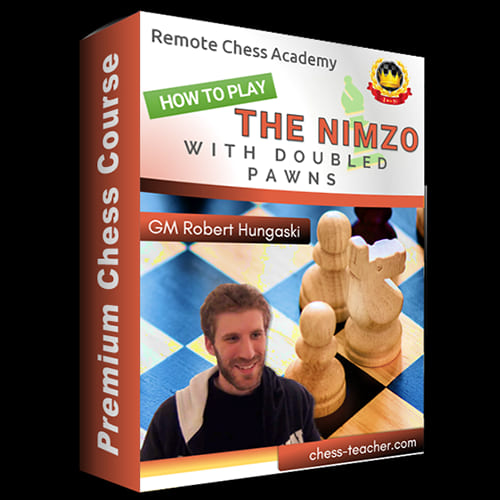
The Nimzo with Doubled Pawns: One Structure, Three Systems
Most Nimzo-Indian material is organized by move order. This course is organized by an idea. After 1.d4 Nf6 2.c4 e6 3.Nc3 Bb4, Black gives up the dark-squared bishop and White gets the bishop pair in exchange for doubled pawns. Hungaski’s opening video sets out the whole story in two sentences: White “is going to have the worse pawn structure and is going to try to compensate for this by having the more active pieces,” and the way to do that is “get a pawn to e5, open up the b1–h7 diagonal for the bishop and launch a kingside attack.” Black’s answer is just as clear — gang up on c4.
The official course page puts it plainly: it is “NOT about memorizing but mastering several main ideas in the Nimzo.” Ten theory lessons build that understanding step by step, and three practical sessions with 51 test positions make you use it. Because the plans are explained from both sides of the board, the course works as a Black weapon and as a White repertoire guide at the same time. It sits comfortably next to the rest of our chess courses list.
| Course Fact | Details |
|---|---|
| Instructor | GM Robert Hungaski (GM title 2012, FIDE Senior Trainer) |
| Opening | Nimzo-Indian Defence — 4.a3 Sämisch, 4.e3 Rubinstein, 4.f3 |
| Video | 14 videos · 3h 47m total (intro + 10 lessons + 3 practical sessions) |
| Study files | 10 lesson PGNs, 3 task PGNs + 3 answer PGNs, printable PDF ebook |
| Practice | 51 positions split by system: 4.a3, 4.e3, 4.f3 |
| Level | Intermediate to advanced |
| Publisher | Remote Chess Academy |
What You Will Actually Learn
Black’s bread-and-butter plan against c4
In the Nimzo with doubled pawns, the recurring Black setup is …b6, …Nc6, …Ba6 and …Na5, sometimes topped up with …c5 and …Rc8, so that every piece hits the weak c4-pawn. Hungaski calls this “Black’s bread and butter in the Nimzo-Indian.” Lessons 1–2 show the aggressive version — attack c4 straight away — and where it gets dangerous: after 4.a3 Bxc3+ 5.bxc3 b6 6.f3 Nc6 7.e4 Ba6, White’s Bg5 pin forces …h6 and …g5, and the course explains why the quiet …Qc8 (unpinning, then …Qb7–c6) is the antidote.
“Fix the weakness first, attack it later”
Lessons 3–4 switch to the solid approach with …c5, which Hungaski describes as “the modern paradigm of how to treat a pawn weakness.” Black first stops e4–e5 with …d6 in time, then returns to c4 with a clear conscience. You also see the white side: why the g1-knight usually avoids f3 (it blocks the f-pawn), why it heads to h3 or e2–g3, and how White uses …e5 to open the position with f4.
The Rubinstein, the Hübner and a forgotten idea
Four lessons on 4.e3 cover the Hübner-style …Bxc3 bxc3 …d6 structure, White’s attempts to exploit the open b1–h7 diagonal without pushing e4 (Qc2, Ng5, Nd2 plans), and the strategic trap of an early f4 that hands Black …Bf5 and a dead c1-bishop. Lesson 8 adds an underrated early 4.e3 Bxc3+ line — an idea the coach credits to his mentor, GM William Lombardy — designed to sidestep Nge2 before White can play it.
4.f3: the modern weapon, met conceptually
Hungaski calls 4.f3 one of his favourite lines with White, rivalling 4.Qc2 as a main weapon, because it “rolls the Sämisch and the Rubinstein into one.” The final lesson declines the heavy-theory 4…c5 5.d5 b5 recommendation in favour of a Hübner-style …Bxc3+, …d6 and a closed centre — a line where understanding beats memory. For White there is the knight route to h3–f4, the square the coach calls “very profitable” across all Sämisch-type systems.
That honesty matters when you plan your study of the Nimzo with doubled pawns. Lines that avoid the doubled pawns — 4.Qc2, 4.Qb3, 4.Bd2 and 4.e3 c5 5.Nge2 — are deliberately left out. If you face 4.Qc2 often, pair this with Meet the Nimzo-Indian with 4.Qc2.
Nimzo with Doubled Pawns: Course Index
Video Lessons
- Introduction — the structure, the three systems, what is not covered (5:27)
- Lesson 1 — 4.a3: Black’s aggressive approach, part 1 (21:04)
- Lesson 2 — 4.a3: Black’s aggressive approach, part 2 (21:25)
- Lesson 3 — 4.a3: Black’s solid approach with …c5, part 1 (17:20)
- Lesson 4 — 4.a3: Black’s solid approach, part 2 (20:50)
- Lesson 5 — 4.e3 Rubinstein system, part 1 (28:19)
- Lesson 6 — 4.e3 Rubinstein system, part 2 (10:43)
- Lesson 7 — 4.e3 Rubinstein system, part 3 (15:01)
- Lesson 8 — 4.e3 Rubinstein system, part 4: early …Bxc3 (18:24)
- Lesson 9 — 4.f3 variation, part 1 (23:31)
- Lesson 10 — 4.f3 variation, part 2: the Hübner-style revival (17:44)
Practice · 51 Positions
- Practical session 1 — 11 positions from 4.a3 (7:03)
- Practical session 2 — 20 positions from the Rubinstein 4.e3 (10:32)
- Practical session 3 — 20 positions from 4.f3 (10:32)
- Task 1–3 PGN files with separate answer files
Study Files
- Theory PGN — Lesson-01 to Lesson-10, one file per video
- Printable ebook (PDF, 10.66 MB) — text version of the course
- Total package: 546 MB
Who Should Study the Nimzo with Doubled Pawns
- Nimzo-Indian players with Black who reach …Bxc3 bxc3 often and want a plan instead of a guess.
- 1.d4 players with White who play 4.a3, 4.e3 or 4.f3 and want to know how the bishop pair and the e5-push really work.
- Intermediate and advanced players who learn best through structures and model plans rather than long engine lines.
- Quiet and aggressive players alike — the course shows both the solid …c5 treatment and the direct assault on c4.
It is less suited to complete beginners or to anyone who needs a full Nimzo repertoire against 4.Qc2 and 4.Nf3 in one package. For a broader 1.d4 Black toolkit, see Never Too Late for the Nimzo-Indian.
- Teaches the Nimzo with doubled pawns as one structure, so the ideas transfer to every doubled-pawn Nimzo
- Plans explained for both colors
- 51 practice positions with separate answer PGNs
- A PGN file for every lesson plus a printable PDF
- Clear about what is excluded, so there are no gaps you discover too late
- Not a complete repertoire — 4.Qc2, 4.Qb3, 4.Bd2 and 5.Nge2 are not covered
- Under four hours of video; deep theory buffs may want more lines
- Assumes you already know basic Nimzo-Indian move orders
FAQ
Can I play the Nimzo with doubled pawns as White as well as Black?
Yes. Every chapter explains White’s compensation — the bishop pair, e4–e5, the b1–h7 diagonal, the knight on h3 — alongside Black’s pressure on c4. The coach’s stated goal is that you “feel comfortable enough to play these positions with either color.”
Which Nimzo-Indian lines are covered?
The Sämisch with 4.a3, the Rubinstein with 4.e3 (including the Hübner structure and an early …Bxc3 sideline) and 4.f3 with the main 4…c5. Lines that avoid doubled pawns are not part of this course.
What files do I get, and how is it delivered?
MP4 videos, PGN files for each lesson and task, and a PDF ebook. Digital files. Crypto payment only. Fast delivery is handled manually after payment confirmation. Download links remain available for 7 days; save your files locally.
If you keep reaching the Nimzo with doubled pawns, this is the course that explains it. Hungaski turns one structure into a coherent plan for both sides — Black’s squeeze on c4, White’s e5 break and kingside attack — and the 51 test positions make sure the ideas stick. It is focused rather than encyclopedic, and that focus is exactly why it works for club players.
Get the full video set, PGNs and PDF ebook through Courses On Budget, and remember to check the coupons page first.
Browse the category: Chess Courses · Chess Courses Cheap List
More from Remote Chess Academy: GM Igor Smirnov & RCA courses
New releases: Courses On Budget updates
Official course page: thechessworld.com
Opening background: Nimzo-Indian Defence on Wikipedia
Recommended Nimzo-Indian stack:




Reviews
There are no reviews yet.