
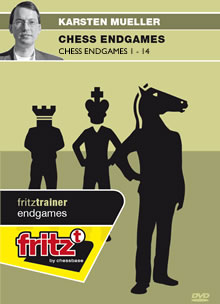
Dr. Karsten Müller – Chess Endgames 1 to 14: The Whole Müller Library in One Package
Karsten Müller started this ChessBase series in 2006 with a DVD on basic mates and pawn endings, and finished it fourteen volumes later with a summary of the rules of thumb that govern every endgame. In the introduction to the last volume he describes how the project grew: the first four volumes are sorted by material, volumes 5–7 are about endgame principles, volume 8 returns to practical rook endings, volumes 9–13 dig into endings with more pieces that most books barely cover, and volume 14 condenses everything. This page covers the full set exactly as it was published.
ChessBase’s own review of the final volume calls the series “one of the most valuable jewels in the ChessBase crown” and notes that “the high quality has been maintained all the way through the 14 volumes.” If you only need one topic, the single volumes of Chess Endgames 1 to 14 are also available — for example Chess Endgames 2 – Rook Endgames — and every Müller title is collected in the GM Karsten Müller category.
| Series Fact | Details |
|---|---|
| Author | GM Dr. Karsten Müller — endgame specialist from Hamburg, PhD in mathematics, ChessBase Magazine endgame author |
| Volumes | 14 — from Basic Knowledge for Beginners to The Golden Guidelines of Endgame Play |
| Video | 815 videos · 84h 17m total (3h 39m to 8h 59m per volume) |
| Format | MP4 video versions of the ChessBase Fritz Trainer DVDs, one folder per volume |
| Extra file | PDF booklet for volume 3, Major Piece Endgames (247.85 KB) |
| Level | Beginner (volume 1) to master level (volumes 9–13) |
| Publisher | ChessBase · total package 3.79 GB |
What Chess Endgames 1 to 14 Teaches You
Theory you must know by heart
Volumes 1–4 are the classical foundation, sorted by material. Volume 1 covers basic mates (including the knight-and-bishop W-manoeuvre), opposition, triangulation, the bodycheck and the rule of the square. Volume 2 is a systematic rook-ending manual from rook vs pawn to four against three on one wing. Volume 3 handles queen endings, queen vs rook, queen vs two rooks and rook vs minor piece, with ten clips on breaking queen-vs-rook fortresses alone. Volume 4 adds rook and bishop vs rook — Cochrane defence, second-rank defence, Philidor, Lolli, Szén and Chéron positions — plus rook vs two minor pieces and the bishop pair.
Principles: activity, prophylaxis, weaknesses
Volume 5 opens with a definition: an endgame is not a middlegame, because the king is activated instead of hidden. It then covers rook activity, initiative in rook-and-knight endings and the right exchange, including the rule that defenders of weaknesses should be exchanged. Volume 6 is about “do not rush”, prophylaxis (as Mark Dvoretsky always stressed), domination, zugzwang and thinking in schemes. Volume 7 turns to weaknesses, the principle of two weaknesses, converting an advantage, fortresses and a full chapter of typical mistakes.
Rook endings in practice — and the guidelines’ exceptions
Because volume 2 was mostly theory, Müller added volume 8 on practical rook endings: the umbrella, checking distance, the horizontal cut-off, simplifying into pawn endings, and why an active defending rook matters. His warning about rules of thumb is the thread through the whole series:
Endings with more pieces — the rare part
Volumes 9–13 are what make Chess Endgames 1 to 14 special. Müller notes that endings with rook and minor pieces occur “much more often than rook endings” yet are rarely treated in books. Volume 9 introduces his own names — “Fischer endgames” for rook and bishop vs rook and knight when the bishop side presses, “Andersson endgames” when the knight side does — and studies Fischer vs Taimanov 1970 and 1971. Volume 10 covers rook and two minor pieces, volume 11 rook vs bishop, volume 12 rook vs knight and volume 13 double-rook endings, built on games by Carlsen, Kramnik, Karpov, Kasparov, Anand, Ivanchuk, Shirov and Capablanca. Volume 14 then distils the series into 65 rule-based clips, from “activate the king” to Capablanca’s theorem.
Chess Endgames 1 to 14: Volume-by-Volume Index
Vol. 1 — Basic Knowledge for Beginners · 36 videos · 5h 36m
- 1.1–1.5 Basic mates: queen, rook, two bishops, bishop and knight with the W-manoeuvre
- 2.1–2.13 Pawn endings: rule of the square, king and pawn vs king, rook’s pawn, bodycheck, pawn vs pawn, protected and distant passed pawns, Capablanca, opposition, triangulation, exchanging one wing, breakthrough
- 3.1–3.7 Knight endings: a knight cannot lose a tempo, knight vs pawn(s), knight endings I–II
- 4.1–4.4 Bishop endings: bishop and pawn(s), bishop endings, opposite-coloured bishops I–II
- 5.1–5.5 Bishop vs knight: both sides’ chances, the knight’s fortress, knight and pawn vs bishop
- 6 Queen vs pawn
Vol. 2 — Rook Endgames · 44 videos · 5h 42m
- 6.0 Introduction · 6.1–6.4 Rook vs pawn
- 6.5–6.12 Rook and pawn vs rook (eight clips)
- 6.13–6.16 Rook and rook’s pawn vs rook
- 6.17–6.29 Rook and two pawns vs rook: connected passed pawns, other two-pawn cases, doubled pawns
- 6.30–6.34 Rook and four pawns vs rook and three on one wing
- 6.35–6.43 Practice: the Flohr–Vidmar classic, umbrella, activity, checking distance, recent rook endings
Vol. 3 — Major Piece Endgames · 59 videos · 7h 10m · PDF
- 7.01–7.14 Queen endings: queen vs pawn, queen vs queen, queen and rook’s, knight’s, bishop’s or central pawn vs queen, g- and h-pawn, perpetual check, mating motifs, far-advanced passed pawn
- 8.01–8.08 Rook vs knight: pawnless, fortress-breaking, advantage for either side
- 9.01–9.15 Rook vs bishop: pawnless, colour complexes, pawns on one wing, pawns on both wings
- 10.01–10.13 Queen vs rook: pawnless, 2nd- and 3rd-rank defence, ten fortress-breaking clips
- 11.01–11.09 Queen vs two rooks: when the rooks are better, when the queen is
- PDF booklet: Major Piece Endgames (247.85 KB)
Vol. 4 — Strategical Endgames · 62 videos · 6h 02m
- Introduction · Rook and bishop vs rook (12 clips): Cochrane defence, second-rank defence, Philidor and Lolli wins, Szén draw, Nunn, Chéron
- Rook and knight vs rook (4) · Rook vs bishop and knight (8)
- Rook and bishop vs rook and bishop: opposite- and same-coloured bishops (4)
- Rook and bishop vs rook and knight (5) · Rook and knight vs rook and knight
- Queen and knight vs queen and bishop (8)
- The bishop pair (9) · Double rook endings (10)
Vol. 5 — Endgame Principles: Activity & Initiative · 46 videos · 4h 18m
- Activity: an endgame isn’t a middlegame, king activity and board geometry, bodycheck, cutting off the king, blockade, rook activity I–III
- Board on fire, Ulf Andersson’s technique, Capablanca’s theorem, the queen to the fore
- Initiative: opposite-coloured bishops favour the side with the initiative (3), structure vs initiative, Stamma’s mate, Carlsen’s forceful knights, the Troitzky line, the fourth phase of the game
- The right exchange: queen exchange (3), exchanging into a pawn endgame (3), rook exchange (4)
- Defenders of weaknesses should be exchanged (5), the defender exchanges pawns, avoiding unfavourable exchanges
Vol. 6 — Endgame Principles: Domination & Prophylaxis · 64 videos · 5h 15m
- Do not rush: pawns cannot move backwards, the art of manoeuvring, over-hasty exchanges, Kramnik’s technique, waiting for the right moment
- Prophylaxis: intermediate moves, following several goals, playing with the whole army, repelling threats, tactical prophylaxis in defence, missed counterplay
- Play against weaknesses (4), the king in the cage, a corner knight
- Domination: rook vs knight, bishop vs knight, Georg Meier’s examples, rook dominating and being dominated, the queen dominated, bishop pair, bishop and knight vs two knights
- Zugzwang and schemes: knight endings are like pawn endings, the knight’s Achilles heel, dance of the kings, triangle manoeuvre, reserve tempi, target positions, the Karpov–Kasparov mystery (3), long-term plans
Vol. 7 — Endgame Principles: Weaknesses & Fortresses · 74 videos · 5h 40m
- Weaknesses: what a weakness is, fixing and creating weaknesses, undermining (3), exchanging the key defender, king invasion, weak colour complexes, two weaknesses, the second front
- Pawns: distant and protected passed pawns, majorities (3), Leko’s play for the better structure, pawn breaks (3), pawn roller, blockade breaker
- Converting an advantage: extra piece, pawn or exchange, space advantage (3), mobility, transforming one advantage into another
- Defence and fortresses: wrong rook’s pawn, drawing corner, desperado rook, bishop endings, “the most stunning move of all time”, fortresses with B vs R, N vs B, N vs R, rook endings, Q vs R
- Typical mistakes: passivity, shock, over-automatic rules, the wrong exchange, premature queening, greed, losing control
Vol. 8 — Practical Rook Endgames · 51 videos · 3h 39m
- Bodychecks, zwischenschach, stalemate tricks, sudden mating attacks, pawns against rook, the lasso
- Rooks behind passed pawns, winning technique against a blockading rook, the rook on both wings
- Checking distance and horizontal cut-off · The umbrella (4)
- Passed-pawn races, what to activate first, fatal passivity vs activity, binding, the beauty of ugly rook moves
- Simplifying into pawn endings (3), drawing technique, Dautov’s defence, the riddle of Marcel Duchamp, duel of the legends
Vol. 9 — Rook and Minor Piece · 71 videos · 7h 38m
- Rook and minor piece vs rook and minor piece: initiative, restriction strategies, coordination, the correct exchange
- “To exchange or not”: six case studies from 1989–2011
- Fischer endgames: Fischer vs Taimanov 1970 and 1971, Fischer’s first win against a Soviet GM, Fischer’s renowned exchange
- Model technique: Karpov, Kramnik, Ivanchuk, Shirov, Carlsen, Svidler, Karjakin, Grischuk, Rozentalis, Andersson
- Zugzwang, blockade, the h-pawn as the knight’s enemy, dark- and light-square play, fortress breakers
Vol. 10 — Rook and Two Minor Pieces · 64 videos · 6h 28m
- A slight initiative weighs very heavily, Magnus the mighty, the Troitzky line, knight magic, knight outposts
- Elite examples: Ivanchuk, Aronian, Leko’s light-footed steeds, Shirov, Short, Ponomariov, Anand, Bacrot, Steinitz
- Play on two wings (4), restriction of knights, the bishop pair, space advantage, the blockade, the Steinitzian restriction method
- Opposite-coloured bishops favour the initiative, Capablanca’s rule, the Berlin Wall and bishops, liquidation to a Fischer endgame
Vol. 11 — Rook against Bishop · 79 videos · 8h 59m
- Pawnless rook vs bishop (usually drawn), draw fortresses, the Guretzky-Cornitz win, the main fortress on the long diagonal
- Rook and pawn vs bishop and pawn, rook’s pawns, zugzwang, line opening, mate nets, trapping the rook
- More material: Kasparov’s combinations, two rooks in the attack, rook exchange as a weapon, connected passed pawns
- Exchange rules: the side fighting the rook avoids exchanges, the defender exchanges pawns, don’t let the bishop pair be halved
- Technique from Kramnik, Anand, Ponomariov, Svidler, Shirov and Carlsen
Vol. 12 — Rook vs Knight · 54 videos · 5h 39m
- Pawnless: drawn when the knight stays close to its king, won when it can be separated
- Aronian’s and Fischer’s fortresses, Flear’s fortress breaker, liquidation to a pawn ending, king invasion, knight tricks
- More material: Kasparov’s powerful rooks, Karpov’s fortress falls, Caruana’s comeback, Magnus’ masterpiece, Vishy’s outpost and blockade breaker
- Octopus knights, star check, Kramnik’s king, Smirin’s knight, McShane’s mate attack, Karpov’s lasso and rooks
Vol. 13 — Double Rook Endings · 44 videos · 4h 32m
- Theory: rook exchange for relief or as a weapon, intermediate check, four vs three on one wing
- Mating attacks: rooks on the seventh, the neuralgic point f7, mate nets with minimal means (3), the king in the trap
- The right exchange: relief or counterattack, liquidating into a pawn ending, how the attacker should proceed
- Classics and moderns: Karpov–Larsen, Rubinstein–Chigorin, Capablanca vs Kan and Janowski, Smyslov, Andersson, Shirov, Caruana, Carlsen, Aronian, Anand
- Passed pawns, activity and “the greed of the computer”
Vol. 14 — The Golden Guidelines of Endgame Play · 67 videos · 7h 31m
- General rules: activate the king, block passed pawns with king or knight, zugzwang and mutual zugzwang, the defender exchanges pawns, “it doesn’t matter what disappears from the board but what remains”
- Strategy: exchange defenders of weaknesses, bishops are easier to exchange than knights, two weaknesses, colour complexes, prophylaxis, do not rush, improve the worst piece
- Pawn and minor-piece rules: W-manoeuvre, square rule, opposition, bodycheck, distant passed pawn, Bähr’s rule, Fine’s and Botvinnik’s rules, the wrong rook’s pawn, Centurini’s rule
- Rook endings: Philidor, Lucena and Vancura, activate the rook, rooks behind passed pawns, the umbrella
- Mixed material: fortresses, rook vs minor pieces, the Fischer and Andersson endgames, Capablanca’s theorem · Outro
Who Needs the Complete Chess Endgames 1 to 14
- Ambitious club and tournament players who want one structured endgame curriculum for the next year or two.
- Coaches who need a deep library of examples, from basic mates to elite rook-and-minor-piece technique.
- Players who already know the basics but keep spoiling better endings — volumes 5–14 are aimed squarely at them.
- Collectors of the single volumes who want the whole series in one download instead of fourteen.
If you only need the fundamentals, the single volume Chess Endgames 1 – Basic Knowledge for Beginners is enough; if you want the summary first, start with Chess Endgames 14 – The Golden Guidelines.
- All of Chess Endgames 1 to 14 in one package: 815 videos, 84h 17m
- Covers theory, principles and practical technique
- Rare depth on rook-and-minor-piece and double-rook endings
- Short clips (about 78% run 3–10 minutes) — easy to study in daily blocks
- Huge range of model games, from Steinitz and Capablanca to Carlsen
- MP4 video only — the interactive Fritz Trainer databases and quizzes are not part of this set
- Only volume 3 includes a PDF; no PGN files
- The series began in 2006, so early volumes predate many recent elite games; the delivery is dense
- Far more material than a casual player will finish
Frequently Asked Questions
Is this really all fourteen volumes?
Yes. The index has one folder for each volume of Chess Endgames 1 to 14, from Basic Knowledge for Beginners to The Golden Guidelines of Endgame Play — 815 videos in total.
In what order should I study Chess Endgames 1 to 14?
Weaker players should go 1 → 2 → 8 → 5–7. Stronger players can start with volume 14 as a map, then go deep into volumes 9–13. Müller himself describes volume 14 as the whole material “in very condensed form.”
What do I get, and how is it delivered?
815 MP4 videos in 14 volume folders plus the volume 3 PDF, 3.79 GB in total. Digital files. Crypto payment only. Fast delivery is handled manually after payment confirmation. Download links remain available for 7 days; save your files locally.
Chess Endgames 1 to 14 is the most complete endgame video library you can own in one download. The first volumes give you the theoretical positions you must know by heart; the middle volumes teach the principles — activity, prophylaxis, the right exchange, two weaknesses; and volumes 9–13 cover the rook-and-minor-piece endings that decide real games but rarely get a book. Volume 14 ties it together.
The trade-off is format: this is video only, without the interactive databases of the original DVDs, so keep a board or engine at hand. For serious improvers, that is a small price for all 84 hours of Chess Endgames 1 to 14. Get the complete series through Courses On Budget and look at the coupons page before checkout.
Browse the category: Chess Courses · Chess Courses Cheap List
More from the author: GM Karsten Müller courses
New releases: Courses On Budget updates
Official series page: shop.chessbase.com (Chess Endgames 14)
Background reading: Chess endgame on Wikipedia
Recommended endgame stack:




Reviews
There are no reviews yet.