

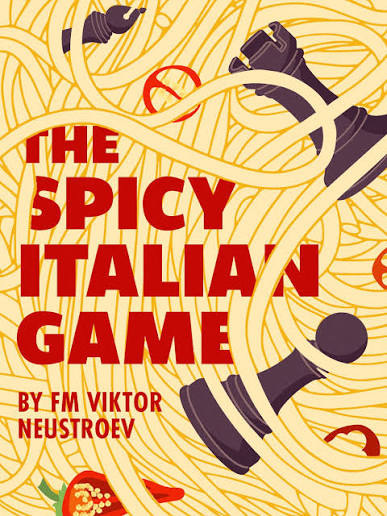
The Spicy Italian Game: Why Bg5 Changes the Giuoco Piano
Neustroev’s introduction is unusually personal. He plays 1.e4 because he wants open, tactical positions, but found the quiet a4, h3, Nbd2–f1–e3 manoeuvring Italian “a bit passive” — the setup he had once analysed with GM Dmitry Bocharov and played for years with only average results. After moving to Argentina in 2023 he took Spanish lessons with GM Robert Hungaski, who showed him the idea of Bg5. It is “definitely not a novelty,” he says, but it has become a regular weapon of top grandmasters, especially from India.
The concept of The Spicy Italian Game is simple to state and rich to play: pin the f6-knight, invite …h6 and …g5, drop the bishop to g3, then hit e5 with d4 — often as a deliberate pawn sacrifice for the initiative. On his chess.com blog the author promotes the course with “complete coverage of 6.Bg5 and other critical lines” and “model games from top players,” and the files confirm both. Browse other repertoires in our chess courses list.
| Course Fact | Details |
|---|---|
| Author | FM Viktor Neustroev — full-time coach (he mentions 20 private and 17 group students) |
| Side & opening | White — Italian Game / Giuoco Piano with c3, d3 and an early Bg5 |
| Black setups covered | Hungarian …Be7 · 3…Nf6 4.d3 d5 · …d6 setups · 5…a6 · 5…O-O · 5…a5 · 5…Qe7 / …d5 / …Bb6 |
| Video | 17 videos · 25h 40m (intro, quickstarter, 7 chapters with overview + main part) |
| Study file | One course PGN (821 KB) |
| Model games | Inside every “Overview & Model Games” video — Praggnanandhaa, Arjun Erigaisi, Wesley So, Demchenko and the author’s own games |
| Level | All levels by design — overviews first for beginners, full chapters for experienced players |
| Publisher | Chessable |
What You Learn in The Spicy Italian Game
The core plan: Bg5, Bh4, Bg3, then d4
In the main position after 1.e4 e5 2.Nf3 Nc6 3.Bc4 Bc5 4.c3 Nf6 5.d3, White plays Bg5 at the right moment and keeps the pin with Bh4 when Black plays …h6, provoking …g5. Black’s kingside pawn storm looks dangerous, but Neustroev’s point is that White can parry it, and the advanced pawns then become targets. The “locked” bishop on g3 wakes up the moment d4 arrives: it adds pressure on e5, and Black “simply cannot hold the pawn structure.” The introduction shows the typical shot — d4 as a deliberate pawn sacrifice, then e5 to open lines while Black’s …h6 and …g5 weaknesses are still on the board.
5…a6, the main line: a4, b4, b5
Chapter 4 (more than four hours in three videos) is the one to start with if you do not know where to begin, because 5…a6 is “the most common plan for black.” Black wants the bishop safe on a7; White answers with the queenside operation a4, b4 and b5, opening the a-file, chasing the c6-knight and fixing a6 as a weakness, and only then the central break. Chapter 4b handles the version where Black retreats to e7 and transposes to a Hungarian-style setup.
Early castling, …a5 and the Hungarian
Against 5…O-O the recommendation is the rare 6.a4 with a knight route via a3 — rather than an immediate Bg5 that lets Black choose a Hungarian setup — and the author jokes that after the course “you can call this variation like Neustroev variation.” Against 5…a5 he prefers castling first so that d4 becomes a real threat, then Bg5 once …d6 is played, using the weakened b5-square. The Hungarian Defence (3…Be7) gets its own chapter built on Nc3, Nf6, d3 instead of c3, after he lost two games in that line in 2019 and went back to the analysis.
Model games and the sidelines that cost points
Each chapter’s overview video teaches through games: Praggnanandhaa–Vidit, Wesley So–Mamedyarov, Arjun Erigaisi–Le Quang Liem, games by Anton Demchenko and two of Neustroev’s own in chapter 3. The final chapter covers early …Qe7 (met by b4 to gain a tempo), …d5 and …Bb6, a move a much lower-rated opponent once used to hold him for twenty moves. If you prefer a classical c3–d4 approach instead, compare The Dynamic Italian Game.
He also explains why he did not choose the Scotch, the Four Knights, the King’s Gambit, the Vienna or the Ruy Lopez against the Berlin — a short, useful lesson in repertoire choice before any moves are shown. Black players can study the other side of these positions in Gambit Buster: 1.e4 e5, which meets the Italian with 3…Bc5.
The Spicy Italian Game: Course Index
Start Here · 1h 45m
Introduction & Quickstarter
- Introduction — why Bg5, and how to study the course (12:28)
- Quickstarter — the most common and representative lines (1:32:35)
Chapters 1–3 · …Nf6 & …Be7 Setups
- Chapter 1 — Hungarian Defence: overview & model games (1:00:32) · main lines (1:04:31)
- Chapter 2 — 3…Nf6 4.d3 d5: overview & model games (49:32) · main lines (1:29:31)
- Chapter 3 — 3…Nf6 4.d3 Bc5 with …d6: overview & model games (1:08:49) · main lines (3:55:51)
Chapters 4–7 · 3…Bc5 Giuoco Piano
- Chapter 4 — 5…a6: overview & model games (1:11:22) · 4a 5…a6 & 6…h6 (1:47:01) · 4b 5…a6 6.Bg5 Be7 (1:05:39)
- Chapter 5 — 5…O-O: overview & model games (1:28:24) · main lines (3:18:09)
- Chapter 6 — 5…a5: overview & model games (1:19:13) · main lines (2:05:12)
- Chapter 7 — other 5th moves (…Qe7, …d5, …Bb6): overview (14:52) · main lines (1:56:52)
Files
- The Spicy Italian Game course PGN (821 KB)
- 17 MP4 video files · total package 8.13 GB
Who The Spicy Italian Game Suits
- 1.e4 players bored by slow Italians who still want a sound, flexible move order.
- Attackers who like pawn sacrifices for the initiative and exploiting …h6 / …g5 weaknesses.
- Club players of any level — the author suggests starting with the overviews and model games, then returning for the detailed chapters.
- Coaches looking for a teachable White system built on one recurring idea.
It is not for players who want the sharp 4.d4 or Evans lines, or who must also answer the Two Knights with Ng5 — the course stays with d3 and does not cover the Fried Liver. For a different take on the same opening, see Arjun Kalyan’s Lethal Italian.
- One recurring plan (Bg5 → d4) that is easy to remember across all chapters
- Over 25 hours of explained video plus a course PGN
- Every chapter has an overview with model games before the deep theory
- Honest coach: shows lines he lost in and how he fixed them
- Covers the annoying sidelines club players actually meet
- Very long — several single videos run over three hours
- White-only Italian; no Fried Liver, Evans or 4.d4 lines
- No separate exercise files beyond the one PGN
- A lot of time goes to rare deviations you may never meet
Common Questions
What if Black plays 3…Nf6 instead of 3…Bc5?
You play 4.d3 rather than the Fried Liver. Usually Black continues …Bc5 and you reach the main lines with c3; chapter 2 covers the rare 4…d5 and chapter 3 the …d6 setups.
Is the early Bg5 sound?
Neustroev calls it “definitely not a novelty” and shows top grandmasters using it. He admits his first results left him unhappy with the positions, and that deeper analysis is what made it work: “now, even if I lose the game in the Italian game, at least I usually have some opening advantage.”
What files do I get, and how is it delivered?
17 MP4 videos (8.13 GB) and the course PGN. Digital files. Crypto payment only. Fast delivery is handled manually after payment confirmation. Download links remain available for 7 days; save your files locally.
The Spicy Italian Game gives 1.e4 players a clear identity in the Giuoco Piano: pin with Bg5, provoke the kingside pawns, then open the centre with d4. Neustroev’s practical coaching voice, the overview-plus-model-games format and the honest notes on his own losses make the 25 hours easier to digest than the runtime suggests.
If you want to keep the Italian but stop drifting into equal manoeuvring games, this is a strong choice. Order on Courses On Budget and check the coupons page first.
Browse the category: Chess Courses · Chess Courses Cheap List
More from FM Neustroev: Sicilian Kan · Beating 1.Nf3 · Complete Semi-Slav
New releases: Courses On Budget updates
Official course page: chessable.com
Opening background: Giuoco Piano on Wikipedia
Recommended Italian Game stack:


Reviews
There are no reviews yet.