
Chess Strategy Lessons from Kramnik’s Trainer
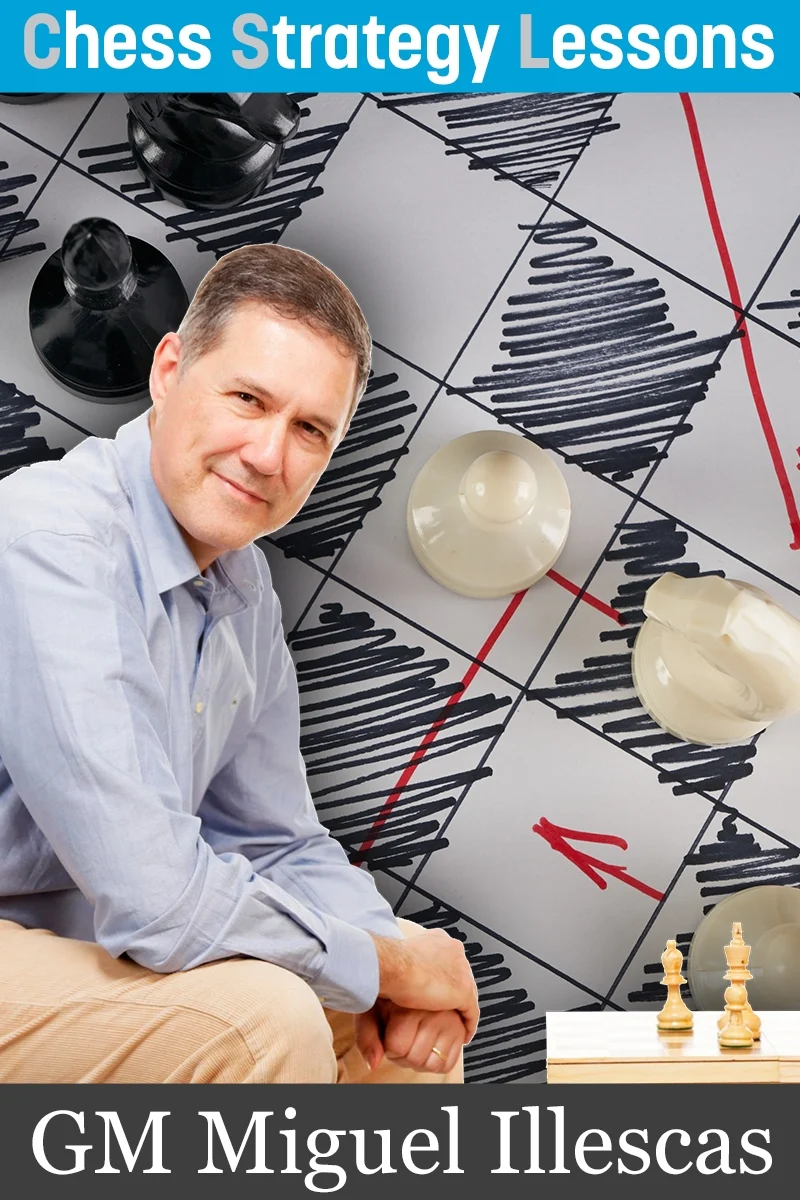
This is a strategy course built from the inside of elite chess. Illescas worked for years as the main coach of Vladimir Kramnik, helped him win the 2000 World Championship in London, and uses that experience throughout. In the bishop-for-knight lessons he recalls what he learned from Kramnik’s handling of the bishop pair; in the endgame lessons he shows his own games against Kasparov, Smyslov, Salov and Ulf Andersson and explains, with some humour, where he went wrong. Every video opens with a diagram and a question, and you are invited to stop and find the plan yourself.
The ICC presents the series as Illescas’s first English-language video course, made with his school EDAMI, and describes the coverage as “when to push rook pawns, when to trade a bishop for a knight” and “the key elements of doubled pawns” — plus the Carlsbad structure, open files, bad pieces, planning by pawn structure and exchanges on the way to an endgame. That is exactly what the 16 lessons deliver. They sit naturally among the strategy titles in our chess courses category.
| Series Fact | Details |
|---|---|
| Instructor | GM Miguel Illescas — eight-time Spanish champion, Kramnik’s second for the 2000 World Championship, FIDE Senior Trainer (2004) |
| Topic | Positional strategy: h-pawn advance, bishop vs knight, backward pawns, open files, doubled pawns, bad pieces, planning, transition to the endgame |
| Video | 16 videos · 8h 57m total (24 to 44 minutes each) |
| Format | MP4 video lectures with on-screen board and “stop the video and think” questions |
| Model games | Kasparov, Karpov, Carlsen, Kramnik, Anand, Capablanca, Botvinnik, Lasker, Reshevsky, Smyslov and Illescas’s own games |
| Level | Intermediate to advanced club players |
| Publisher | Internet Chess Club (ICC), in collaboration with EDAMI |
What the Chess Strategy Lessons Teach
h4 as a strategic weapon, not an attack
The first video deals with a modern fashion: both sides castled kingside and White simply pushes the h-pawn. Illescas separates this clearly from Dragon-style h4 attacks and explains the long-term logic instead. If Black answers …h5, the g5 and g6 squares can become weak; if Black plays …h6, his kingside pawns lose flexibility; if Black waits, White gains space with h5–h6 and trades an h-pawn for a g-pawn — a deal that leaves the black king more exposed and the white pawns controlling more squares. The examples come from Caruana’s games at the most recent Candidates event.
When a good bishop takes a knight
Two videos cover one of the hardest decisions in chess. Starting from the old idea that the bishop is usually worth more, Illescas shows when giving up the good bishop is right — and what you must do afterwards. His key rule: after trading a bishop, put your pawns on the colour of the missing bishop, as Yuffa does with …e6 in a Caro-Kann against Radjabov from the 2019 World Cup. Carlsen–Kramnik and examples from Kramnik’s own repertoire show the same balance from the elite side.
Structures: Carlsbad, open files and doubled pawns
Lessons 4–9 are pure structure. The backward c7-pawn in the Carlsbad structure after an early b4–b5 (with Anand’s rapid technique against Ljubojević and a Carlsen–Aronian comparison). Open and semi-open files, why the rooks are exchanged when both sides fight for one file, the “remove the defender of the entry square” method, and Kasparov–Petrosian, Bugojno 1982, as a warning against passive defence. Then doubled pawns: Illescas’s point is that they are weak mainly when isolated, while doubled pawns inside a chain — like the Nimzo-Indian a3 structure — can be good in the opening, good in the middlegame and bad only in the endgame.
Bad pieces, planning and the road to the endgame
Lesson 10 starts from Kasparov–Karpov, Seville 1987, and asks whether a bad piece is bad permanently or only for now. Lessons 11–12 teach planning from the pawn structure with Botvinnik–Capablanca from AVRO 1938 and Salov–Illescas, Madrid 1994. The final four videos are about exchanges: when to enter an endgame and when to stay in the middlegame, with Reshevsky as a model, Illescas’s own game against Kasparov from 1989, a game he played aged 16, and a long Smyslov encounter and a 72-move knight ending against Ulf Andersson.
The tone throughout is a trainer talking to a student, not a lecture. If you prefer a more systematic, book-style curriculum alongside these Chess Strategy Lessons, pair them with GM Johan Hellsten’s Mastering Chess Strategy or the video version of Silman’s Complete Book of Chess Strategy.
Chess Strategy Lessons: Video Index
Structures and Pieces
- Video 1 — Advancing the h-pawn with both kings castled short (31:17)
- Video 2 — Good bishop takes knight, part 1 (37:59)
- Video 3 — Good bishop takes knight, part 2: early trades in the opening (38:03)
- Video 4 — The backward c-pawn in the Carlsbad structure, part 1 (28:13)
- Video 5 — The backward c-pawn, part 2: Anand’s technique (23:59)
- Video 6 — The open file, part 1 (30:43)
- Video 7 — The open file, part 2: removing the defender of the entry squares (30:24)
- Video 8 — Doubled pawns, part 1 (31:49)
- Video 9 — Doubled pawns, part 2: the Nimzo-Indian structure (31:58)
- Video 10 — Bad pieces: permanent or temporary? (37:59)
- Video 11 — Making a plan from the pawn structure, part 1 (35:47)
- Video 12 — Pawn structure and the positional attack, part 2 (28:37)
Transition to the Endgame · 4 Videos
- Video 13 — Exchanging pieces: endgame or middlegame? (37:35)
- Video 14 — Liquidation to the endgame: Illescas’s games, including Kasparov 1989 (44:07)
- Video 15 — Steering into a favourable endgame (27:03)
- Video 16 — From middlegame to endgame: Smyslov and a knight ending vs Andersson (42:10)
Package
- 16 MP4 video files, one per lesson
- Total runtime: 8h 57m · total size: 1.13 GB
Who Will Get the Most from This Series
- Club players around intermediate level and above who calculate well enough but lose games to slow positional mistakes.
- Players who struggle with trades — bishop for knight, rook exchanges on an open file, or the queen trade that decides the endgame.
- Students of classic and modern games who want Capablanca and Botvinnik explained next to Carlsen and Caruana.
- Coaches looking for well-chosen strategic examples with clear verbal explanations.
Beginners will find the pace and the level of the examples demanding; a gentler start is IM Andrew Martin’s First Steps in Chess Strategy.
- Taught by a world-championship second with first-hand stories
- Clear rules of thumb: pawns on the colour of the traded bishop, doubled pawns weak mainly when isolated
- Strong mix of classic and recent elite games
- Four full videos on the middlegame-to-endgame transition — rarely covered
- Almost nine hours of material, organised by theme
- Video only — no PGN or database files with the games
- The ICC lists the series as 17 parts; this package contains 16 videos
- Videos are numbered, not titled, so use the index above to navigate
Questions About the Chess Strategy Lessons
Is this an opening course?
No. Openings appear only as the source of a structure — the Carlsbad, the Nimzo-Indian a3 structure, a Caro-Kann bishop trade. The subject is what to do after the opening: plans, exchanges, pawn structures and the endgame transition.
Does Illescas use his own games?
Yes, especially in the second half: games against Salov, Kasparov, Smyslov and Ulf Andersson, plus a game he played at 16. He is honest about his mistakes, which makes the endgame lessons very practical.
What exactly do I download, and how is it delivered?
Sixteen MP4 lesson videos (1.13 GB in total). Digital files. Crypto payment only. Fast delivery is handled manually after payment confirmation. Download links remain available for 7 days; save your files locally.
These Chess Strategy Lessons are the kind of material you normally only get from a private trainer. Illescas picks the decisions that quietly lose club games — an unnecessary bishop trade, the wrong reaction to h4, a passive rook on an open file, the wrong exchange before the endgame — and explains them with clear rules and memorable examples, from Capablanca to Caruana and from his own career.
The lack of PGN files is the only real drawback; keep a board or engine next to you and the nine hours become a full strategy workshop. Get the series through Courses On Budget and see the coupons page before you pay.
Browse the category: Chess Courses · Chess Courses Cheap List
New releases: Courses On Budget updates
Official course page: shop.chessclub.com (ICC)
Background reading: Chess strategy on Wikipedia
Recommended chess strategy stack:



Reviews
There are no reviews yet.