
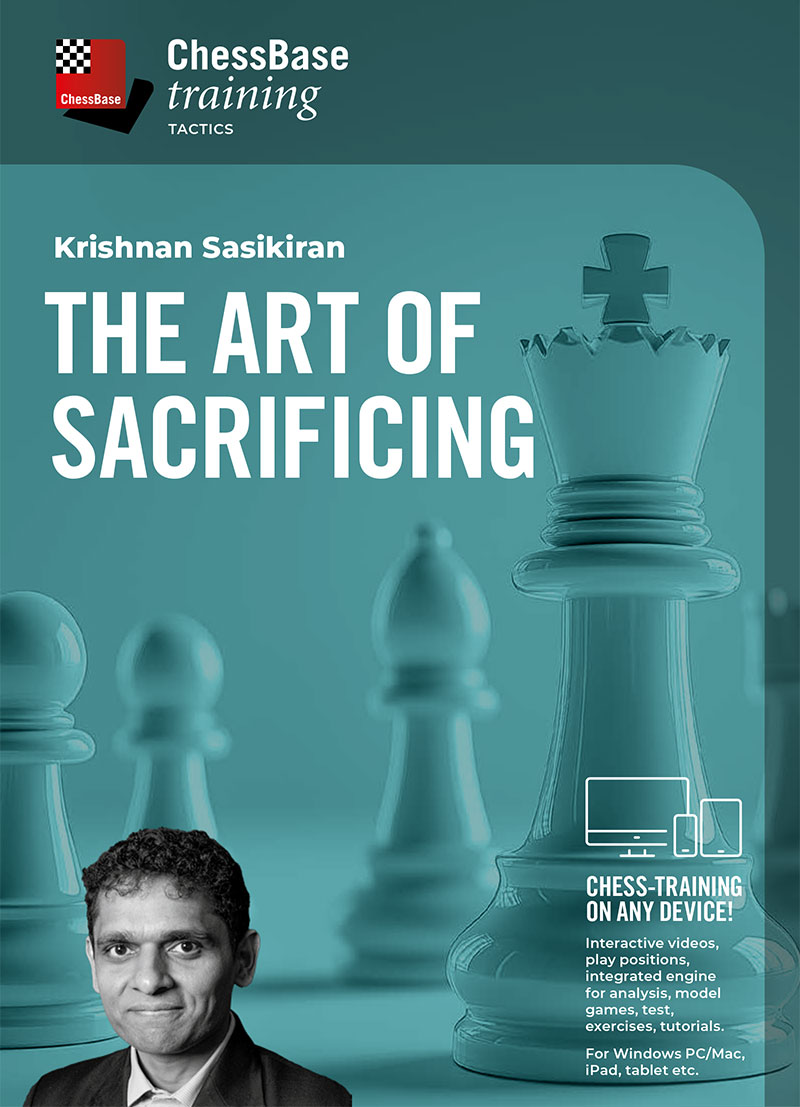
The Art of Sacrificing: Material for Initiative, Attack and Structure
ChessBase opens the official description with a line every club player recognises: “The perfect sacrifice is every chess player’s dream.” The course then treats the sacrifice in all its forms — for the initiative, for an attack, for a better pawn structure — using examples from Sasikiran’s own career. According to the publisher, he explains not only the moves but his thought process and his emotions at the board, the part of a sacrifice that annotations in books usually leave out.
This product is supplied as a protected ChessBase FritzTrainer package, so the chapter list and running time on this page come from the official ChessBase product page rather than from our own transcripts. What stands out in that list is the balance: four chapters on making sacrifices and a fifth on surviving them. If you want a second, more structural view of the same theme, IM Kostya Kavutskiy’s Positional Sacrifices Vol. 2: Pieces is a natural partner. More strategy titles are in our chess courses list.
| Course Fact | Details |
|---|---|
| Instructor | GM Krishnan Sasikiran — eleven-time Olympiad participant for India (publisher), peak rating 2720 in 2012, second to Viswanathan Anand in the 2013 World Championship |
| Topic | Pawn, exchange, attacking and queen sacrifices — and defending against them |
| Running time | 8h 57m of video (official figure) |
| Structure | Introduction, five chapters, practice positions |
| Training | Interactive exercises with video feedback; blindfold calculation alongside the author |
| Format | ChessBase FritzTrainer, English, Windows package of about 3 GB in two parts |
| Level | Tournament player to professional (publisher’s rating) |
| Publisher | ChessBase, released July 2025 |
What the Five Chapters Cover
Pawn sacrifices with four different goals
The biggest chapter is about the smallest unit of material. Its lessons are named after what the pawn buys: long-term initiative, immediate initiative (two parts), restricting your opponent (two parts) and long-term active play (two parts). That split is useful in practice — before you give up a pawn you should know which of the four you are playing for. “Sacrificing a Pawn for Initiative” is one of the two lessons ChessBase offers as a free sample.
Exchange sacrifices and sacrificing for the attack
Two two-part chapters follow: the exchange sacrifice, where a rook is given for a knight or bishop, and sacrifices made directly to attack the king. A ChessBase review of the course describes the progression from pawn sacrifices through exchange sacrifices to queen sacrifices, and puts the core idea simply: “The art of sacrificing lies in correctly assessing the return for the material invested.”
The queen sacrifice
The fourth chapter, again in two parts, is devoted to the biggest investment on the board. For most players a queen sacrifice is something they admire in other people’s games; here it is treated as a decision with the same logic as a pawn sacrifice — what do you get back, and is it enough?
Playing against the sacrifice
This is the chapter that makes the Art of Sacrificing different from most sacrifice courses. Four lessons look at the defender’s side: accepting a sacrifice and creating a counter-attack, playing against the exchange sacrifice, and enduring a sacrifice-induced attack (two parts). Knowing when a sacrifice is unsound is as valuable as playing one, and it is the part of the subject that club players practise least.
Thinking aloud and calculating blindfold
The publisher stresses Sasikiran’s teaching style: he explains his thinking during his own games, and at times asks you to calculate variations blindfold alongside him. That turns the course into visualisation and calculation training as well as a lesson in sacrifices. Interactive exercises with video feedback, and a final practice section, let you test the ideas yourself.
The Art of Sacrificing: Course Contents
Chapters and Lessons
- Introduction
- Pawn Sacrifices — Sacrificing a Pawn for Long-Term Initiative · Sacrificing a Pawn for Initiative, parts 1–2 · Sacrificing a Pawn to Restrict Your Opponent, parts 1–2 · Sacrificing a Pawn for Long-Term Active Play, parts 1–2
- Exchange Sacrifices — Exchange Sacrifice, parts 1–2
- Sacrificing for the Attack — parts 1–2
- Queen Sacrifice — parts 1–2
- Playing Against the Sacrifice — Accepting the Sacrifice and Creating a Counter-Attack · Playing Against the Exchange Sacrifice · Enduring the Sacrifice-Induced Attack, parts 1–2
Practice
- Practice Positions — final training section
- Interactive exercises with video feedback inside the lessons
Package
- ChessBase FritzTrainer course for Windows, delivered in two parts
- Cover image
- Total package: about 3 GB
Who This Sacrifice Course Is For
- Tournament players who see sacrifices in their games but cannot judge whether the compensation is real.
- Defenders who keep losing to speculative attacks and want a method for accepting, refuting or surviving a sacrifice.
- Players working on calculation — the blindfold sections double as visualisation training.
- ChessBase users who like interactive video with exercises and feedback inside the program.
The publisher rates it for tournament players and professionals, so it is not the place to learn your first combinations. Newer players will get more from First Steps in Gambits and Sacrifices or from solving a pattern book such as 1001 Brilliant Chess Sacrifices and Combinations.
- Almost nine hours of video from an elite grandmaster
- Covers every scale of sacrifice, from one pawn to the queen
- A full chapter on defending against sacrifices
- Examples from the author’s own games, with his thinking explained
- Interactive exercises and blindfold calculation build practical skill
- Windows ChessBase package — not a set of plain MP4 files
- The practice section is small; a ChessBase review counts only four training positions
- Aimed at tournament players; beginners may find it too demanding
Frequently Asked Questions
Does the Art of Sacrificing only teach attacking sacrifices?
No. Attacking sacrifices are one chapter. The largest chapter is about pawn sacrifices for initiative, restriction and long-term activity, and another chapter teaches you how to play against sacrifices.
Which games are used as examples?
The publisher states that the examples come from Sasikiran’s own career, which is why he can explain his decisions and feelings at the board. We do not list individual games here because the official page does not name them.
What format is it in, and how is it delivered?
It is a ChessBase FritzTrainer course for Windows, supplied as a two-part package of about 3 GB. Digital files. Crypto payment only. Fast delivery is handled manually after payment confirmation. Download links remain available for 7 days; save your files locally.
The Art of Sacrificing is a broad, grandmaster-level look at one of the most emotional decisions in chess. Its structure is its strength: four reasons to give up a pawn, then the exchange, the attack and the queen, and finally a chapter that teaches you to sit on the other side of the board. With nearly nine hours of video and the author’s own games as material, it suits tournament players who want to sacrifice with judgement rather than hope.
Remember it is a Windows ChessBase package, and check the coupons page before ordering.
Browse the category: Chess Courses · Chess Courses Cheap List
New releases: Courses On Budget updates
Official course page: shop.chessbase.com
About the author: Krishnan Sasikiran on Wikipedia
Recommended sacrifice stack:


Reviews
There are no reviews yet.