

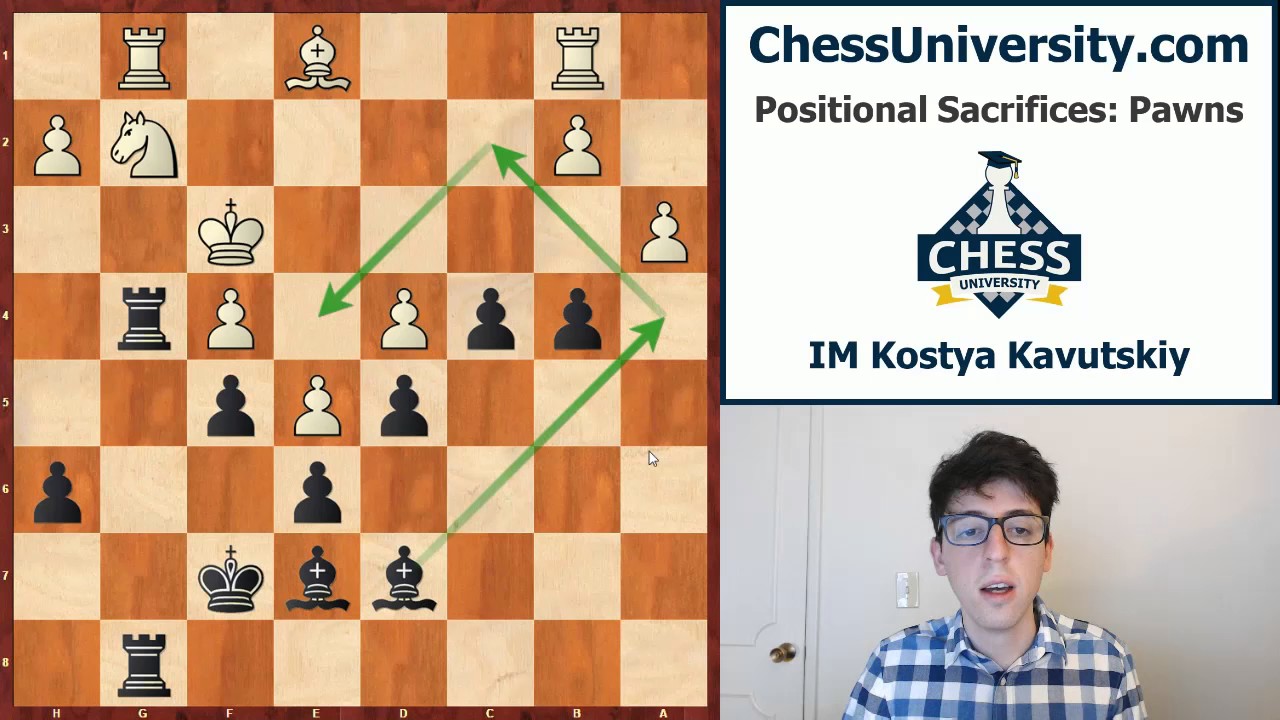
Positional Pawn Sacrifices: Paying One Pawn for a Better Position
Most club players know the gambit: a pawn for development and a quick attack. Positional pawn sacrifices are something else. Kavutskiy defines the theme in the opening of Volume 2, looking back at this course: one side gives up a pawn “not necessarily to get an attack or some kind of initiative, but rather to get some kind of strategic advantage” — control over a key file or square, or damage to the opponent’s pawn structure. The Chess University announcement for the course sums up the same list: “control of key squares, files and diagonals” and “damaging the opponent’s structure”.
The course is built like a catalogue of reasons to sacrifice. Each chapter takes one kind of compensation — an outpost, an open line, a colour complex, domination, structural damage, opening theory — and shows it in master games from Steinitz to Carlsen. Kavutskiy is careful about the line between dynamic and positional play: in one Kasparov game he stops to label a pawn offer “more of a dynamic pawn sacrifice”, not the kind this course is about. This is Volume 1 of a two-part series; the material sacrifices — exchange, piece, rook and queen — are covered in Positional Sacrifices Vol. 2: Pieces. Both sit in our chess courses list.
| Course Fact | Details |
|---|---|
| Instructor | IM Kostya Kavutskiy, International Master and professional coach |
| Topic | Positional pawn sacrifices in the opening, middlegame and endgame |
| Series | Positional Sacrifices — Vol. 1 Pawns (this course) · Vol. 2 Pieces |
| Video | 17 videos · 5h 56m total (2 classics lessons, 14 chapter lessons, modern examples and conclusion) |
| Practice | 6 exercise sheets (PDF), one per chapter, with answers in PGN |
| Study files | Lesson-example and additional-example PGNs for every chapter, classics and modern-games PGNs, course outline PDF |
| Level | Club to advanced — announced by the publisher for 1600–2100 Elo |
| Publisher | Chess University |
Six Reasons to Give Up a Pawn
Outposts from the d4–d5 and e4–e5 breaks
Chapter 1 starts with the most common of all positional pawn sacrifices: pushing the d-pawn or e-pawn into a defended square so the opponent must capture, and then planting a knight on the square that opens up. The classics section already shows the model — Steinitz’s d4–d5 against von Bardeleben (Hastings 1895), followed by Nd4 — and Penrose’s e5 break against Tal in a Benoni-type structure. Part 3 adds unusual cases, such as Nepomniachtchi advancing f5 and then f6 in an Open Sicilian purely to win the f5 square for a knight that Black can never safely chase away with …g6.
Open files and long diagonals
Chapter 2 is about lines. Part 1 opens files for the rooks, with two Kasparov games as the starting point. Part 2 covers diagonals: Wang Yue vs Radjabov from Wijk aan Zee 2009, where White aims for a good-knight-versus-bad-bishop ending and Black answers by simply giving up the e-pawn to free his dark-squared bishop. The coach also shows what White should have done instead, so you see both sides of the decision.
Colour complexes and the blockade
This is the most distinctive part of the course. The active blockade — Geller’s …e4 and …f4 against Pilnik, building a dark-square wall before winning on the kingside — is shown next to the defensive blockade, where a pawn is sacrificed to lock the position and hold a draw. Part 3 explains the trade-off behind Jaan Ehlvest’s King’s Indian …Nh5: a whole centre pawn given up to remove White’s dark-squared bishop and leave Black’s bishop without a rival.
Domination, space and a broken structure
Chapters 4 and 5 deal with long-term compensation. Petrosian vs Portisch shows a pawn given up to restrict the enemy pieces, and Polugaevsky vs Romanishin (1978) a pawn traded for a space advantage in a well-known Slav position. In the structure chapter Kavutskiy draws a useful distinction: some sacrifices double the enemy pawns and win the material back quickly, while the more ambitious kind leaves the pawn alone and plays around the damaged structure. Fischer’s thematic e5–e6 against Olafsson opens the chapter.
Pawn sacrifices that come from the opening
Chapter 6 links the theme to real repertoire choices. The Benko Gambit is presented as positional rather than purely dynamic, through Taimanov vs Bronstein from the 1953 Zurich Candidates, and the Sicilian …d6–d5 break in Petrosian vs Smyslov (USSR Championship 1949) shows the same idea in a middlegame structure. If you want a second, more theoretical take on this chapter, Strategy University Vol. 3: Pawn Sacrifice covers similar ground. The course ends with recent elite games, including Carlsen vs Wesley So from the 2015 Sinquefield Cup.
Positional Pawn Sacrifices: Vol. 1 Course Index
Lessons in Course Order
- The Classics, part 1 — historic positional sacrifices from Steinitz to Penrose–Tal (32:10)
- The Classics, part 2 — Kasparov’s pawn sacrifices (21:52)
- Chapter 1.1 — Creating an outpost: the d4–d5 break (19:31)
- Chapter 1.2 — Creating an outpost: the e4–e5 break (26:14)
- Chapter 1.3 — Creating an outpost: unique examples (30:38)
- Chapter 2.1 — Opening lines: files (26:55)
- Chapter 2.2 — Opening lines: diagonals (17:14)
- Chapter 3.1 — Colour complex: active blockade (20:38)
- Chapter 3.2 — Colour complex: defensive blockade (13:38)
- Chapter 3.3 — Colour complex: exchanging the key bishop (23:07)
- Chapter 4.1 — Domination: restricting enemy pieces (17:26)
- Chapter 4.2 — Domination: space advantage (22:16)
- Chapter 5.1 — Destroying the enemy pawn structure, part 1 (18:18)
- Chapter 5.2 — Destroying the enemy pawn structure, part 2 (9:11)
- Chapter 6.1 — Opening sacrifices: theoretical pawn sacrifices (20:46)
- Chapter 6.2 — Opening sacrifices: thematic middlegame sacrifices (14:57)
- Modern classics and conclusion (21:28)
Practice · 6 Exercise Sets
- Exercises PDF for each of Chapters 1–6
- Matching answer file in PGN for every exercise sheet
Study Files
- Lesson Examples PGN and Additional Examples PGN for every chapter
- The Classics PGN and Modern Examples PGN
- Course information and table of contents (PDF)
- Total package: 503 MB
Who Should Study Positional Pawn Sacrifices
- Club players around 1600–2100 who reach good positions but rarely find a way to change them.
- Materialistic players who hold on to every pawn and want to understand when a pawn is worth less than a square.
- Benko, King’s Indian and Sicilian players who want the positional logic behind the standard pawn offers in their openings.
- Students of classic games who like learning from Steinitz, Capablanca, Petrosian, Tal and Kasparov alongside modern elite examples.
It is not a first course on sacrifices. If you are still learning what a gambit is and how to attack a king, start with First Steps in Gambits and Sacrifices and come back to this one later.
- Positional pawn sacrifices organised by type of compensation, so each idea is easy to recognise in your own games
- Exercise sheet with PGN answers for every chapter
- Separate PGN files for lesson examples and additional examples
- Strong mix of classic and recent elite games
- Clear line drawn between dynamic gambits and true positional sacrifices
- Pawn sacrifices only — exchange, piece and queen sacrifices are in Vol. 2
- Chapter 5 part 2 is short (about 9 minutes)
- Games are shown at club-master pace; beginners may need to pause often
Questions About Vol. 1
How is a positional pawn sacrifice different from a gambit?
A gambit usually pays a pawn for time and a quick initiative. The positional pawn sacrifices in this course pay for something that lasts — a square, a file, a colour complex, a broken structure — and the compensation can take many moves to cash in. Kavutskiy points out the difference whenever an example is closer to the dynamic kind.
Do I need Vol. 2 as well?
No. Vol. 1 stands on its own and covers only pawns. Vol. 2 moves on to exchange sacrifices, minor-piece sacrifices and rook and queen sacrifices. Together they form the complete series.
What is in the download, and how is it delivered?
17 MP4 videos, PGN files for every chapter, six exercise PDFs with PGN answers and a course outline PDF. Digital files. Crypto payment only. Fast delivery is handled manually after payment confirmation. Download links remain available for 7 days; save your files locally.
Kavutskiy’s course makes positional pawn sacrifices feel like a normal planning tool rather than a romantic gamble. Each chapter answers one question — what can a pawn buy? — and the answers are concrete: an outpost after d4–d5, an open diagonal, a dark-square blockade, a ruined structure. With exercises and PGNs for every chapter, it is one of the more complete strategy packages for the club-to-expert range.
Pair it with Vol. 2 for the piece sacrifices, and check the coupons page before you order.
Browse the category: Chess Courses · Chess Courses Cheap List
New releases: Courses On Budget updates
Official course announcement: Chess University on chess.com
Background reading: Sacrifice (chess) on Wikipedia
Recommended sacrifice and strategy stack:


Reviews
There are no reviews yet.