
Complete Chess Endgames Review: The Verdict in 60 Seconds
Karsten Müller spent eight years on this ChessBase project, and it shows. The fourteen volumes run from the king-and-queen mate to rook against two minor pieces, and the coach never loses his systematic tone. The package is not a course you finish in a month; it is a library you dip into for a year. Its strongest asset is the long middle section on endings with rooks and minor pieces, an area most endgame books treat in a few pages. Its weakest point is the format: these are video exports of the Fritz Trainer discs, so the interactive databases and quiz positions of the originals are not part of the download.
Depth gets a perfect score because nothing in our store goes further into mixed-material endings. Structure loses points because the series grew over time: the first four volumes are sorted by material, the next three by theme, and volume 14 repeats the key rules, so a newcomer needs a map. That map is what this Complete Chess Endgames review tries to give you. Study files score lowest: apart from one PDF booklet in volume 3 you get video only, so keep a board or an engine open. Browse every endgame title on our chess courses list if you want to compare first.
Meet the Coach
- Born 1970 in Hamburg; Grandmaster title in 1998
- PhD in mathematics from the University of Hamburg (2002)
- Co-author of Fundamental Chess Endings with Frank Lamprecht (2001)
- ChessBase Magazine contributor since 1997 and long-time Bundesliga player for HSK (per ChessBase)
The mathematician is visible inside the lessons. In the introduction to the final volume Müller says he prefers what he calls graphical guidelines — winning zones, drawing zones, the magic square — over long algebraic calculation, because he sees them faster himself. He also explains the plan behind the series: volumes 9–13 follow Glenn Flear’s work on endings with two pieces each, and his personal favourite is volume 9, because rook and minor piece endings occur in practice even more often than pure rook endings.
How to Get the Series
Where the 84h 17m Goes, Volume by Volume
The product page lists the clips of every volume. For this Complete Chess Endgames review we added up the runtime instead, because the split tells you more than the titles do. The average clip lasts just over six minutes, but the volumes differ a lot: practical rook endings (volume 8) is the shortest disc, while rook against bishop (volume 11) runs almost nine hours on its own. Red bars are material-based volumes; dark bars are the principle volumes and the final summary.
Group the volumes and the real shape of the series appears. The material-based foundation (volumes 1–4) takes 1,471 minutes, the principles block (5–7) 914, practical rook endings 220, the mixed-material block (9–13) 2,000 and the golden guidelines 452. In other words, almost 40% of the whole package sits in endings with rooks and minor pieces or two rooks on each side. If those are the endings you keep reaching from your openings, this is where the value is.
A Worked Example: Improve the Worst Piece
To judge a teacher, follow one idea from rule to result. Our pick comes from volume 14, where Müller explains what the literature also calls Makogonov’s principle. The model game is Karjakin–Wang Hao from the 2013 Supreme Masters event, a quiet position with bishops against a knight and no immediate tactics.
- State the rule. In a quiet position, ask every piece which one is furthest from its potential, then improve it or exchange it. Müller’s advice is literal: talk to your pieces.
- Check that the position really is quiet. Before any planning he tests Black’s one tactical try on the c-file and shows why it fails to a back-rank mate. Only then do the rules apply.
- Interview the pieces. The rook on d1 already holds an open file. The other rook and the bishop have jobs. The king on b1 stands on a light square where the enemy bishop can check and is far from the centre — so it is the worst piece. Karjakin plays Kb2, where the b3-pawn also keeps the knight out.
- Include the pawns. Next, the queenside majority and especially the a-pawn has the most potential, while the king walks towards the centre to support the bishop.
- Use flexibility as a tiebreak. When rook and bishop both look improvable, choose the bishop: it has only one good route, to d3, while the rook has several and should keep its options.
- Finish with the last unit. At the end even the h-pawn counts as a piece. Karjakin’s h4 brings his backward h-pawn into play and Wang Hao resigns.
The sequence shows Müller’s method in miniature: one guideline, a concrete check that it applies, a top-level game, and a warning at the end that principles alone never win. You meet the same pattern in hundreds of clips across the series.
Second Example: The Three-File Rule for Passed Pawns
Opposite-coloured bishops have the largest drawing tendency of all theoretical endings, and volume 14 gives a precise guideline for the case where one side has two extra passed pawns. If the pawns are two files apart or less, the defender usually draws by blockading them on one diagonal. The famous exception is a pair of bishop’s pawns, a c-pawn and an f-pawn, which cannot be stopped on the same diagonal. If the pawns are three files apart or more, the attacker usually wins, unless one of them is a wrong rook’s pawn the king can stop.
What makes the clip valuable is the next layer. Müller shows that the defender cannot simply wait on one diagonal; the bishop must take aim at a pawn at the right moment and then switch diagonals. He then shows an attacking king march in which zugzwang breaks one line of defence after another, and a single careless pawn push that would have handed the defender a fortress. The rule takes thirty seconds to learn; the clip shows why knowing it is not enough, and it is the main reason this Complete Chess Endgames review treats volume 14 as more than a summary.
The Index, Turned Into Six Study Paths by Goal
The full volume-by-volume file list lives on the course page. Nobody should watch 84 hours in order, so for this Complete Chess Endgames review we regrouped the real runtimes by the problem you want to solve. The pace column assumes 45 minutes of video a day; double it if you replay the positions on a board, which we strongly recommend.
| Your goal | Watch | Video time | Pace at 45 min/day |
|---|---|---|---|
| Stop losing “simple” endings | Vols 1 + 2 | 679 min | about 16 days |
| Save and win more rook endings | Vols 2, 8 and 13 | 836 min | about 19 days |
| Convert better positions | Vols 5–7 | 914 min | about 21 days |
| Handle queens and major pieces | Vols 3 + 4 | 792 min | about 18 days |
| Master rook vs minor pieces | Vols 9–12 | 1,727 min | about 39 days |
| Refresh everything before a tournament | Vol 14 | 452 min | about 11 days |
Two tips from the transcripts make these paths work better. First, Müller often stops and asks “what do you think?” before he shows the solution, so pause the video there instead of letting it run. Second, volume 14 cross-references almost every earlier disc, which makes it a good final exam for whichever path you chose.
Endgames · All levels
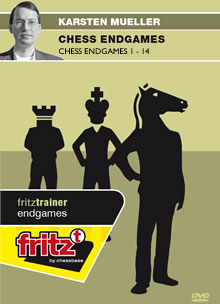
GM Karsten Müller — Complete Chess Endgames 1 to 14
Fourteen volumes, 815 short clips and the volume 3 PDF booklet, from basic mates through principles, practical rook endings and mixed material to the golden guidelines. The complete index with every volume folder is on the product page.
Test Yourself: Four Questions From the Series
Every honest Complete Chess Endgames review should help you judge whether the series fits your level. These four questions come straight from the lessons. If you answer all of them, start with volumes 9–13; if not, the early volumes are your first stop. Open a question to check your answer.
1. In the basic king-and-queen mate, what does Müller teach first?
2. Which pieces should blockade an enemy passed pawn?
3. With opposite-coloured bishops and two extra passed pawns, when do the pawns usually win?
4. In a quiet position, how do you choose your next plan with Makogonov’s principle?
Complete Chess Endgames Review: Strengths and Gaps
A coach who argues with his own rules
Müller teaches rules of thumb, but he spends just as much time on the moments when they collide. In rook-plus-opposite-bishop positions, for example, the endgame rule says “drawish” while the middlegame rule says opposite bishops favour the attacker — and he shows that the attacker should keep the rooks on. That habit of testing every guideline against a counter-example is the best thing in the series.
Modern elite games next to the classics
Theory clips use composed positions and classic fortresses such as Kling and Horwitz, but the practical examples are heavy with recent top-level play: Kramnik and Grischuk in their 2011 Candidates match, Karjakin, Carlsen, Caruana, Anand and Aronian in the later volumes. The older volumes, recorded from 2006 onwards, naturally use older games, which is one reason volume 14 is useful as an update.
Where the package stops
Any fair Complete Chess Endgames review has to talk about format. There are no PGN files and no test databases, so the practice is only as good as your discipline with the pause button. If you learn best from exercises, add Power Play 16: Test Your Rook Endgames or Power Play 15: Practical Pawn Endgames. If you want a compact list of must-know positions instead of 84 hours, The 100 Endgames You Must Know is the leaner choice, and Dvoretsky’s Endgame Manual suits players who want the classic reference in course form.
Which Endgame Course Should You Pick?
Here is the practical end of our Complete Chess Endgames review. The store carries the whole series plus the single volumes and several other endgame courses. Match the product to the endings you actually reach; each name links to its product page.
| If you need… | Choose |
|---|---|
| Every Müller endgame volume in one download | Müller — Complete Chess Endgames 1 to 14 |
| Only the rules of thumb, in one disc | Chess Endgames 14 — The Golden Guidelines |
| Only practical rook endings | Chess Endgames 8 — Practical Rook Endgames |
| Endgame technique through world champions’ games | Müller — Endgames of the World Champions |
| A short list of must-know theoretical positions | The 100 Endgames You Must Know |
- All 14 volumes and 815 clips in one package
- Unmatched depth on rook and minor piece endings
- Every rule tested against exceptions and real games
- Short clips — easy to fit into daily study
- Volume 14 works as a summary and a review test
- Video only: no PGN files and no interactive quizzes
- Only volume 3 includes a PDF booklet
- Early volumes date from 2006 onwards
- Far too much to watch in order without a plan
FAQ
Is this Complete Chess Endgames review based on the real files?
Yes. Every runtime comes from the 815 video files in the 14 volume folders, and every example and quote comes from the lesson transcripts, cross-checked with ChessBase’s own pages.
Can I buy just one volume instead of all fourteen?
Yes. Each volume is also sold on its own, so you can start with one block, for example volume 8 for rook endings or volume 14 for the rules of thumb, and add the rest later.
How long does the full series take?
The video runs 84h 17m. At 45 minutes a day that is about 16 weeks; the six study paths in this review cut it into blocks of 7 to 29 hours.
How is the course delivered?
Digital files. Crypto payment only. Fast delivery is handled manually after payment confirmation. Download links remain available for 7 days; save your files locally.
Our Complete Chess Endgames review comes down to one sentence: this is the deepest endgame video library you can own, taught by a specialist who checks every rule against the exceptions. It gives you the theory to know by heart, the principles to convert better positions and an extraordinary amount of material on mixed-material endings. At 8.4 out of 10 it loses points only for the bare video format and the missing practice files.
Pick a study path, look at the complete volume index and get the series from Courses On Budget — and check the coupons page first.
Browse the category: Chess Courses · Chess Courses Cheap List
More from the author: GM Karsten Müller courses
New releases: Courses On Budget updates
External resource: en.chessbase.com (review of the final volume)
About the author: Karsten Müller on Wikipedia
Recommended course stack:
19 Karsten Müller programs in one place — instant download, forever license, no subscription.
Browse all Karsten Müller courses →


